Department of Hematology, University Medical Centre Groningen, University of Groningen Cancer Research Centre, Groningen, The Netherlands; and.
Department of Molecular Biology, Radboud Institute for Molecular Life Sciences, Nijmegen, The Netherlands.
Blood Adv. 2019 Feb 12;3(3):320-332. doi: 10.1182/bloodadvances.2018024422.
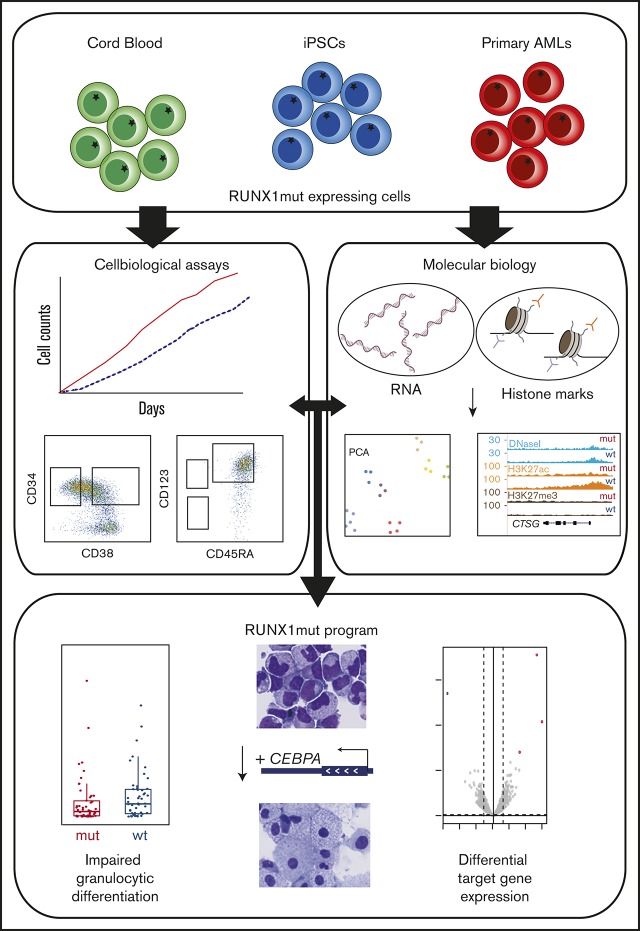
To unravel molecular mechanisms by which Runt-related transcription factor 1 (RUNX1) mutations contribute to leukemic transformation, we introduced the RUNX1-S291fs300X mutation in human CD34 stem/progenitor cells and in human induced pluripotent stem cells (iPSCs). In both models, RUNX1mut overexpression strongly impaired myeloid commitment. Instead, self-renewal was enhanced, as shown, by increased long-term culture-initiating cell frequencies and enhanced colony-forming cell replating capacity. Long-term suspension cultures with RUNX1mut-transduced cord blood (CB) CD34 cells continued for more than 100 days, during which the cells displayed an immature granulocyte-macrophage progenitor-like CD34/CD123/CD45RA phenotype. The CD34/CD38 hematopoietic stem cell (HSC) population most likely acted as cell of origin, as HSCs provided the best long-term proliferative potential on overexpression of RUNX1mut. expression was reduced in RUNX1mut cells, and reexpression of partly restored differentiation. RNA-seq analysis on CB/iPSC systems and on primary patient samples confirmed that RUNX1 mutations induce a myeloid differentiation block, and that a common set of RUNX1mut-upregulated target genes was strongly enriched for gene ontology terms associated with nucleosome assembly and chromatin structure. Interestingly, in comparison with AML1-ETO binding in acute myeloid leukemias (AMLs), we found significantly distinct genomic distribution and differential expression for RUNX1mut of genes such as , , and that may potentially contribute to the underlying difference in clinical outcomes between RUNX1mut and AML1-ETO patients. In conclusion, RUNX1mut appears to induce a specific transcriptional program that contributes to leukemic transformation.
为了揭示 runt 相关转录因子 1(runx1)突变导致白血病转化的分子机制,我们在人 cd34 干细胞/祖细胞和人诱导多能干细胞(ips)中引入了 runx1-s291fs300x 突变。在这两种模型中,runx1mut 的过表达强烈抑制了髓系细胞的定向分化。相反,正如通过增加长期培养起始细胞频率和增强集落形成细胞再植能力所显示的那样,自我更新能力增强。用转染了 runx1mut 的脐带血(cb)cd34 细胞进行长期悬浮培养超过 100 天,在此期间,细胞表现出不成熟的粒细胞-巨噬细胞祖细胞样 cd34/cd123/cd45ra 表型。cd34/cd38 造血干细胞(hsc)群体很可能作为起源细胞,因为 hsc 在过表达 runx1mut 时提供了最佳的长期增殖潜力。runx1mut 细胞中 的表达减少,而 的重新表达部分恢复了分化。cb/ips 系统和原发性患者样本的 RNA-seq 分析证实,runx1 突变诱导了髓系分化阻滞,并且一组常见的 runx1mut 上调靶基因强烈富集与核小体组装和染色质结构相关的基因本体术语。有趣的是,与急性髓系白血病(aml)中 aml1-eto 结合相比,我们发现 runx1mut 的基因如 、 、 和 的基因组分布和差异表达明显不同,这些基因可能有助于 runx1mut 和 aml1-eto 患者之间临床结果的差异。总之,runx1mut 似乎诱导了一种特定的转录程序,有助于白血病的转化。