Institute for Biodiversity and Ecosystem Dynamics (IBED), University of Amsterdam, Amsterdam, The Netherlands.
Department of Wetland Ecology, Estación Biológica de Doñana (EBD-CSIC), Seville, Spain.
Mol Ecol. 2019 Apr;28(7):1812-1825. doi: 10.1111/mec.15020. Epub 2019 Apr 4.
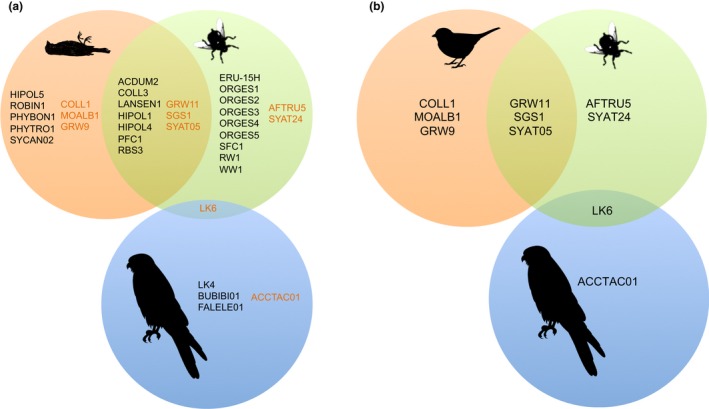
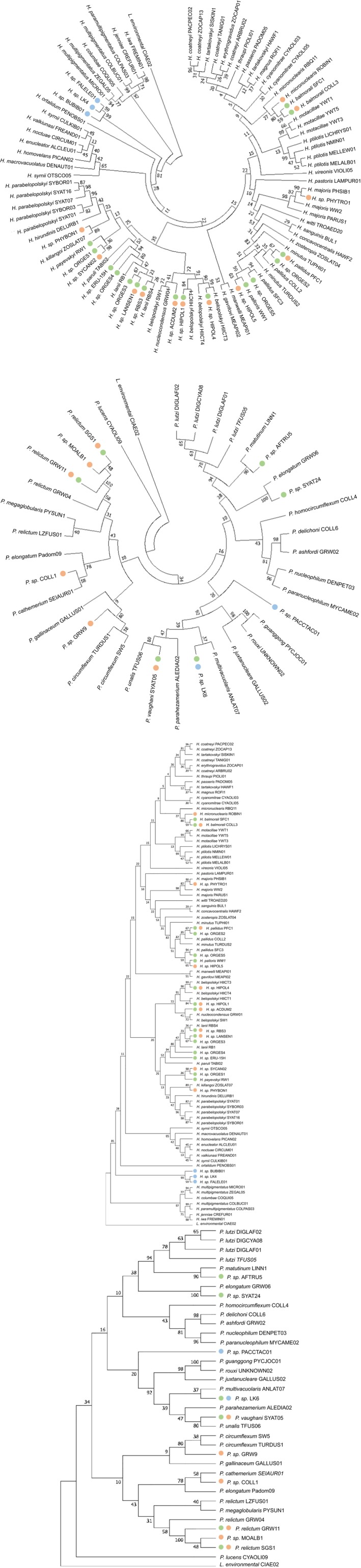
Host shifts are widespread among avian haemosporidians, although the success of transmission depends upon parasite-host and parasite-vector compatibility. Insular avifaunas are typically characterized by a low prevalence and diversity of haemosporidians, although the underlying ecological and evolutionary processes remain unclear. We investigated the parasite transmission network in an insular system formed by Eleonora's falcons (the avian host), louse flies that parasitize the falcons (the potential vector), and haemosporidians (the parasites). We found a great diversity of parasites in louse flies (16 Haemoproteus and 6 Plasmodium lineages) that did not match with lineages previously found infecting adult falcons (only one shared lineage). Because Eleonora's falcon feeds on migratory passerines hunted over the ocean, we sampled falcon kills in search of the origin of parasites found in louse flies. Surprisingly, louse flies shared 10 of the 18 different parasite lineages infecting falcon kills. Phylogenetic analyses revealed that all lineages found in louse flies (including five new lineages) corresponded to Haemoproteus and Plasmodium parasites infecting Passeriformes. We found molecular evidence of louse flies feeding on passerines hunted by falcons. The lack of infection in nestlings and the mismatch between the lineages isolated in adult falcons and louse flies suggest that despite louse flies' contact with a diverse array of parasites, no successful transmission to Eleonora's falcon occurs. This could be due to the falcons' resistance to infection, the inability of parasites to develop in these phylogenetically distant species, or the inability of haemosporidian lineages to complete their development in louse flies.
在禽类血孢子虫中,宿主转移现象非常普遍,尽管传播的成功与否取决于寄生虫-宿主和寄生虫-媒介的相容性。尽管岛屿鸟类区系的血孢子虫通常具有低流行率和多样性,但潜在的生态和进化过程仍不清楚。我们调查了由 Eleonora 的隼(鸟类宿主)、寄生在隼上的虱蝇(潜在媒介)和血孢子虫(寄生虫)组成的岛屿系统中的寄生虫传播网络。我们在虱蝇中发现了丰富多样的寄生虫(16 种 Haemoproteus 和 6 种 Plasmodium 谱系),这些寄生虫与以前感染成年隼的寄生虫谱系不匹配(只有一个共享谱系)。由于 Eleonora 的隼以在海洋上空猎食的迁徙雀形目鸟类为食,我们在隼的捕杀物中采样,以寻找虱蝇中发现的寄生虫的来源。令人惊讶的是,虱蝇与 10 种不同的寄生虫谱系共享,这些寄生虫谱系感染了隼的捕杀物。系统发育分析显示,虱蝇中发现的所有谱系(包括 5 个新谱系)都对应于感染雀形目鸟类的 Haemoproteus 和 Plasmodium 寄生虫。我们发现了虱蝇以隼猎食的雀形目鸟类为食的分子证据。幼隼没有感染,以及在成年隼和虱蝇中分离出的谱系不匹配表明,尽管虱蝇接触了多种多样的寄生虫,但没有成功传播给 Eleonora 的隼。这可能是由于隼对感染的抵抗力、寄生虫在这些系统发育上相距甚远的物种中无法发育,或者血孢子虫谱系无法在虱蝇中完成发育。