Keskin Sevdenur, Simsek M Fethullah, Vu Ha T, Yang Carlton, Devoto Stephen H, Ay Ahmet, Özbudak Ertuğrul M
Department of Genetics, Albert Einstein College of Medicine, Bronx, NY 10461, USA.
Division of Developmental Biology, Cincinnati Children's Hospital Medical Center, Cincinnati, OH 45229, USA.
iScience. 2019 Feb 22;12:247-259. doi: 10.1016/j.isci.2019.01.021. Epub 2019 Jan 21.
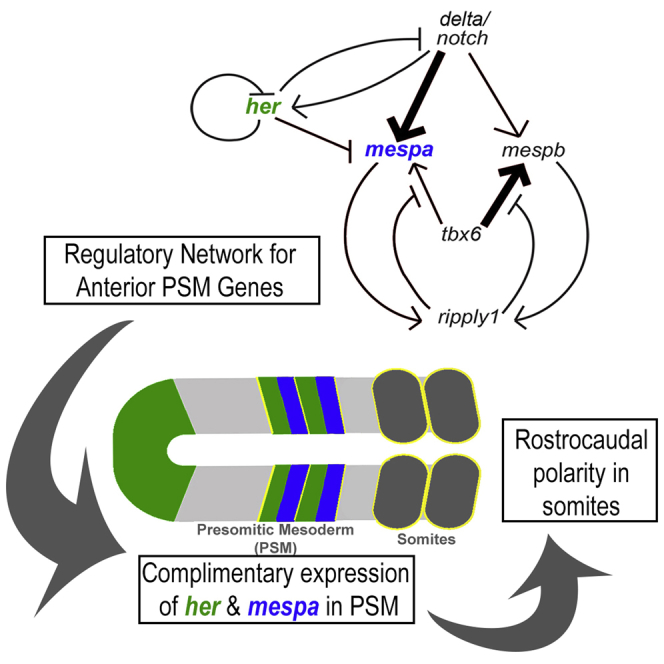
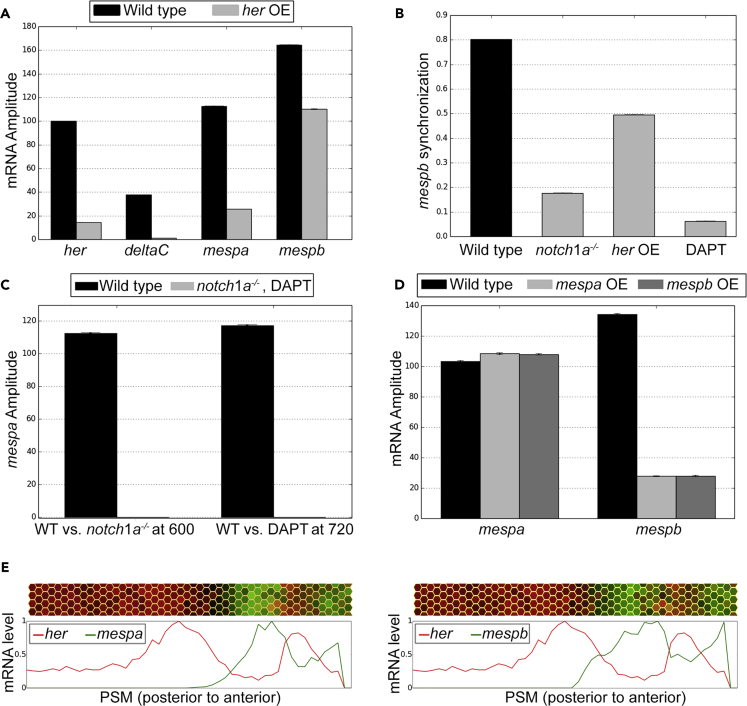
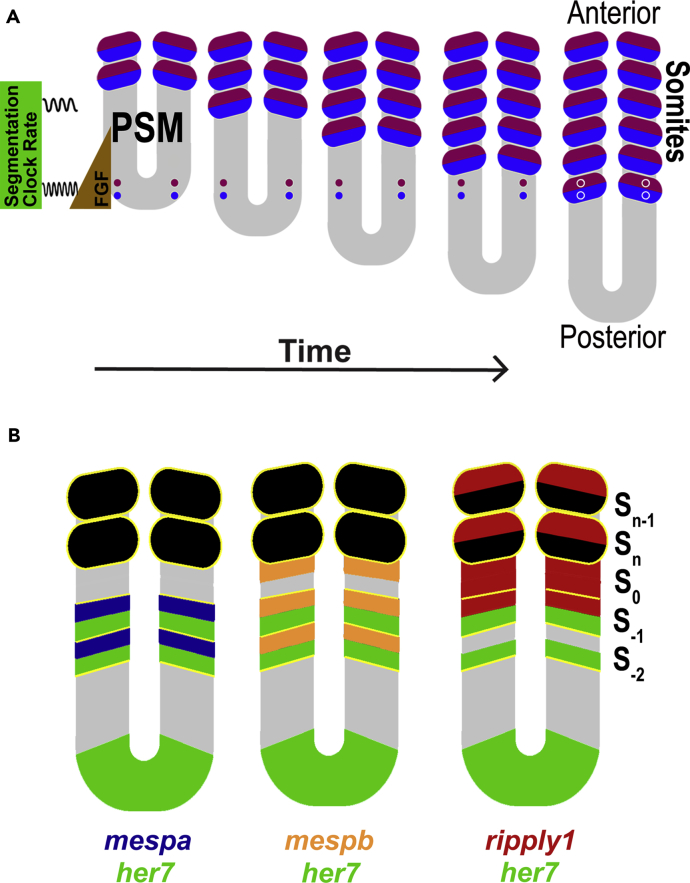
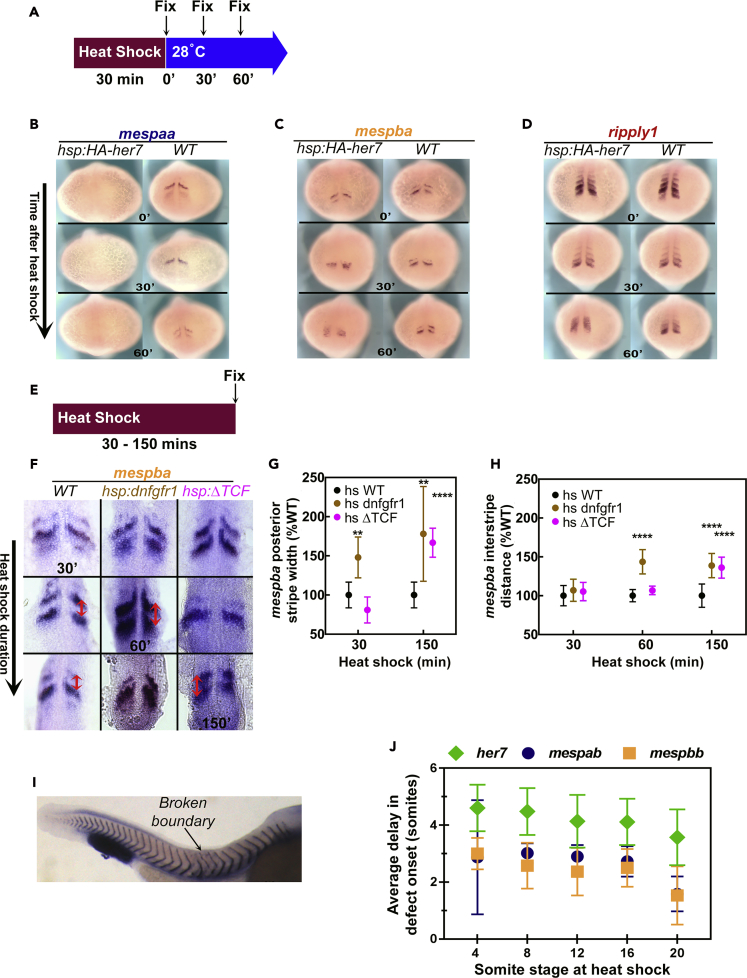
Gene regulatory networks govern pattern formation and differentiation during embryonic development. Segmentation of somites, precursors of the vertebral column among other tissues, is jointly controlled by temporal signals from the segmentation clock and spatial signals from morphogen gradients. To explore how these temporal and spatial signals are integrated, we combined time-controlled genetic perturbation experiments with computational modeling to reconstruct the core segmentation network in zebrafish. We found that Mesp family transcription factors link the temporal information of the segmentation clock with the spatial action of the fibroblast growth factor signaling gradient to establish rostrocaudal (head to tail) polarity of segmented somites. We further showed that cells gradually commit to patterning by the action of different genes at different spatiotemporal positions. Our study provides a blueprint of the zebrafish segmentation network, which includes evolutionarily conserved genes that are associated with the birth defect congenital scoliosis in humans.
基因调控网络在胚胎发育过程中控制模式形成和分化。体节是脊柱及其他组织的前体,其分割由来自分割时钟的时间信号和来自形态发生素梯度的空间信号共同控制。为了探究这些时间和空间信号是如何整合的,我们将时间控制的基因扰动实验与计算建模相结合,以重建斑马鱼的核心分割网络。我们发现,Mesp家族转录因子将分割时钟的时间信息与成纤维细胞生长因子信号梯度的空间作用联系起来,以建立分节体节的头尾(从头到尾)极性。我们进一步表明,细胞通过不同基因在不同时空位置的作用逐渐确定模式。我们的研究提供了斑马鱼分割网络的蓝图,其中包括与人类先天性脊柱侧弯出生缺陷相关的进化保守基因。