Department of Chemical Engineering and Biotechnology, University of Cambridge, Cambridge, UK.
BioPharmaceutical Development Division, MedImmune, Cambridge, UK.
Biotechnol Bioeng. 2019 Jun;116(6):1315-1325. doi: 10.1002/bit.26946. Epub 2019 Feb 20.
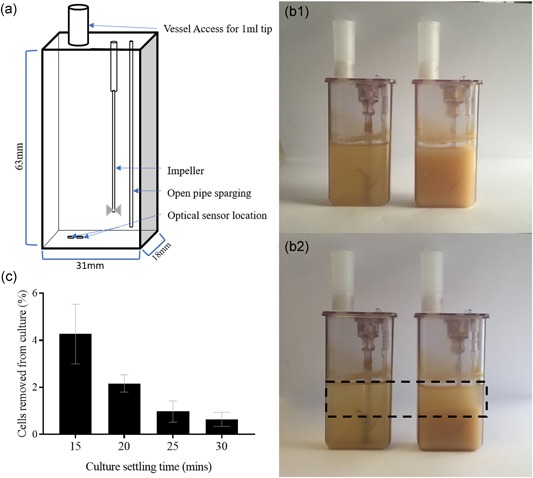
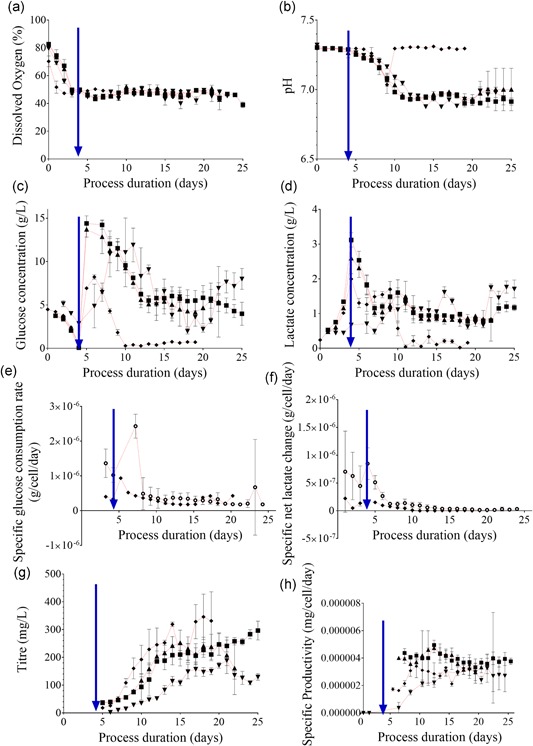
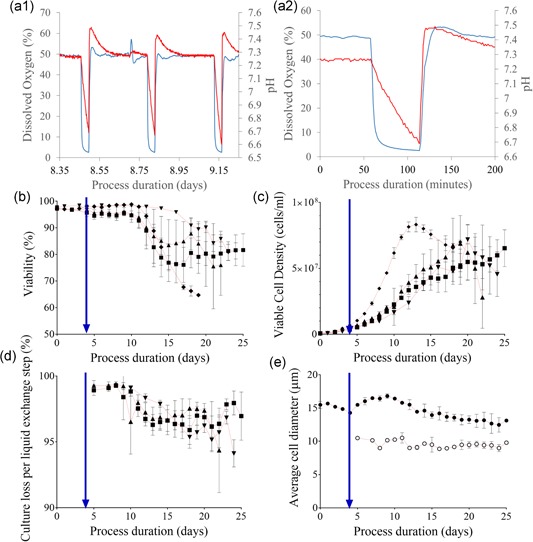
Without a scale-down model for perfusion, high resource demand makes cell line screening or process development challenging, therefore, potentially successful cell lines or perfusion processes are unrealized and their ability untapped. We present here the refunctioning of a high-capacity microscale system that is typically used in fed-batch process development to allow perfusion operation utilizing in situ gravity settling and automated sampling. In this low resource setting, which involved routine perturbations in mixing, pH and dissolved oxygen concentrations, the specific productivity and the maximum cell concentration were higher than 3.0 × 10 mg/cell/day and 7 × 10 cells/ml, respectively, across replicate microscale perfusion runs conducted at one vessel volume exchange per day. A comparative analysis was conducted at bench scale with vessels operated in perfusion mode utilizing a cell retention device. Neither specific productivity nor product quality indicated by product aggregation (6%) was significantly different across scales 19 days after inoculation, thus demonstrating this setup to be a suitable and reliable platform for evaluating the performance of cell lines and the effect of process parameters, relevant to perfusion mode of culturing.
如果没有用于灌注的缩小模型,高资源需求会使得细胞系筛选或工艺开发具有挑战性,因此,有潜力的成功细胞系或灌注工艺无法实现,其能力也无法得到挖掘。我们在此介绍了一种大容量微尺度系统的重新功能化,该系统通常用于分批补料工艺开发,可利用原位重力沉降和自动化采样进行灌注操作。在这种低资源环境下,混合、pH 和溶解氧浓度会经常受到干扰,在每天进行一次容器体积交换的重复微尺度灌注运行中,比生产率和最大细胞浓度分别高于 3.0×10 毫克/细胞/天和 7×10 细胞/ml。在接种后 19 天,利用细胞保留装置在灌注模式下运行的容器进行了对比分析,无论是比生产率还是产品质量(6%的聚集物)都没有明显的差异,这表明该设置是评估细胞系性能和与培养的灌注模式相关的工艺参数的影响的合适且可靠的平台。