Mahuku George, Nzioki Henry Sila, Mutegi Charity, Kanampiu Fred, Narrod Clare, Makumbi Dan
International Institute of Tropical Agriculture (IITA), P.O. Box 34441, Dar es Salaam, Tanzania.
Kenya Agricultural and Livestock Research Organization (KALRO), P.O. Box 57811-00200, Nairobi, Kenya.
Food Control. 2019 Feb;96:219-226. doi: 10.1016/j.foodcont.2018.08.032.
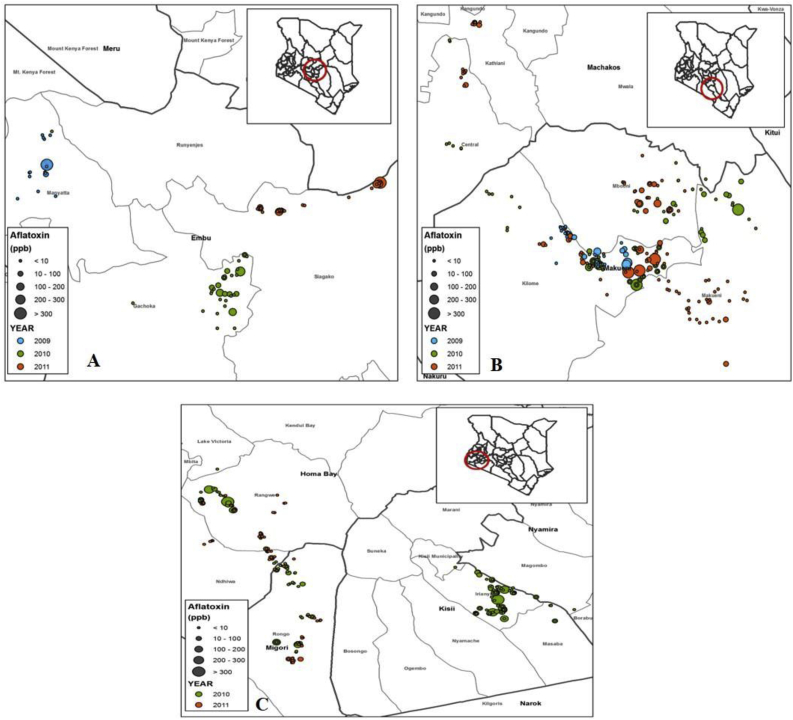
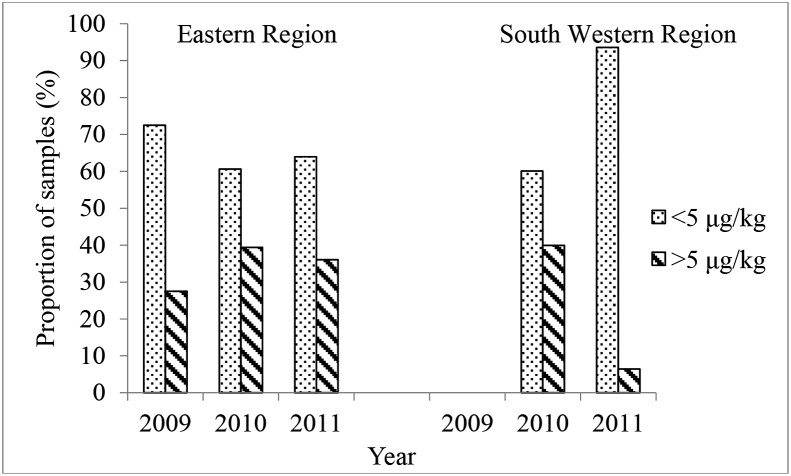
Maize, the main dietary staple in Kenya, is one of the crops most susceptible to contamination by aflatoxin. To understand sources of aflatoxin contamination for home grown maize, we collected 789 maize samples from smallholder farmers' fields in Eastern and South Western, two regions in Kenya representing high and low aflatoxin risk areas, respectively, and determined aflatoxin B (AFB) using ELISA with specific polyclonal antibodies. AFB was detected in 274 of the 416 samples from Eastern Kenya at levels between 0.01 and 9091.8 μg kg (mean 67.8 μg kg). In South Western, AFB was detected in 233 of the 373 samples at levels between 0.98 and 722.2 μg kg (mean 22.3 μg kg). Of the samples containing AFB, 153 (55.8%) from Eastern and 102 (43.8%) from South Western exceeded the maximum allowable limit of AFB (5 μg kg) in maize for human consumption in Kenya. The probable daily intake (PDI) of AFB in Eastern Kenya ranged from 0.07 to 60612 ng kg bw day (mean 451.8 ng kg bw day), while for South Western, PDI ranged from 6.53 to 4814.7 ng kg bw day (mean 148.4 ng kg bw day). The average PDI for both regions exceeded the estimated provisional maximum tolerable daily intake of AFB, which is a health concern for the population in these regions. These results revealed significant levels of preharvest aflatoxin contamination of maize in both regions. Prevention of preharvest infection of maize by toxigenic strains should be a critical focal point to prevent aflatoxin contamination and exposure.
玉米是肯尼亚的主要主食作物,也是最易受黄曲霉毒素污染的作物之一。为了解本土种植玉米的黄曲霉毒素污染来源,我们从肯尼亚东部和西南部的小农户农田中采集了789份玉米样本,这两个地区分别代表高黄曲霉毒素风险区和低黄曲霉毒素风险区,并用特异性多克隆抗体通过酶联免疫吸附测定法(ELISA)测定黄曲霉毒素B(AFB)。在肯尼亚东部416份样本中的274份检测到AFB,含量在0.01至9091.8μg/kg之间(平均67.8μg/kg)。在西南部,373份样本中的233份检测到AFB,含量在0.98至722.2μg/kg之间(平均22.3μg/kg)。在含有AFB的样本中,肯尼亚东部的153份(55.8%)和西南部的102份(43.8%)超过了肯尼亚供人类食用玉米中AFB的最大允许限量(5μg/kg)。肯尼亚东部AFB的每日可能摄入量(PDI)在0.07至60612ng/kg体重·天之间(平均451.8ng/kg体重·天),而西南部的PDI在6.53至4814.7ng/kg体重·天之间(平均148.4ng/kg体重·天)。两个地区的平均PDI均超过了AFB的估计暂定每日最大耐受摄入量,这对这些地区的人群健康构成了威胁。这些结果表明,两个地区玉米收获前黄曲霉毒素污染水平都很高。预防产毒菌株对玉米的收获前感染应成为预防黄曲霉毒素污染和暴露的关键重点。