Gasperini Alessandra Marcon, Rodriguez-Sixtos Alicia, Verheecke-Vaessen Carol, Garcia-Cela Esther, Medina Angel, Magan Naresh
Applied Mycology Group, Cranfield Soil and Agrifood Institute, Environment and Agrifood Theme, Cranfield University, Bedford, United Kingdom.
Front Microbiol. 2019 Nov 8;10:2525. doi: 10.3389/fmicb.2019.02525. eCollection 2019.
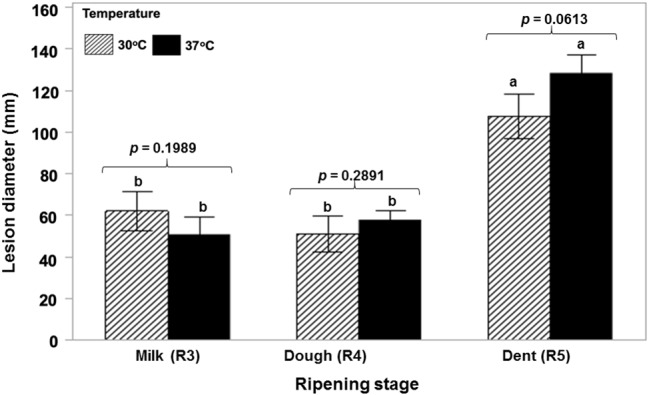
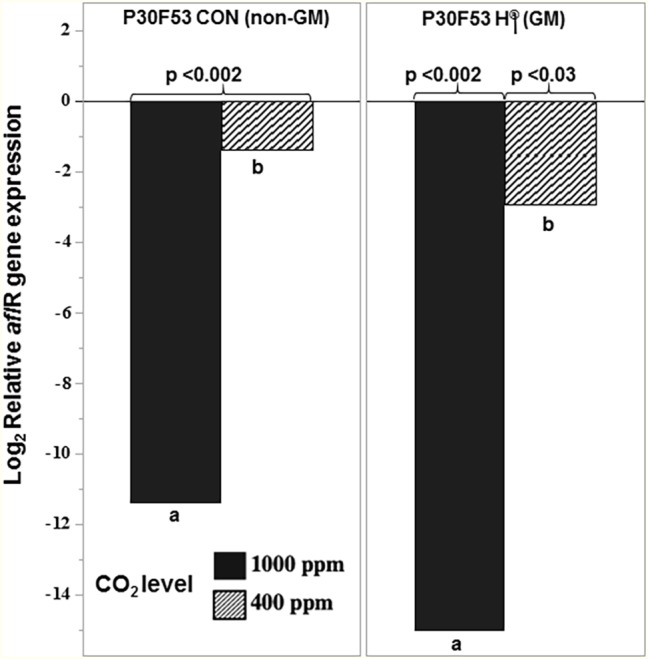
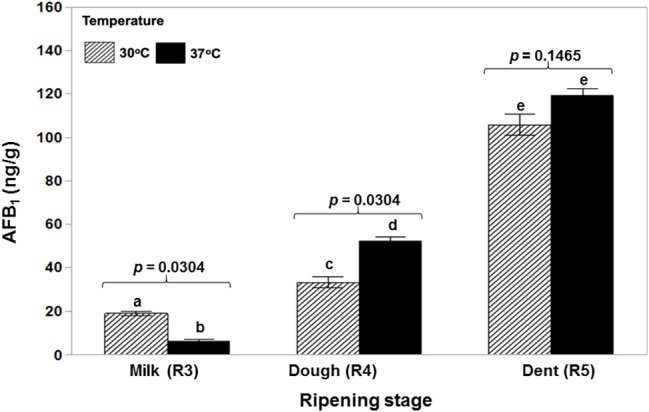
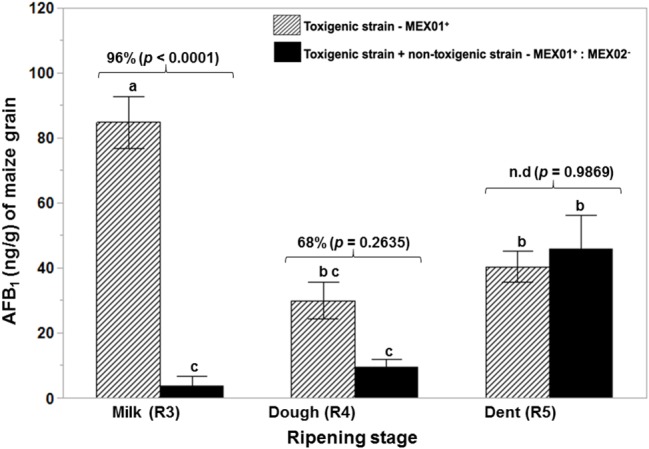
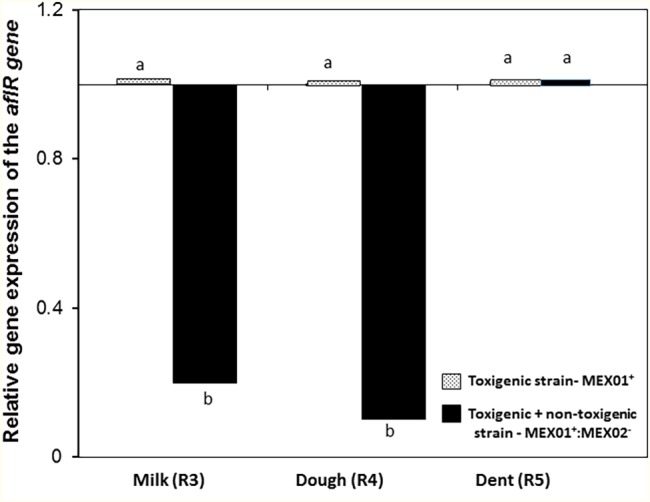
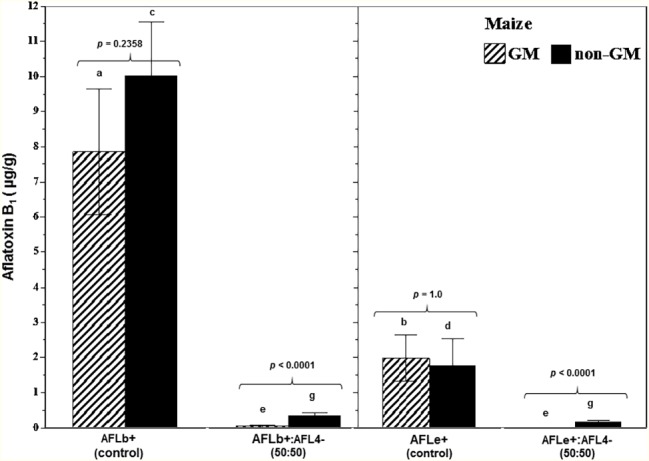
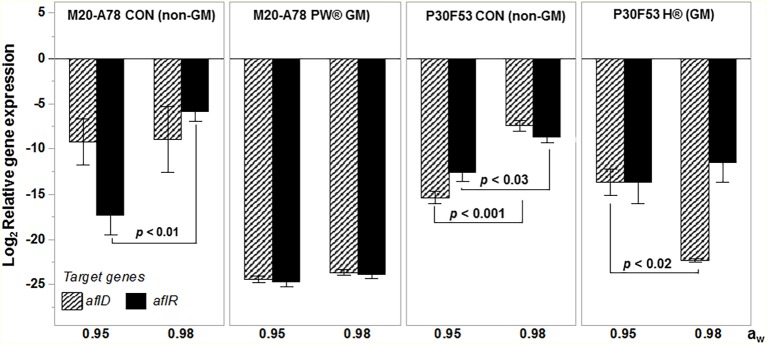
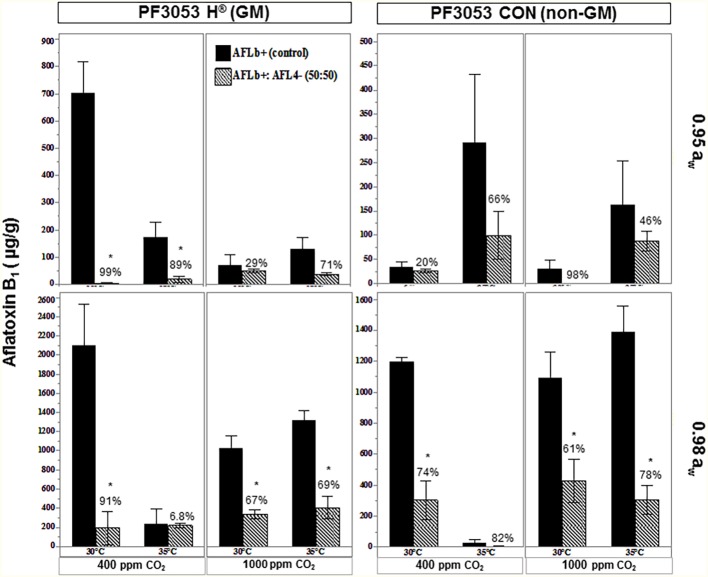
There has been significant interest in the development of formulations of non-toxigenic strains of for control of toxigenic strains to reduce the aflatoxin B (AFB) contamination of maize. In the future, climate change (CC) abiotic conditions of temperature (+2-4°C), CO (existing levels of 400 vs. 800-1,200 ppb), and drought stress will impact on the agronomy and control of pests and diseases. This study has examined (1) the effect of two-way interacting factors of water activity × temperature on colonization and AFB contamination of maize cobs of different ripening ages; (2) the effect of non-toxigenic strains of (50:50 inoculum ratio) on relative control of toxigenic and AFB contamination of ripening cobs; (3) post-harvest control of AFB by non-toxigenic strains of in non-GM and isogenic GM maize cultivars using the same inoculum ratio; and (4) the impact of three-way interacting CC factors on relative control of AFB in maize cobs pre-harvest and in stored non-GM/GM cultivars. Pre-harvest colonization and AFB production by a toxigenic strain was conserved at 37°C when compared with 30°C, at the three ripening stages of cob development examined: milk ripe (R3), dough (R4), and dent (R5). However, pre-harvest biocontrol with a non-toxigenic strain was only effective at the R3 and R4 stages and not at the R5 stage. This was supported by relative expression of the regulatory biosynthetic gene in the different treatments. When exposed to three-way interacting CC factors for control of AFB pre-harvest, the non-toxigenic strain was effective at R3 and £4 stages but not at the R5 stage. Post-harvest storage of non-GM and GM cultivars showed that control was achievable at 30°C, with slightly better control in GM-cultivars in terms of the overall inhibition of AFB production. However, in stored maize, the non-toxigenic strains of had conserved biocontrol of AFB contamination, especially in the GM-maize cultivars under three-way interacting CC conditions (37°C × 1,000 ppm CO and drought stress). This was supported by the relative expression of the gene in these treatments. This study suggests that the choice of the biocontrol strains, for pre- or post-harvest control, needs to take into account their resilience in CC-related abiotic conditions to ensure that control of AFB contamination can be conserved.
人们对开发非产毒菌株制剂以控制产毒菌株从而减少玉米黄曲霉毒素B(AFB)污染有着浓厚兴趣。未来,气候变化(CC)的非生物条件,如温度升高(+2 - 4°C)、二氧化碳浓度变化(现有水平400 ppm与800 - 1200 ppm)以及干旱胁迫,将影响农作物的农艺管理以及病虫害防治。本研究考察了:(1)水分活度×温度这两个相互作用因素对不同成熟度玉米穗轴定殖和AFB污染的影响;(2)非产毒菌株(接种比例50:50)对产毒菌株的相对控制作用以及对成熟穗轴AFB污染的影响;(3)使用相同接种比例,非产毒菌株对非转基因和同基因转基因玉米品种收获后AFB的控制作用;(4)CC三个相互作用因素对收获前和储存的非转基因/转基因玉米品种穗轴中AFB相对控制的影响。在所考察的玉米穗轴发育的三个成熟阶段:乳熟期(R3)、面团期(R4)和蜡熟期(R5),与30°C相比,产毒菌株在37°C下收获前的定殖和AFB产生得以维持。然而,非产毒菌株的收获前生物防治仅在R3和R4阶段有效,在R5阶段无效。不同处理中该调控生物合成基因的相对表达支持了这一结果。当暴露于用于收获前控制AFB的CC三个相互作用因素时,非产毒菌株在R3和R4阶段有效,但在R5阶段无效。非转基因和转基因品种收获后的储存情况表明,在30°C下可以实现控制,就AFB产生的总体抑制而言,转基因品种的控制效果略好。然而,在储存的玉米中,非产毒菌株对AFB污染具有持续的生物防治作用,尤其是在CC三个相互作用条件(37°C×1000 ppm二氧化碳和干旱胁迫)下的转基因玉米品种中。这些处理中该基因的相对表达支持了这一结果。本研究表明,选择用于收获前或收获后控制的生物防治菌株时,需要考虑它们在与CC相关的非生物条件下的适应能力,以确保能够持续控制AFB污染。