Medical School & Clinical Hospital, Universidade Federal de Minas Gerais, Belo Horizonte, Minas Gerais, Brazil.
Department of Physiological Sciences, Universidade Federal do Espírito Santo, Vitória, Espirito Santo, Brazil.
PLoS One. 2019 Feb 4;14(2):e0210522. doi: 10.1371/journal.pone.0210522. eCollection 2019.
Arterial stiffness has been associated with renal dysfunction and its progression, but the pathophysiological relation underlying this association has not been fully established, particularly among individuals without hypertension and diabetes. We investigated the cross-sectional associations between arterial stiffness and renal function in adults without cardiovascular disease, and whether this association remained among subjects without hypertension and diabetes.
All eligible participants from ELSA-Brasil (2008-2010), aged 35 to 74 years (N = 13,586) were included, of whom 7,979 were free from hypertension and diabetes. The response variables were: 1) low glomerular filtration rate (eGFR<60ml/min/1.73m2) estimated by CKD-EPI; 2) increased albumin/creatinine ratio (ACR ≥30mg/g); and 3) chronic kidney disease (CKD). Arterial stiffness was ascertained by the carotid-femoral pulse wave velocity (PWV). The covariates were sex, age, race/color, level of schooling, smoking, body mass index, total cholesterol/HDL-c glycated hemoglobin, diabetes, systolic blood pressure, heart rate and use of antihypertensive drugs. Logistic regression was used to examine the associations.
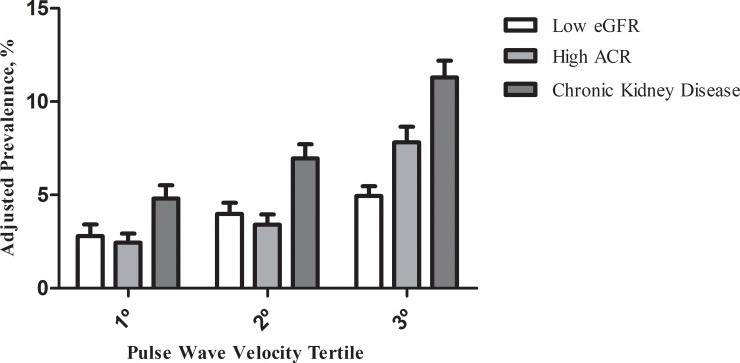
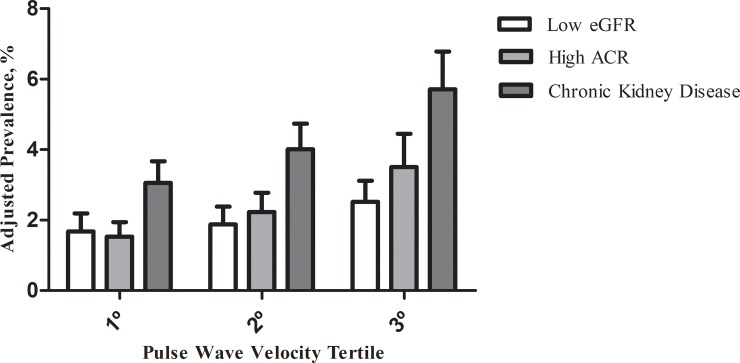
After all adjustments, 1 m/s increase in PWV was associated with ORs equal to 1.10 (95%CI: 1.04-1.16), 1.10 (95%CI: 1.05-1.16) and 1.12 (95%CI: 1.08-1.17) of low eGFR, high ACR, and CKD, respectively. In subjects without hypertension and diabetes, these ORs were 1.19 (95%CI: 1.07-1.33), 1.20 (95%CI: 1.07-1.32) and 1.21 (95%CI: 1.11-1.30), respectively.
The increase in PWV was associated with all renal dysfunction markers, even in individuals without hypertension and diabetes, suggesting a relation that is not completely mediated by the presence of these conditions.
动脉僵硬度与肾功能障碍及其进展有关,但这种关联的病理生理关系尚未完全确定,特别是在没有高血压和糖尿病的人群中。我们研究了无心血管疾病的成年人中动脉僵硬度与肾功能之间的横断面关系,以及在无高血压和糖尿病的受试者中,这种关系是否仍然存在。
所有符合条件的来自 ELSA-Brasil(2008-2010 年)的参与者,年龄 35 至 74 岁(N=13586),其中 7979 人无高血压和糖尿病。反应变量为:1)估计肾小球滤过率(eGFR)<60ml/min/1.73m2 的低肾小球滤过率(CKD-EPI);2)白蛋白/肌酐比值(ACR)升高(≥30mg/g);3)慢性肾病(CKD)。动脉僵硬度通过颈股脉搏波速度(PWV)确定。协变量为性别、年龄、种族/肤色、教育程度、吸烟、体重指数、总胆固醇/高密度脂蛋白胆固醇、糖化血红蛋白、糖尿病、收缩压、心率和抗高血压药物的使用。使用逻辑回归来检查关联。
在所有调整后,PWV 增加 1m/s 与 eGFR 降低、ACR 升高和 CKD 的 OR 分别为 1.10(95%CI:1.04-1.16)、1.10(95%CI:1.05-1.16)和 1.12(95%CI:1.08-1.17)。在无高血压和糖尿病的受试者中,这些 OR 分别为 1.19(95%CI:1.07-1.33)、1.20(95%CI:1.07-1.32)和 1.21(95%CI:1.11-1.30)。
PWV 的增加与所有肾功能障碍标志物有关,即使在没有高血压和糖尿病的个体中也是如此,这表明这种关系并非完全由这些疾病的存在所介导。