Department of Epidemiology, Erasmus MC-University Medical Center Rotterdam, Rotterdam, the Netherlands.
Department of Neurology, Erasmus MC-University Medical Center Rotterdam, Rotterdam, the Netherlands.
PLoS Med. 2019 Feb 4;16(2):e1002741. doi: 10.1371/journal.pmed.1002741. eCollection 2019 Feb.
Non-communicable diseases (NCDs) are leading causes of premature disability and death worldwide. However, the lifetime risk of developing any NCD is unknown, as are the effects of shared common risk factors on this risk.
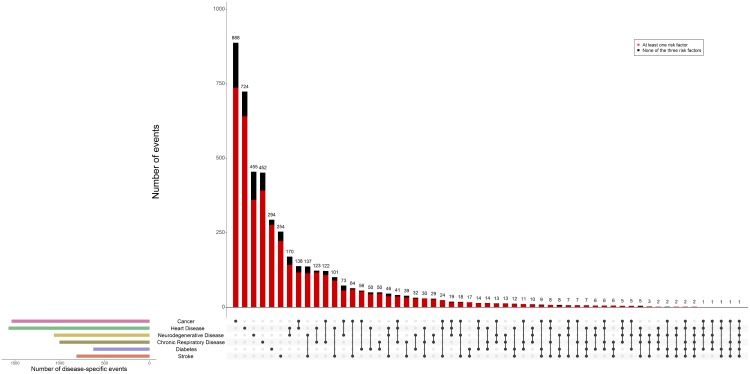
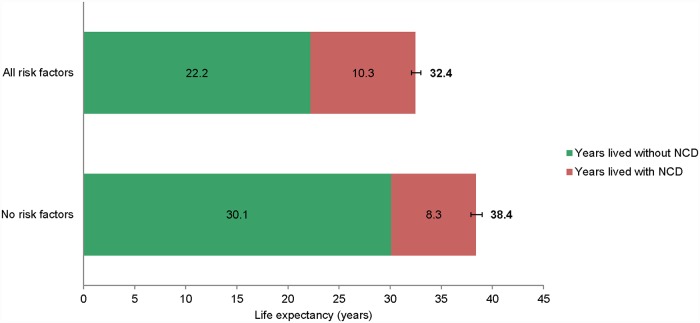
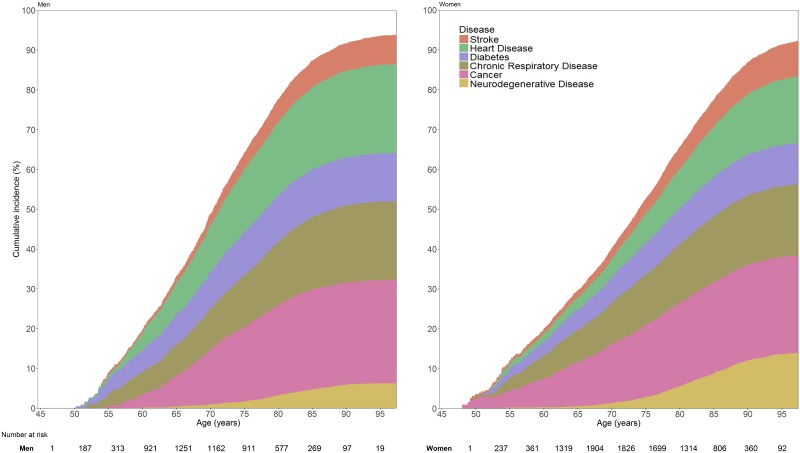
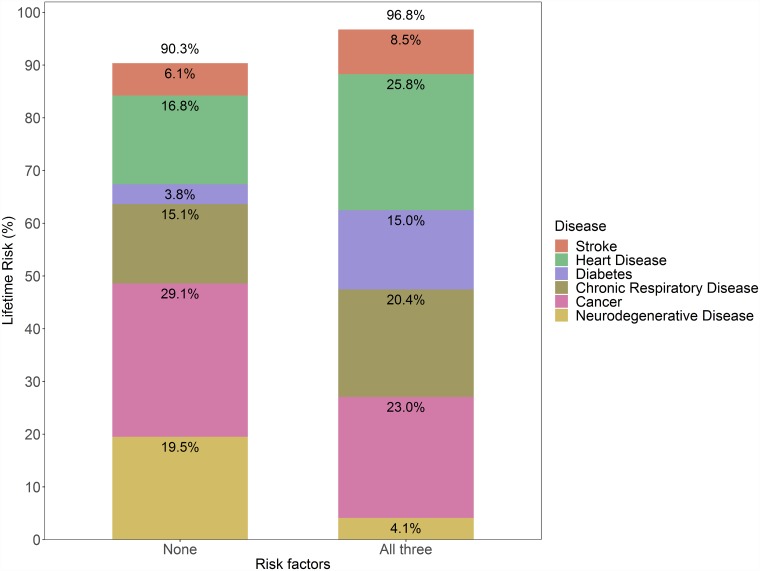
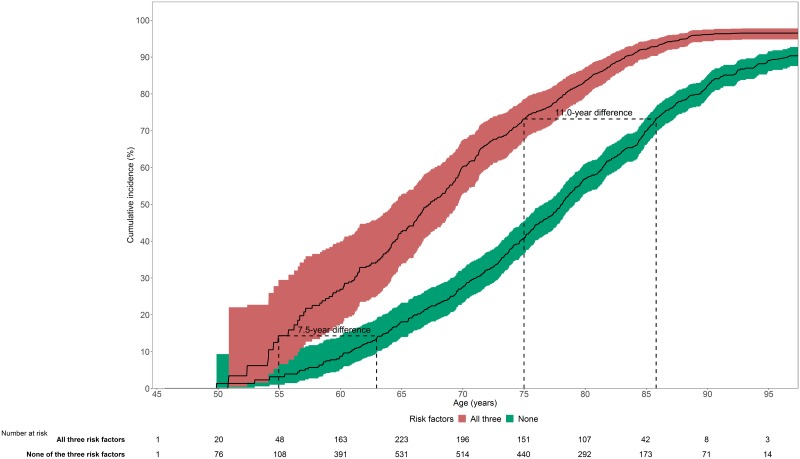
Between July 6, 1989, and January 1, 2012, we followed participants from the prospective Rotterdam Study aged 45 years and older who were free from NCDs at baseline for incident stroke, heart disease, diabetes, chronic respiratory disease, cancer, and neurodegenerative disease. We quantified occurrence/co-occurrence and remaining lifetime risk of any NCD in a competing risk framework. We additionally studied the lifetime risk of any NCD, age at onset, and overall life expectancy for strata of 3 shared risk factors at baseline: smoking, hypertension, and overweight. During 75,354 person-years of follow-up from a total of 9,061 participants (mean age 63.9 years, 60.1% women), 814 participants were diagnosed with stroke, 1,571 with heart disease, 625 with diabetes, 1,004 with chronic respiratory disease, 1,538 with cancer, and 1,065 with neurodegenerative disease. NCDs tended to co-occur substantially, with 1,563 participants (33.7% of those who developed any NCD) diagnosed with multiple diseases during follow-up. The lifetime risk of any NCD from the age of 45 years onwards was 94.0% (95% CI 92.9%-95.1%) for men and 92.8% (95% CI 91.8%-93.8%) for women. These risks remained high (>90.0%) even for those without the 3 risk factors of smoking, hypertension, and overweight. Absence of smoking, hypertension, and overweight was associated with a 9.0-year delay (95% CI 6.3-11.6) in the age at onset of any NCD. Furthermore, the overall life expectancy for participants without these risk factors was 6.0 years (95% CI 5.2-6.8) longer than for those with all 3 risk factors. Participants aged 45 years and older without the 3 risk factors of smoking, hypertension, and overweight at baseline spent 21.6% of their remaining lifetime with 1 or more NCDs, compared to 31.8% of their remaining life for participants with all of these risk factors at baseline. This difference corresponds to a 2-year compression of morbidity of NCDs. Limitations of this study include potential residual confounding, unmeasured changes in risk factor profiles during follow-up, and potentially limited generalisability to different healthcare settings and populations not of European descent.
Our study suggests that in this western European community, 9 out of 10 individuals aged 45 years and older develop an NCD during their remaining lifetime. Among those individuals who develop an NCD, at least a third are subsequently diagnosed with multiple NCDs. Absence of 3 common shared risk factors is associated with compression of morbidity of NCDs. These findings underscore the importance of avoidance of these common shared risk factors to reduce the premature morbidity and mortality attributable to NCDs.
非传染性疾病(NCDs)是全球导致过早残疾和死亡的主要原因。然而,人们并不清楚一生中患上任何一种 NCD 的风险有多大,也不知道共同存在的危险因素对这种风险的影响有多大。
1989 年 7 月 6 日至 2012 年 1 月 1 日期间,我们对前瞻性鹿特丹研究中的参与者进行了随访,这些参与者年龄在 45 岁及以上,在基线时没有 NCD,他们的研究终点是中风、心脏病、糖尿病、慢性呼吸道疾病、癌症和神经退行性疾病。我们在竞争风险框架下量化了任何 NCD 的发病/共病情况和剩余终生风险。此外,我们还研究了任何 NCD 的终生风险、发病年龄和基线时 3 个共同危险因素(吸烟、高血压和超重)的总体预期寿命。在 9061 名参与者(平均年龄 63.9 岁,60.1%为女性)的 75354 人年随访中,814 名参与者被诊断患有中风,1571 名患有心脏病,625 名患有糖尿病,1004 名患有慢性呼吸道疾病,1538 名患有癌症,1065 名患有神经退行性疾病。从 45 岁开始,NCD 往往会大量共同发生,1563 名参与者(所有患有任何 NCD 者的 33.7%)在随访期间被诊断患有多种疾病。从 45 岁开始,男性任何 NCD 的终生风险为 94.0%(95%CI 92.9%-95.1%),女性为 92.8%(95%CI 91.8%-93.8%)。即使是那些没有吸烟、高血压和超重这 3 个危险因素的人,这些风险仍然很高(>90.0%)。没有吸烟、高血压和超重与任何 NCD 发病年龄延迟 9.0 年相关(95%CI 6.3-11.6)。此外,没有这些危险因素的参与者的总体预期寿命比那些有 3 个危险因素的参与者长 6.0 年(95%CI 5.2-6.8)。在基线时没有吸烟、高血压和超重这 3 个危险因素的 45 岁及以上的参与者,在其剩余的寿命中有 21.6%的时间患有 1 种或多种 NCD,而在基线时同时具有这 3 个危险因素的参与者中,这一比例为 31.8%。这种差异相当于 NCD 发病年龄的 2 年压缩。本研究的局限性包括潜在的残余混杂因素、随访期间危险因素谱的未测量变化,以及可能对不同的医疗保健环境和非欧洲裔人群的普遍适用性有限。
我们的研究表明,在这个西欧社区,45 岁及以上的人群中,每 10 人中有 9 人在其剩余的一生中会患上某种 NCD。在那些患上 NCD 的人中,至少有三分之一的人随后被诊断患有多种 NCD。没有 3 个常见的共同危险因素与 NCD 发病年龄的压缩有关。这些发现强调了避免这些常见的共同危险因素的重要性,以减少 NCD 导致的过早发病和死亡。