Alves-Costa Silas, de Souza Bruno Feres, Rodrigues Francisco Aparecido, Ferraro Alexandre Archanjo, Nascimento Gustavo G, Leite Fabio R M, Ladeira Lorena Lúcia Costa, Batista Rosângela Fernandes Lucena, Thomaz Erika Bárbara Abreu Fonseca, Alves Claudia Maria Coelho, Ribeiro Cecilia Claudia Costa
Graduate Program in Dentistry, Federal University of Maranhão, Av. dos Portugueses, 1966, São Luís, MA, Brazil.
Graduate Program in Computer Science, Federal University of Maranhão, São Luís, Brazil.
Diabetol Metab Syndr. 2024 Sep 28;16(1):235. doi: 10.1186/s13098-024-01469-8.
Noncommunicable diseases (NCDs) predominantly affect adults, but pathophysiological changes begin decades earlier, as a continuum, with initial events apparent in adolescence. Hence, early identification and intervention are crucial for the prevention and management of NCDs. We investigated the complex network of socioeconomic, behavioral, and metabolic factors associated with the presence of NCD in Brazilian adolescents.
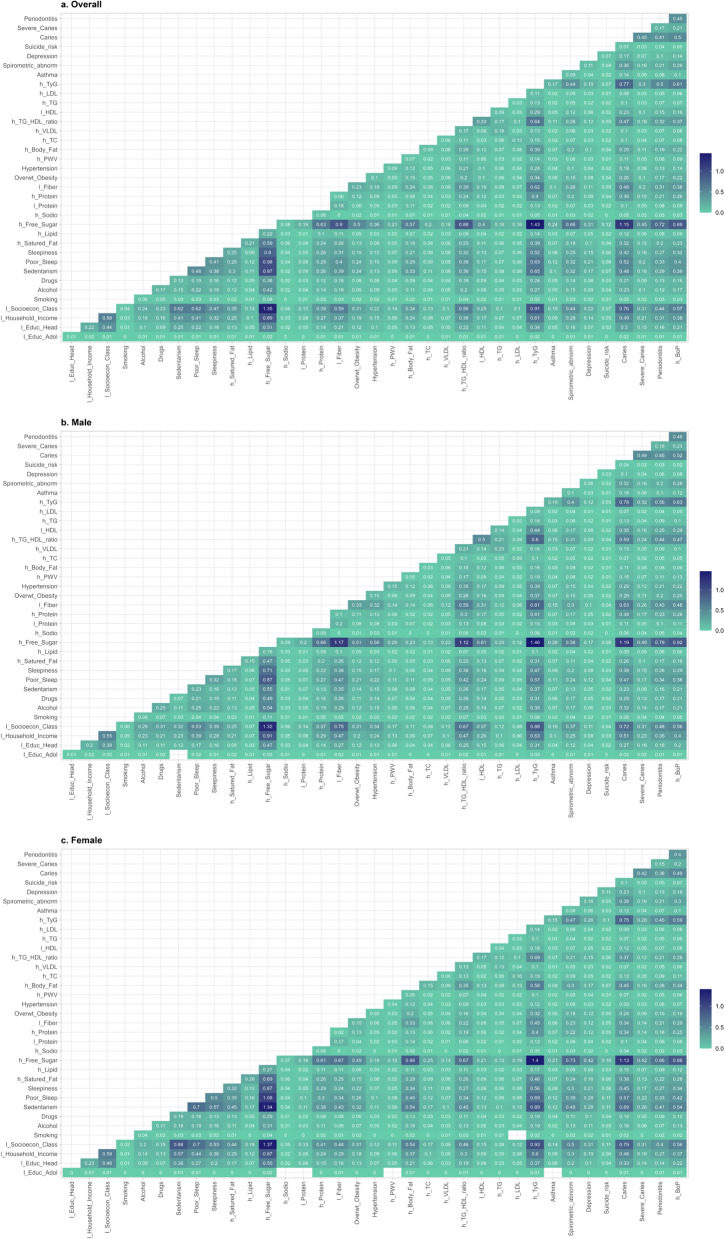
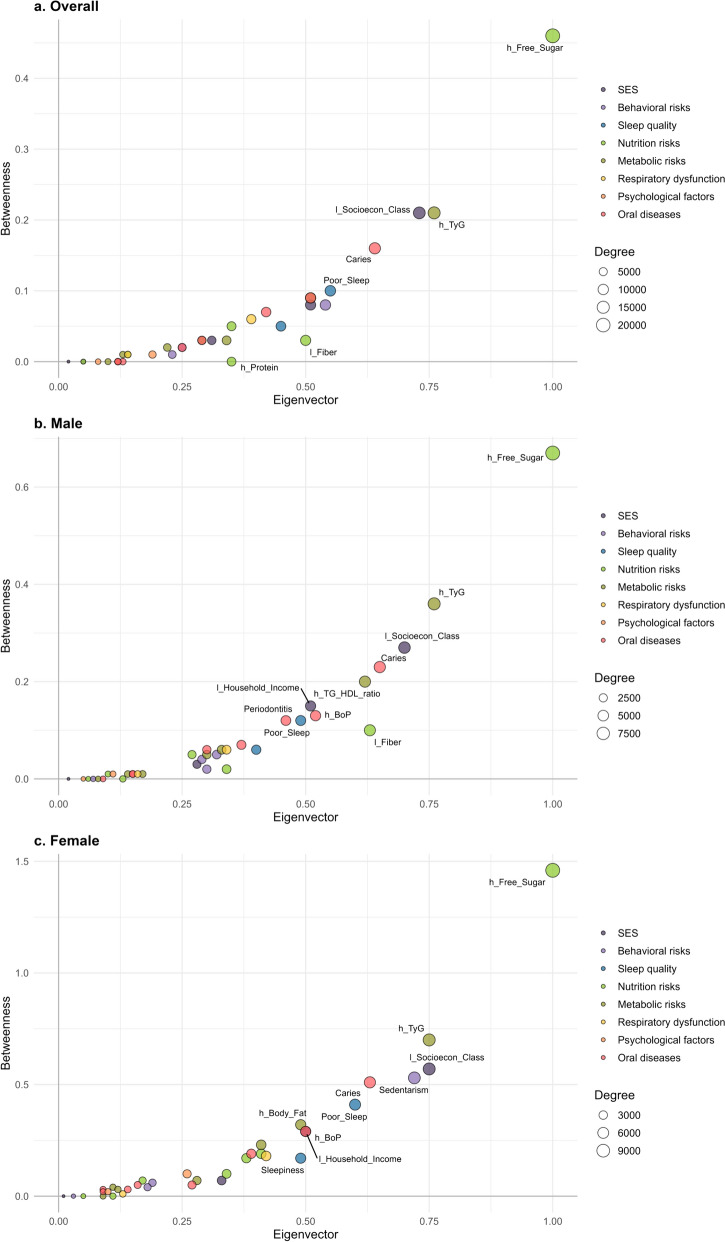
We conducted a cross-sectional study nested within the São Luís segment of the Ribeirão Preto, Pelotas, and São Luís (RPS) cohort's consortium, focusing on 18-19-year-olds (n = 2515). Data were collected prospectively, from which we constructed a complex network with NCD-related factors/indicators as nodes and their co-occurrences as edges. General and sex-based models analyzed: socioeconomic status, behavioral (smoking, alcohol, and other drugs use, unhealthy diet, poor sleep, physical inactivity), and metabolic factors (overweight/obesity, elevated blood pressure, poor lipid profile). We also looked for NCDs in adolescence like asthma, abnormal spirometry, depression, suicide risk, and poor oral health. The network was characterized by degree, betweenness, eigenvector, local transitivity, Shannon entropy, and cluster coefficient.
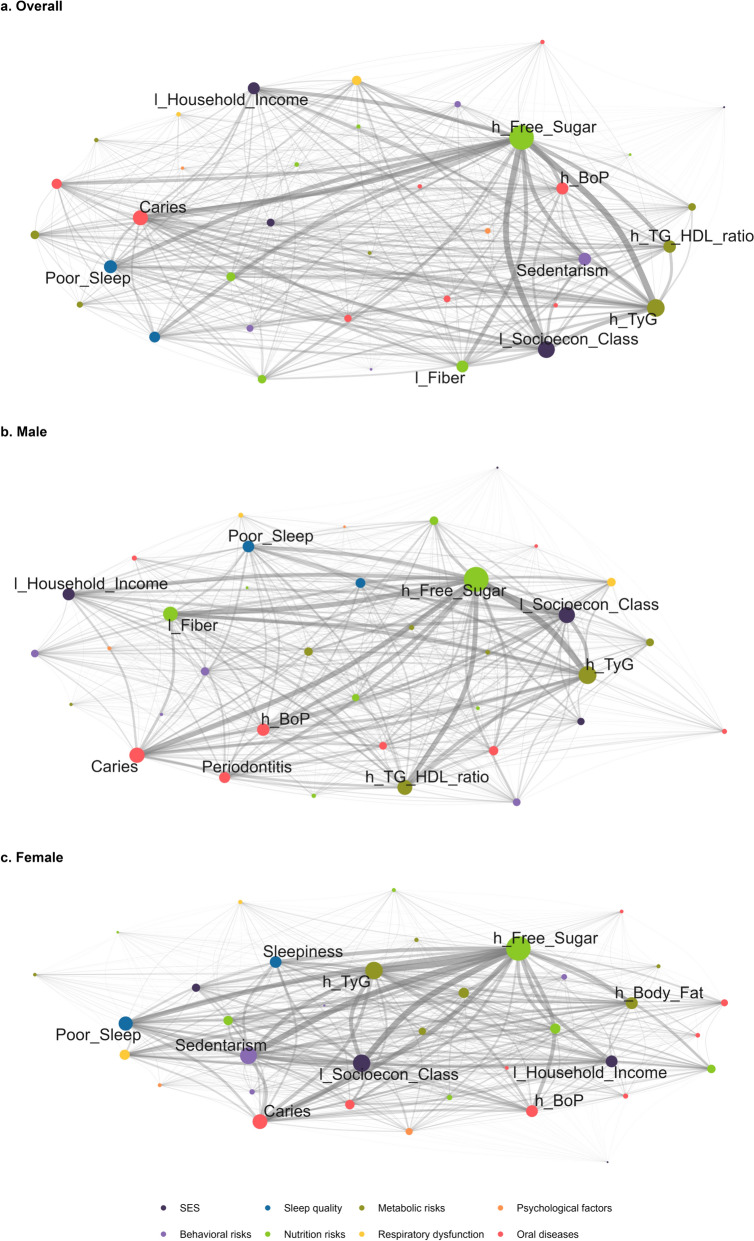
The adolescents had an average age of 18.3 years, 52.3% were female and 47.7% male. 99.8% of them have a diet rich in free sugars, 15% are overweight/obese and 72.3% had an elevated TyG index. High free sugar emerged as the central hub, followed by high TyG index (an early marker of insulin resistance) and low socioeconomic class. In males, low fiber intake and a high triglycerides/HDL ratio highlighted cardiometabolic concerns; in females, sedentary behavior and poor sleep marked metabolic and psychological challenges, along with caries in both sexes.
Our findings provide insights into central health challenges during adolescence, such as high free sugars, insulin resistance, and low socioeconomic indicators, suggesting that interventions targeted at these central hubs could have a significant impact on their NCD network.
非传染性疾病(NCDs)主要影响成年人,但病理生理变化在几十年前就已开始,是一个连续的过程,最初的事件在青春期就很明显。因此,早期识别和干预对于非传染性疾病的预防和管理至关重要。我们调查了巴西青少年中与非传染性疾病存在相关的社会经济、行为和代谢因素的复杂网络。
我们在里贝朗普雷图、佩洛塔斯和圣路易斯(RPS)队列联盟的圣路易斯部分进行了一项横断面研究,重点关注18 - 19岁的青少年(n = 2515)。数据是前瞻性收集的,我们构建了一个复杂网络,将与非传染性疾病相关的因素/指标作为节点,它们的共现作为边。基于总体和性别的模型分析了:社会经济地位、行为因素(吸烟、饮酒和使用其他药物、不健康饮食、睡眠不足、身体活动不足)和代谢因素(超重/肥胖、血压升高、血脂异常)。我们还研究了青少年时期的非传染性疾病,如哮喘、肺功能异常、抑郁症、自杀风险和口腔健康不佳。该网络的特征包括度、介数、特征向量、局部传递性、香农熵和聚类系数。
这些青少年的平均年龄为18.3岁,52.3%为女性,47.7%为男性。其中99.8%的人饮食中富含游离糖,15%超重/肥胖,72.3%的人TyG指数升高。高游离糖成为核心枢纽,其次是高TyG指数(胰岛素抵抗的早期标志物)和低社会经济阶层。在男性中,低纤维摄入量和高甘油三酯/高密度脂蛋白比值突出了心脏代谢方面的问题;在女性中,久坐行为和睡眠不足标志着代谢和心理挑战,此外两性都存在龋齿问题。
我们的研究结果揭示了青少年时期的核心健康挑战,如高游离糖、胰岛素抵抗和低社会经济指标,表明针对这些核心枢纽的干预措施可能会对他们的非传染性疾病网络产生重大影响。