Gonçalves Diego de Souza, Ferreira Marina da Silva, Guimarães Allan J
Departamento de Microbiologia e Parasitologia, Instituto Biomédico, Universidade Federal Fluminense, Rio de Janeiro 24210-130, Brazil.
Departamento de Imunologia, Instituto de Microbiologia Professor Paulo de Góes, Universidade Federal do Rio de Janeiro, Rio de Janeiro 21941-970, Brazil.
Bioengineering (Basel). 2019 Feb 1;6(1):13. doi: 10.3390/bioengineering6010013.
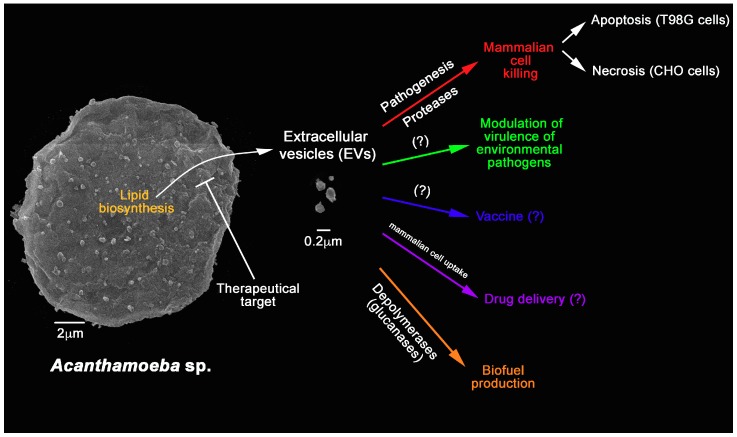
Extracellular vesicles (EVs) are membranous compartments of distinct cellular origin and biogenesis, displaying different sizes and include exosomes, microvesicles, and apoptotic bodies. The EVs have been described in almost every living organism, from simple unicellular to higher evolutionary scale multicellular organisms, such as mammals. Several functions have been attributed to these structures, including roles in energy acquisition, cell-to-cell communication, gene expression modulation and pathogenesis. In this review, we described several aspects of the recently characterized EVs of the protozoa a free-living amoeba (FLA) of emerging epidemiological importance, and compare their features to other parasites' EVs. These EVs are comprised of small microvesicles and exosomes and carry a wide range of molecules involved in many biological processes like cell signaling, carbohydrate metabolism and proteolytic activity, such as kinases, glucanases, and proteases, respectively. Several biomedical applications of these EVs have been proposed lately, including their use in vaccination, biofuel production, and the pharmaceutical industry, such as platforms for drug delivery.
细胞外囊泡(EVs)是具有不同细胞起源和生物发生过程的膜性区室,大小各异,包括外泌体、微囊泡和凋亡小体。几乎在每一种生物中都有对EVs的描述,从简单的单细胞生物到进化程度较高的多细胞生物,如哺乳动物。这些结构具有多种功能,包括在能量获取、细胞间通讯、基因表达调控和发病机制中的作用。在这篇综述中,我们描述了最近鉴定的原生动物(一种具有新出现的流行病学重要性的自由生活变形虫,FLA)的EVs的几个方面,并将它们的特征与其他寄生虫的EVs进行比较。这些EVs由小微囊泡和外泌体组成,并携带多种参与许多生物过程的分子,如细胞信号传导、碳水化合物代谢和蛋白水解活性,分别如激酶、葡聚糖酶和蛋白酶。最近已经提出了这些EVs的几种生物医学应用,包括它们在疫苗接种、生物燃料生产和制药工业中的应用,如药物递送平台。