Zhou Liyan, Yan Shancheng, Song Haizeng, Wu Han, Shi Yi
Collaborative Innovation Center of Advanced Microstructures, Nanjing University, Nanjing, 210093, P. R. China.
National Laboratory of Solid State Microstructures, School of Electronic Science and Engineering, Nanjing University, Nanjing, 210093, P. R. China.
Sci Rep. 2019 Feb 4;9(1):1357. doi: 10.1038/s41598-018-37598-0.
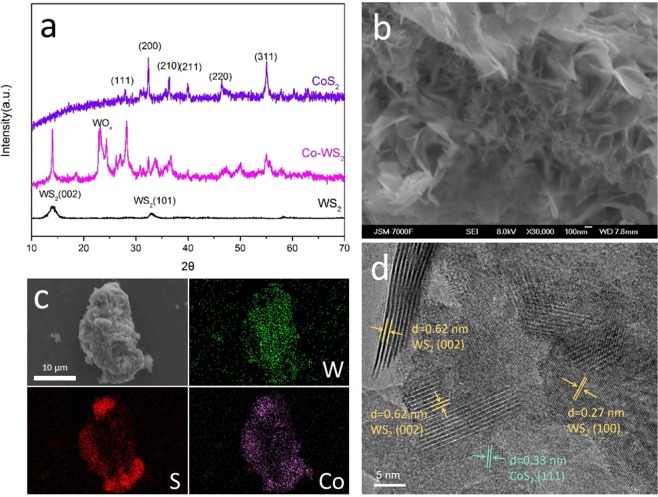
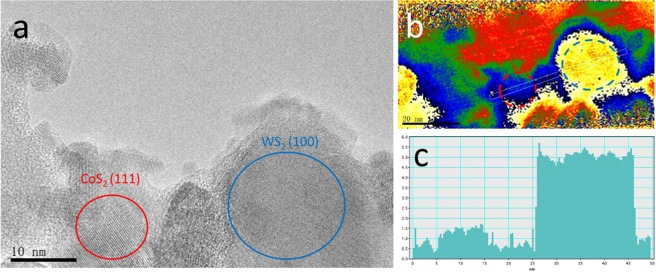
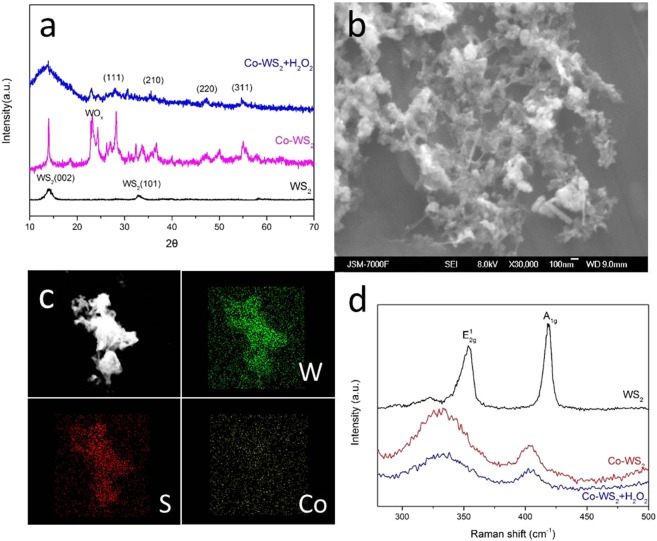
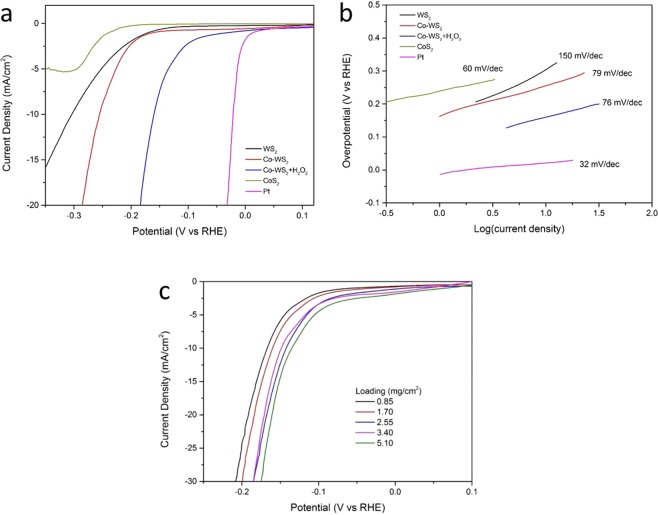
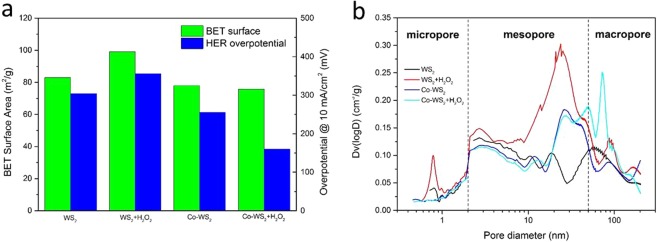
Tungsten Disulfide (WS) is considered to be a promising Hydrogen Evolution Reaction (HER) catalyst to replace noble metals (such as Pt and Pd). However, progress in WS research has been impeded by the inertness of the in-plane atoms during HER. Although it is known that microstructure and defects strongly affect the electrocatalytic performance of catalysts, the understanding of such related catalytic origin still remains a challenge. Here, we combined a one-pot synthesis method with wet chemical etching to realize controlled cobalt doping and tunable morphology in WS. The etched products, which composed of porous WS, CoS and a spot of WO, show a low overpotential and small Tafel slope in 0.5 M HSO solution. The overpotential could be optimized to -134 mV (at 10 mA/cm) with a Tafel slope of 76 mV/dec at high loadings (5.1 mg/cm). Under N adsorption analysis, the treated WS sample shows an increase in macropore (>50 nm) distributions, which may explain the increase inefficiency of HER activity. We applied electron holography to analyze the catalytic origin and found a low surface electrostatic potential in Co-doped region. This work may provide further understanding of the HER mechanism at the nanometer scale, and open up new avenues for designing catalysts based on other transition metal dichalcogenides for highly efficient HER.
二硫化钨(WS)被认为是一种很有前景的析氢反应(HER)催化剂,有望取代贵金属(如铂和钯)。然而,WS研究的进展受到其在析氢反应过程中面内原子惰性的阻碍。尽管已知微观结构和缺陷会强烈影响催化剂的电催化性能,但对这种相关催化起源的理解仍然是一个挑战。在这里,我们将一锅合成法与湿化学蚀刻相结合,以实现WS中可控的钴掺杂和可调控的形貌。蚀刻产物由多孔WS、CoS和少量WO组成,在0.5 M HSO溶液中表现出低过电位和小塔菲尔斜率。在高负载量(5.1 mg/cm)下,过电位可优化至-134 mV(在10 mA/cm时),塔菲尔斜率为76 mV/dec。在N吸附分析中,处理后的WS样品显示大孔(>50 nm)分布增加,这可能解释了析氢活性效率的提高。我们应用电子全息术分析催化起源,发现钴掺杂区域的表面静电势较低。这项工作可能会进一步加深对纳米尺度析氢机理的理解,并为基于其他过渡金属二硫属化物设计高效析氢催化剂开辟新途径。