Department of Nutritional Sciences, College of Human Sciences, Texas Tech University, Lubbock, TX, 79409, USA.
Neurobiology of Nutrition Laboratory, Pennington Biomedical Research Center, Louisiana State University System, Baton Rouge, LA, 70808, USA.
Int J Obes (Lond). 2019 Nov;43(11):2143-2150. doi: 10.1038/s41366-019-0328-x. Epub 2019 Feb 4.
Dieting often fails because weight loss triggers strong counter-regulatory biological responses such as increased hunger and hypometabolism that are thought to be critically dependent on the master fuel sensor in the mediobasal hypothalamus (MBH). Because prolonged starvation has been shown to increase AgRP and NPY, the expression level of these two orexigenic genes has been taken as an experimental readout for the presence or absence of hunger. Roux-en-Y gastric bypass (RYGB) surgery leads to a significant weight loss without inducing the associated hunger, indicating possible changes in hypothalamic neuropeptides and/or signaling. Our goal was to assess key genes in the MBH involved in regulating body weight, appetite, and inflammation/oxidative stress after RYGB surgery in mice.
Obese mice on a high-fat diet were subjected to either sham or RYGB surgery, or caloric restriction to match the weight of RYGB group. Chow-fed mice without surgery served as an additional control group. After 2 or 12 weeks post-surgery, hypothalamic genes were analyzed by real-time qPCR.
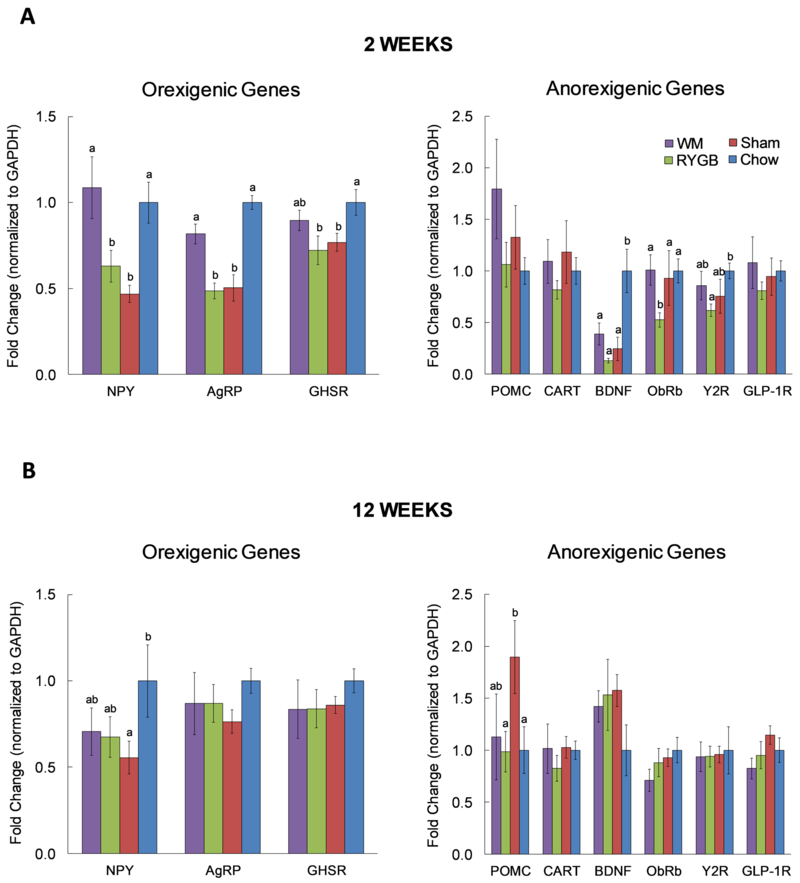
During the rapid weight loss phase at 2 weeks after RYGB surgery, hypothalamic AgRP and NPY gene expression was not increased compared to mice with sham surgery, indicating that the mice are not hungry. In contrast, the same weight loss induced by caloric restriction promptly triggered increased AgRP and NPY expression. This differential effect of RYGB and caloric restriction was no longer observed during the weight-maintenance phase at 12 weeks after surgery. A similar differential effect was observed for ObRb, but not for POMC and CART expression. Furthermore, RAGE and IBA-1, two markers for inflammation/oxidative stress, were significantly suppressed after RYGB compared to caloric restriction at 2 weeks post-surgery.
These findings suggest that RYGB prevents the biologically adaptive hunger response triggered by undernutrition and weight loss, and suppresses weight loss-induced hypothalamic inflammation markers.
节食经常失败,因为体重减轻会引发强烈的代偿性生物反应,如饥饿感增加和代谢降低,这些反应被认为严重依赖于中脑腹侧被盖区(MBH)中的主要燃料传感器。因为长期饥饿已被证明会增加 AgRP 和 NPY,所以这两种食欲素基因的表达水平被用作饥饿存在与否的实验读出。Roux-en-Y 胃旁路(RYGB)手术可显著减轻体重而不引起相关饥饿感,这表明下丘脑神经肽和/或信号可能发生变化。我们的目标是评估 RYGB 手术后小鼠中调节体重、食欲和炎症/氧化应激的 MBH 中的关键基因。
高脂肪饮食肥胖小鼠接受假手术或 RYGB 手术,或热量限制以匹配 RYGB 组的体重。未接受手术的 Chow 喂养小鼠作为附加对照组。手术后 2 或 12 周,通过实时 qPCR 分析下丘脑基因。
在 RYGB 手术后 2 周快速减肥期间,与假手术相比,下丘脑 AgRP 和 NPY 基因表达没有增加,表明小鼠不饥饿。相比之下,热量限制引起的相同体重减轻会立即引发 AgRP 和 NPY 表达增加。RYGB 和热量限制的这种差异作用在手术后 12 周的体重维持阶段不再观察到。ObRb 也观察到类似的差异效应,但 POMC 和 CART 表达则不然。此外,与热量限制相比,RYGB 术后 2 周时 RAGE 和 IBA-1(炎症/氧化应激的两个标志物)的表达显著受到抑制。
这些发现表明,RYGB 可防止由营养不良和体重减轻引发的生物学适应性饥饿反应,并抑制体重减轻诱导的下丘脑炎症标志物。