Chen Hui-Zi, Bonneville Russell, Yu Lianbo, Wing Michele R, Reeser Julie W, Krook Melanie A, Miya Jharna, Samorodnitsky Eric, Smith Amy, Martin Dorrelyn, Dao Thuy, Guo Qishan, Liebner David, Freud Aharon G, Allenby Patricia, Roychowdhury Sameek
Department of Internal Medicine, Division of Medical Oncology, Comprehensive Cancer Center, The Ohio State University, Columbus, Ohio, USA.
Department of Internal Medicine, Hematology and Oncology Fellowship Program, Comprehensive Cancer Center, The Ohio State University, Columbus, Ohio, USA.
Oncotarget. 2019 Jan 8;10(3):277-288. doi: 10.18632/oncotarget.26352.
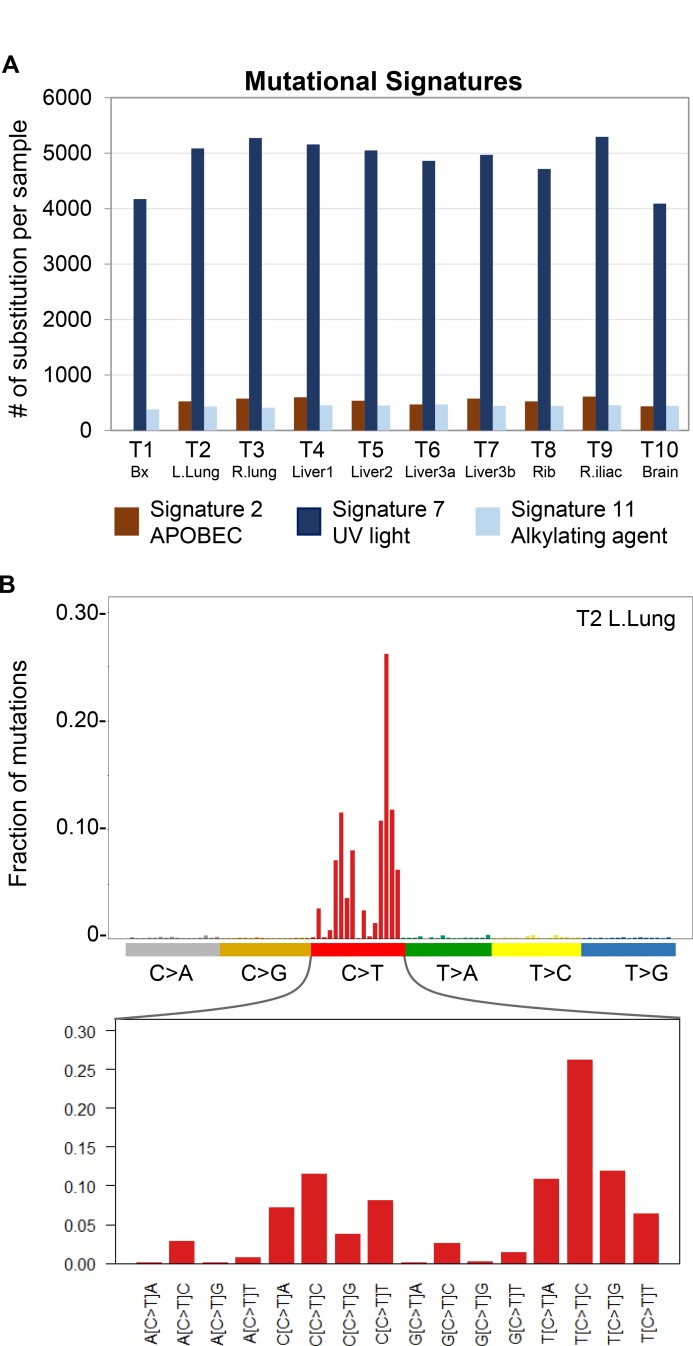
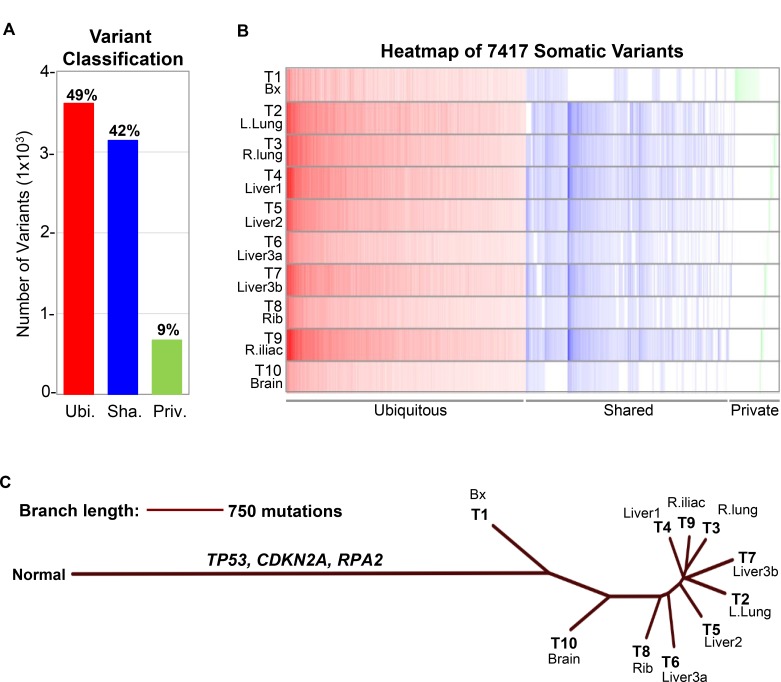
Interdigitating dendritic cell sarcoma (IDCS) is an extremely rare cancer of dendritic cell origin that lacks a standardized treatment approach. Here, we performed genomic characterization of metastatic IDCS through whole exome sequencing (WES) of tumor tissues procured from a patient who underwent research autopsy. WES was also performed on a treatment-naïve tumor biopsy sample obtained from prior surgical resection. Our analyses revealed ultra-hypermutation, defined as >100 mutations per megabase, in this patient's cancer, which was further characterized by the presence of three distinct mutational signatures including UV radiation and APOBEC signatures. To characterize clonal heterogeneity, we used the bioinformatics tool Canopy to leverage single nucleotide and copy number variants to catalog six subclones across various metastatic tumors. Truncal alterations, defined as being present in all clonal tumor cell populations, in this patient's cancer include point mutations in and and amplifications of and , which are likely driver mutations. In summary, we have performed genomic characterization evaluating tumor mutational burden (TMB) and heterogeneity in a patient with metastatic IDCS. Despite ultra-hypermutation, this patient's cancer was not responsive to treatment with PD-1 inhibition. Our results underscore the importance of characterizing clonal heterogeneity in TMB-high cancers.
交指状树突状细胞肉瘤(IDCS)是一种极为罕见的起源于树突状细胞的癌症,目前缺乏标准化的治疗方法。在此,我们通过对一名接受研究性尸检患者的肿瘤组织进行全外显子组测序(WES),对转移性IDCS进行了基因组特征分析。还对先前手术切除获取的未经治疗的肿瘤活检样本进行了WES。我们的分析揭示了该患者癌症存在超高度突变,定义为每兆碱基>100个突变,其进一步特征是存在包括紫外线辐射和载脂蛋白B mRNA编辑酶催化多肽样蛋白(APOBEC)特征在内的三种不同的突变特征。为了表征克隆异质性,我们使用生物信息学工具Canopy利用单核苷酸和拷贝数变异对各种转移性肿瘤中的六个亚克隆进行分类。该患者癌症中的主干改变(定义为存在于所有克隆性肿瘤细胞群体中)包括 和 中的点突变以及 和 的扩增,这些可能是驱动突变。总之,我们对一名转移性IDCS患者进行了评估肿瘤突变负荷(TMB)和异质性的基因组特征分析。尽管存在超高度突变,但该患者的癌症对PD - 1抑制治疗无反应。我们的结果强调了在TMB高的癌症中表征克隆异质性的重要性。