Department of Pharmacy, Anhui Mental Health Center, Hefei, Anhui 230000, P.R. China.
School of Pharmacy, Anhui Medical University, Hefei, Anhui 230032, P.R. China.
Int J Mol Med. 2019 Apr;43(4):1778-1788. doi: 10.3892/ijmm.2019.4085. Epub 2019 Jan 31.
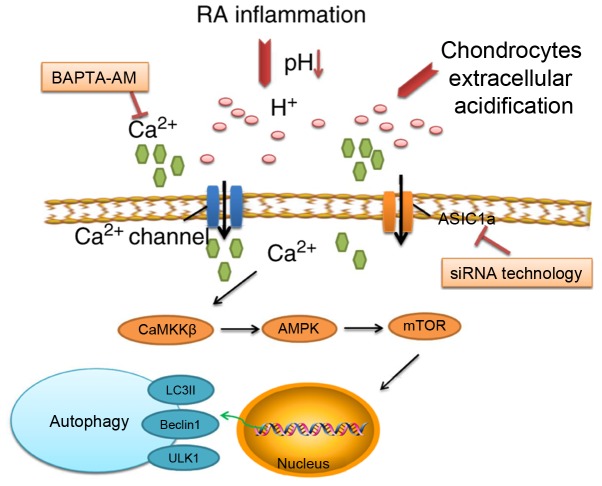
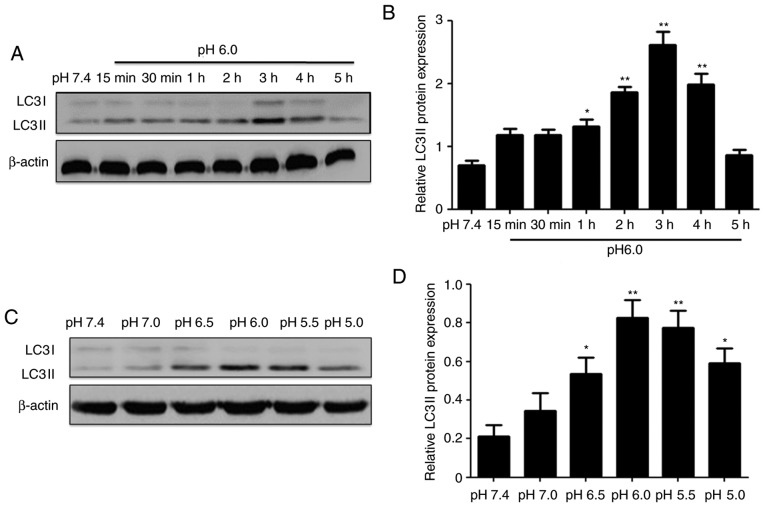
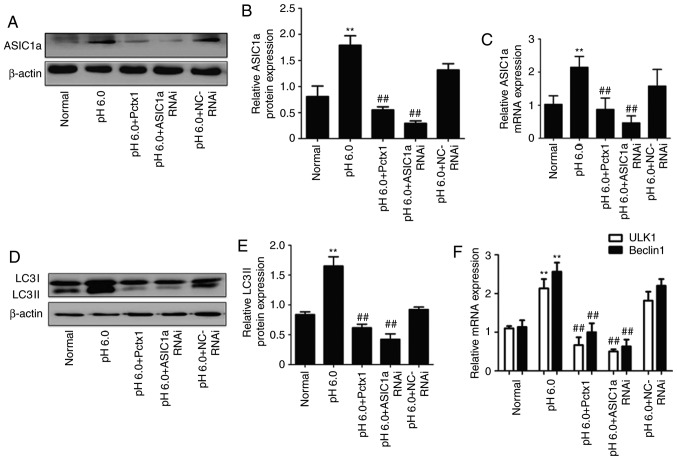
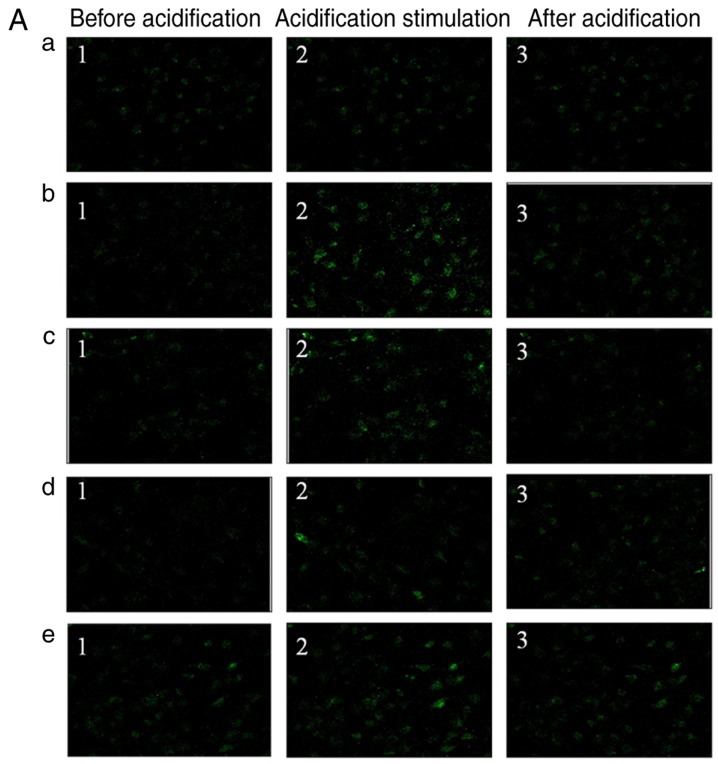
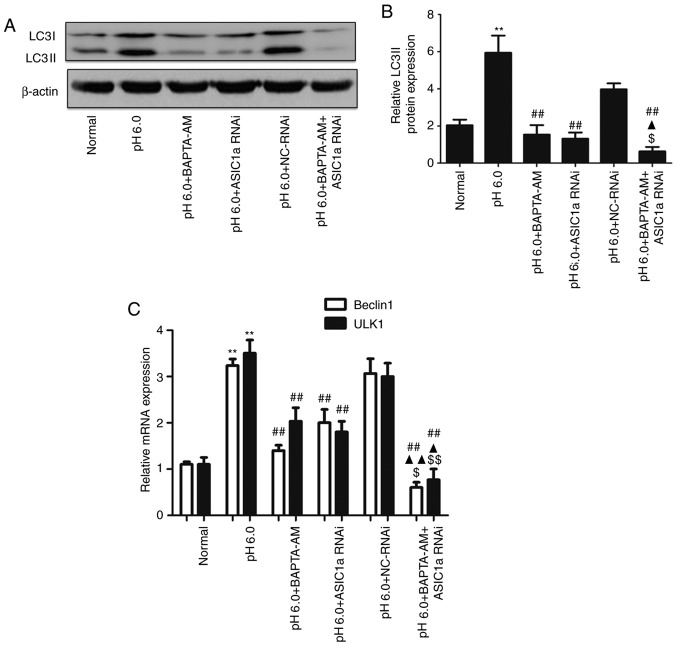
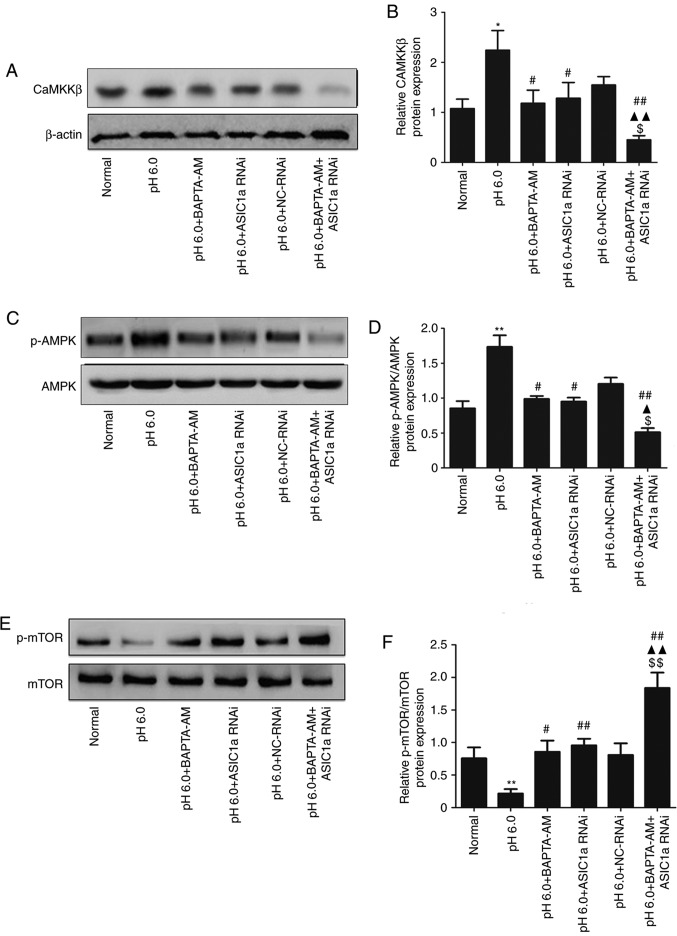
Acid‑sensing ion channel 1a (ASIC1a), member of the degenerin/epithelial sodium channel protein superfamily, serves a critical role in various physiological and pathological processes. The aim of the present study was to examine the role of ASIC1a in the autophagy of rat articular chondrocytes. Autophagy was induced by acidic stimulation in rat articular chondrocytes and the extent of autophagy was evaluated via the expression levels of microtubule‑associated protein 1 light chain 3II, Beclin1 and uncoordinated‑51 like kinase1. Suppression of ASIC1a was achieved using small interfering RNA technology and/or inhibitor psalmotoxin‑1. The expression levels of autophagy markers were measured by western blot analysis and reverse transcription‑quantitative polymerase chain reaction methods. Intracellular calcium ([Ca2+]i) was analyzed using a Ca2+‑imaging method. Additionally, protein expression levels of the Ca2+/calmodulin‑dependent protein kinase kinase β (CaMKKβ)/5'‑monophosphate‑activated protein kinase (AMPK)/mammalian target of rapamycin (mTOR) pathway were measured by western blot analysis. The results showed that autophagy was increased in a pH‑ and time‑dependent manner with exposure to an acidic environment. In addition, silencing ASIC1a significantly decreased the expression levels of autophagy makers, accompanied by abrogation of the acid‑induced [Ca2+]i increase. Furthermore, silencing of ASIC1a downregulated the levels of CaMKKβ/β‑actin and phosphorylated (p‑) AMPK/AMPK, and upregulated the levels of p‑mTOR/mTOR. These results indicated that ASIC1a is a potent regulator of autophagy in chondrocytes, which may be associated with decreased Ca2+ influx and the CaMKKβ/AMPK/mTOR pathway.
酸敏感离子通道 1a(ASIC1a)属于退行性/上皮钠通道蛋白超家族成员,在各种生理和病理过程中发挥着关键作用。本研究旨在探讨 ASIC1a 在大鼠关节软骨细胞自噬中的作用。通过酸性刺激诱导大鼠关节软骨细胞自噬,并通过微管相关蛋白 1 轻链 3II、Beclin1 和非协调 51 样激酶 1 的表达水平评估自噬程度。使用小干扰 RNA 技术和/或抑制剂 psalmotoxin-1 抑制 ASIC1a。通过 Western blot 分析和逆转录-定量聚合酶链反应方法测量自噬标志物的表达水平。通过钙成像法分析细胞内钙([Ca2+]i)。此外,通过 Western blot 分析测量 Ca2+/钙调蛋白依赖性蛋白激酶激酶β(CaMKKβ)/5'-单磷酸激活蛋白激酶(AMPK)/哺乳动物雷帕霉素靶蛋白(mTOR)通路的蛋白表达水平。结果表明,暴露于酸性环境中,自噬呈 pH 和时间依赖性增加。此外,沉默 ASIC1a 显著降低自噬标志物的表达水平,同时酸诱导的[Ca2+]i 增加被阻断。此外,沉默 ASIC1a 下调 CaMKKβ/β-肌动蛋白和磷酸化(p)AMPK/AMPK 的水平,并上调 p-mTOR/mTOR 的水平。这些结果表明,ASIC1a 是软骨细胞自噬的有效调节剂,可能与钙内流减少和 CaMKKβ/AMPK/mTOR 通路有关。