Department of Sport Performance, National Taiwan University of Sport, Taichung 40404, Taiwan, R.O.C.
Department of Nursing, Chung Jen Catholic Junior College, Chiayi 62241, Taiwan, R.O.C.
Int J Oncol. 2019 Apr;54(4):1271-1281. doi: 10.3892/ijo.2019.4704. Epub 2019 Jan 30.
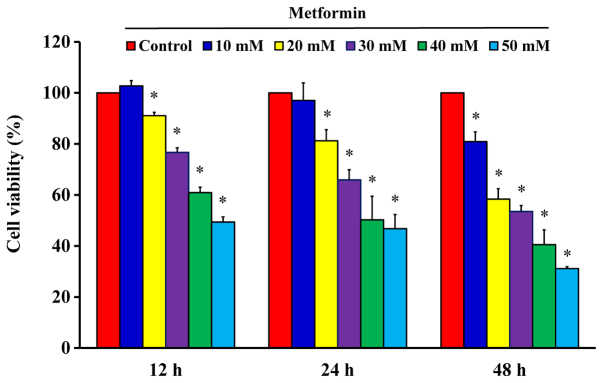
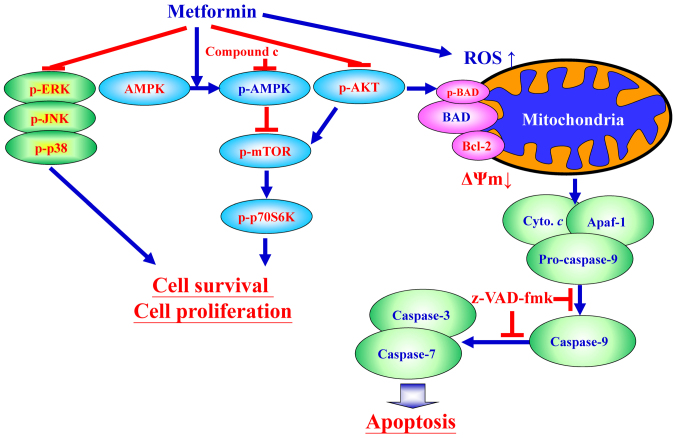
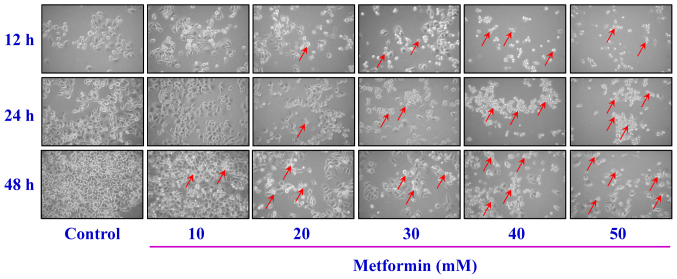
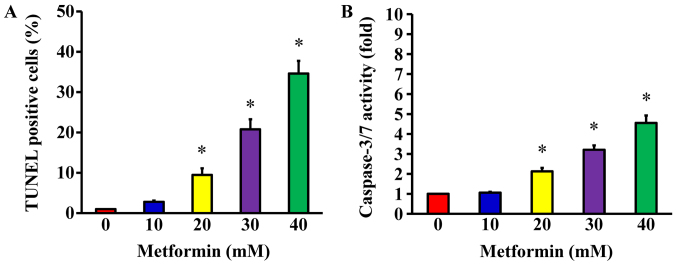
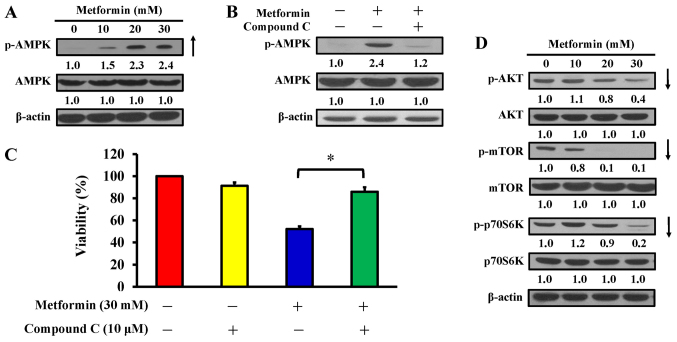
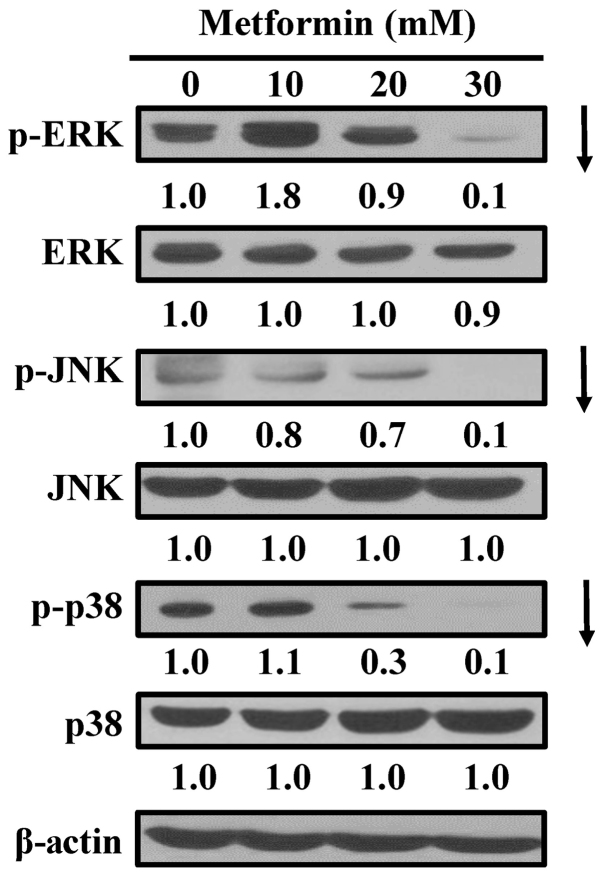
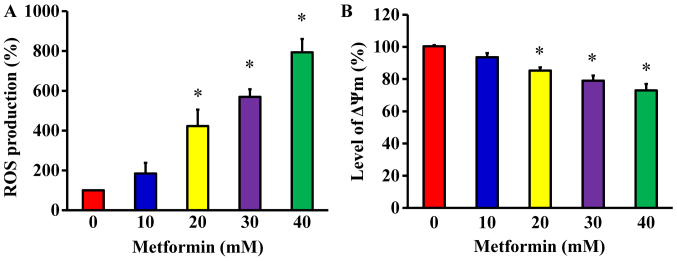
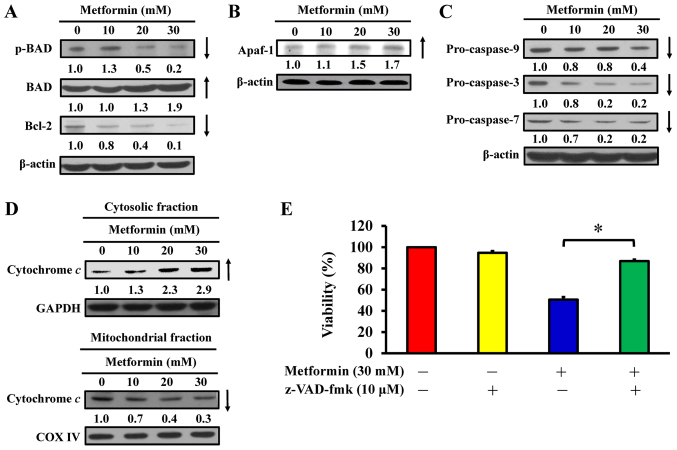
Metformin is commonly used to treat patients with type 2 diabetes and is associated with a decreased risk of cancer. Previous studies have demonstrated that metformin can act alone or in synergy with certain anticancer agents to achieve anti‑neoplastic effects on various types of tumors via adenosine monophosphate‑activated protein kinase (AMPK) signaling. However, the role of metformin in AMPK‑mediated apoptosis of human gastric cancer cells is poorly understood. In the current study, metformin exhibited a potent anti‑proliferative effect and induced apoptotic characteristics in human AGS gastric adenocarcinoma cells, as demonstrated by MTT assay, morphological observation method, terminal deoxynucleotidyl transferase dUTP nick end labeling and caspase‑3/7 assay kits. Western blot analysis demonstrated that treatment with metformin increased the phosphorylation of AMPK, and decreased the phosphorylation of AKT, mTOR and p70S6k. Compound C (an AMPK inhibitor) suppressed AMPK phosphorylation and significantly abrogated the effects of metformin on AGS cell viability. Metformin also reduced the phosphorylation of mitogen‑activated protein kinases (ERK, JNK and p38). Additionally, metformin significantly increased the cellular ROS level and included loss of mitochondrial membrane potential (ΔΨm). Metformin altered apoptosis‑associated signaling to downregulate the BAD phosphorylation and Bcl‑2, pro‑caspase‑9, pro‑caspase‑3 and pro‑caspase‑7 expression, and to upregulate BAD, cytochrome c, and Apaf‑1 proteins levels in AGS cells. Furthermore, z‑VAD‑fmk (a pan‑caspase inhibitor) was used to assess mitochondria‑mediated caspase‑dependent apoptosis in metformin‑treated AGS cells. The findings demonstrated that metformin induced AMPK‑mediated apoptosis, making it appealing for development as a novel anticancer drug for the treating gastric cancer.
二甲双胍常用于治疗 2 型糖尿病患者,并且与降低癌症风险有关。先前的研究表明,二甲双胍可以单独或与某些抗癌药物协同作用,通过腺苷单磷酸激活蛋白激酶 (AMPK) 信号通路对各种类型的肿瘤发挥抗肿瘤作用。然而,二甲双胍在 AMPK 介导的人胃癌细胞凋亡中的作用尚不清楚。在本研究中,通过 MTT 检测、形态观察法、末端脱氧核苷酸转移酶 dUTP 缺口末端标记法和 caspase-3/7 检测试剂盒,发现二甲双胍对人 AGS 胃腺癌细胞表现出很强的抗增殖作用,并诱导其发生凋亡特征。Western blot 分析表明,二甲双胍处理可增加 AMPK 的磷酸化,降低 AKT、mTOR 和 p70S6k 的磷酸化。化合物 C(一种 AMPK 抑制剂)抑制 AMPK 磷酸化,并显著削弱二甲双胍对 AGS 细胞活力的作用。二甲双胍还降低了丝裂原激活的蛋白激酶(ERK、JNK 和 p38)的磷酸化。此外,二甲双胍显著增加了细胞内 ROS 水平并包括线粒体膜电位(ΔΨm)的丧失。二甲双胍改变了与凋亡相关的信号通路,下调 BAD 的磷酸化和 Bcl-2、pro-caspase-9、pro-caspase-3 和 pro-caspase-7 的表达,并上调 AGS 细胞中 BAD、细胞色素 c 和 Apaf-1 蛋白的水平。此外,使用 z-VAD-fmk(一种广谱半胱天冬酶抑制剂)评估了在二甲双胍处理的 AGS 细胞中由线粒体介导的 caspase 依赖性凋亡。研究结果表明,二甲双胍诱导了 AMPK 介导的凋亡,使其成为治疗胃癌的一种有吸引力的新型抗癌药物。