Department of Biochemistry and Molecular Medicine, College of Medicine, Alfaisal University, P.O. Box 50927, Riyadh 11533, Saudi Arabia.
Department of Translational Health Sciences, Bristol Medical School, University of Bristol, Bristol BS8 1QU, UK.
Int J Mol Sci. 2024 Apr 6;25(7):4083. doi: 10.3390/ijms25074083.
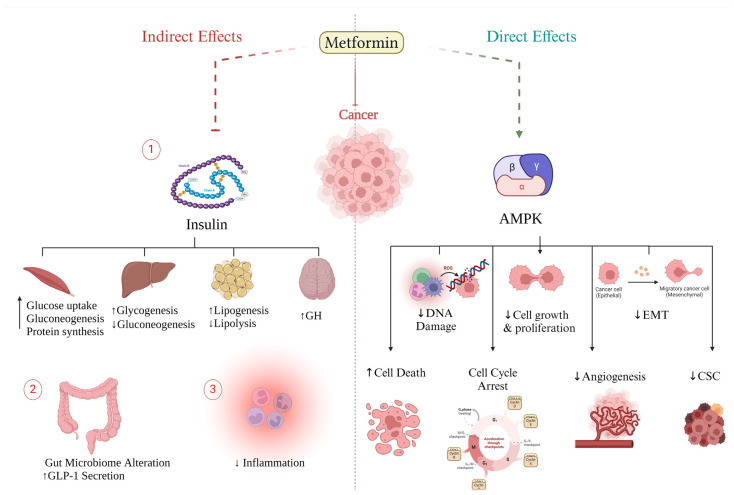
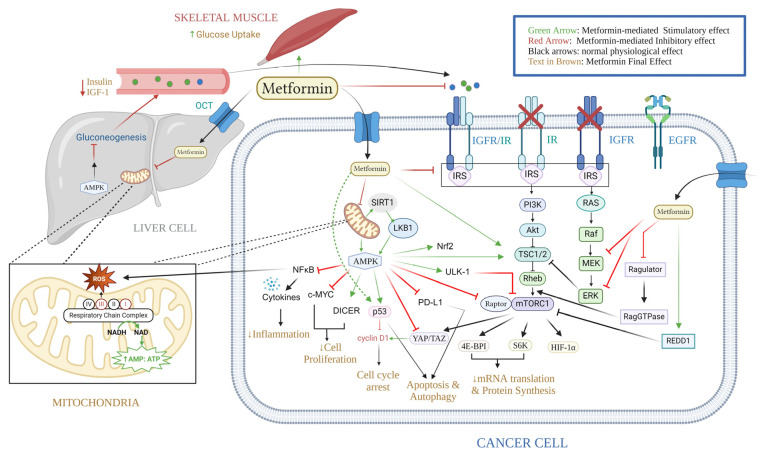
Cancer continues to pose a significant global health challenge, as evidenced by the increasing incidence rates and high mortality rates, despite the advancements made in chemotherapy. The emergence of chemoresistance further complicates the effectiveness of treatment. However, there is growing interest in the potential of metformin, a commonly prescribed drug for type 2 diabetes mellitus (T2DM), as an adjuvant chemotherapy agent in cancer treatment. Although the precise mechanism of action of metformin in cancer therapy is not fully understood, it has been found to have pleiotropic effects, including the modulation of metabolic pathways, reduction in inflammation, and the regulation of cellular proliferation. This comprehensive review examines the anticancer properties of metformin, drawing insights from various studies conducted in vitro and in vivo, as well as from clinical trials and observational research. This review discusses the mechanisms of action involving both insulin-dependent and independent pathways, shedding light on the potential of metformin as a therapeutic agent for different types of cancer. Despite promising findings, there are challenges that need to be addressed, such as conflicting outcomes in clinical trials, considerations regarding dosing, and the development of resistance. These challenges highlight the importance of further research to fully harness the therapeutic potential of metformin in cancer treatment. The aims of this review are to provide a contemporary understanding of the role of metformin in cancer therapy and identify areas for future exploration in the pursuit of effective anticancer strategies.
癌症仍然是一个重大的全球健康挑战,尽管在化疗方面取得了进展,但发病率和死亡率仍在上升。化疗耐药性的出现进一步使治疗效果复杂化。然而,二甲双胍作为治疗 2 型糖尿病(T2DM)的常用药物,作为癌症治疗的辅助化疗药物的潜力越来越受到关注。虽然二甲双胍在癌症治疗中的确切作用机制尚不完全清楚,但已发现其具有多种作用,包括调节代谢途径、减少炎症和调节细胞增殖。本综述从体外和体内研究、临床试验和观察性研究中,考察了二甲双胍的抗癌特性,汲取了各种研究的见解。本综述讨论了涉及胰岛素依赖和非依赖途径的作用机制,阐明了二甲双胍作为不同类型癌症治疗剂的潜力。尽管有令人鼓舞的发现,但仍存在一些需要解决的挑战,如临床试验结果存在冲突、剂量考虑因素以及耐药性的发展。这些挑战凸显了进一步研究的重要性,以充分发挥二甲双胍在癌症治疗中的治疗潜力。本综述的目的是提供对二甲双胍在癌症治疗中的作用的当代理解,并确定未来探索的领域,以寻求有效的抗癌策略。