Coxiella Pathogenesis Section, Laboratory of Bacteriology, Rocky Mountain Laboratories, National Institute of Allergy and Infectious Diseases, National Institutes of Health, Hamilton, Montana, USA.
Coxiella Pathogenesis Section, Laboratory of Bacteriology, Rocky Mountain Laboratories, National Institute of Allergy and Infectious Diseases, National Institutes of Health, Hamilton, Montana, USA
mBio. 2019 Feb 5;10(1):e02816-18. doi: 10.1128/mBio.02816-18.
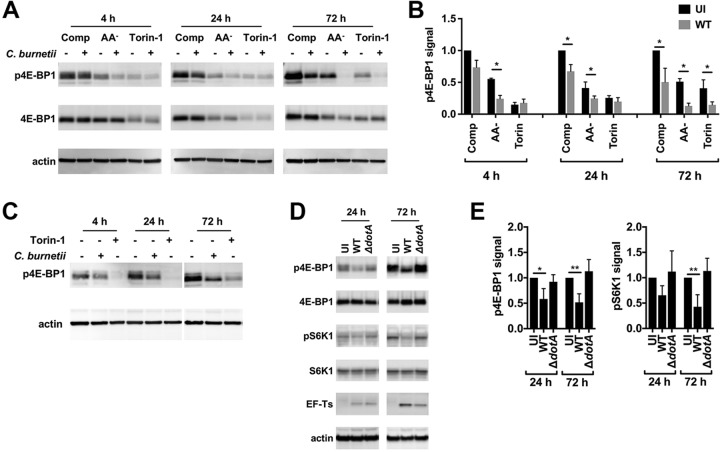
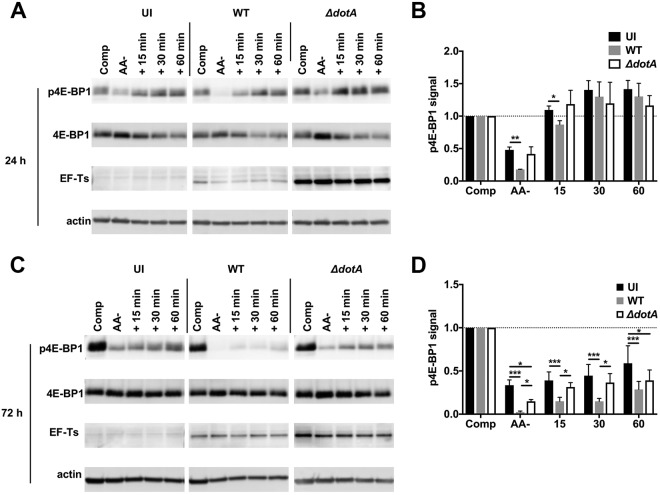
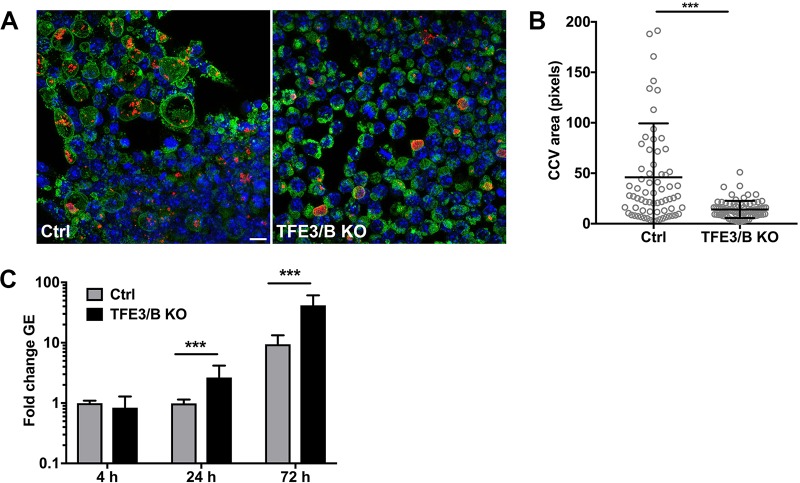
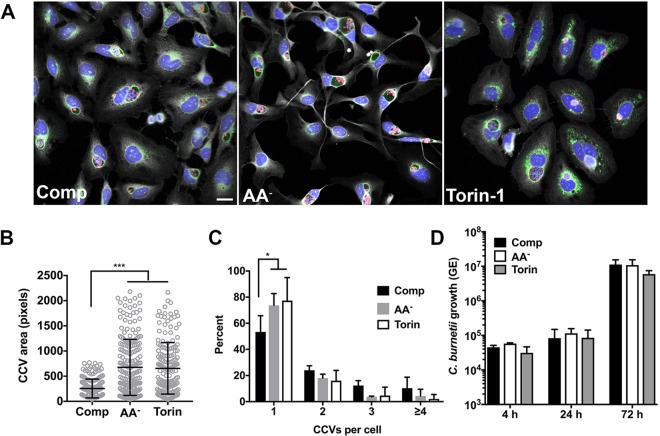
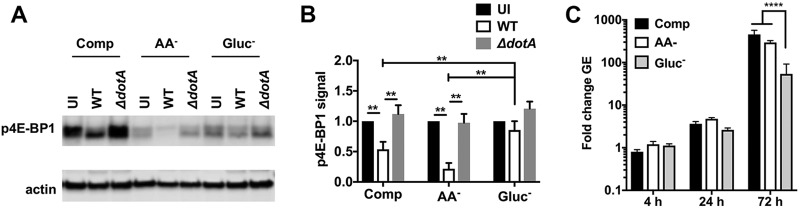
The Q fever agent is a Gram-negative bacterium that invades macrophages and replicates inside a specialized lysosomal vacuole. The pathogen employs a type 4B secretion system (T4BSS) to deliver effector proteins into the host cell that modify the containing vacuole (CCV) into a replication-permissive niche. Mature CCVs are massive degradative organelles that acquire lysosomal proteins. Inhibition of mammalian (or mechanistic) target of rapamycin complex 1 (mTORC1) kinase by nutrient deprivation promotes autophagy and lysosome fusion, as well as activation of the transcription factors TFE3 and TFEB (TFE3/B), which upregulates expression of lysosomal genes. Here, we report that inhibits mTORC1 as evidenced by impaired localization of mTORC1 to endolysosomal membranes and decreased phosphorylation of elF4E-binding protein 1 (4E-BP1) and S6 kinase 1 in infected cells. Infected cells exhibit increased amounts of autophagy-related proteins protein 1A/1B-light chain 3 (LC3) and p62 as well as of activated TFE3. However, did not accelerate autophagy or block autophagic flux triggered by cell starvation. Activation of autophagy or transcription by TFE3/B increased CCV expansion without enhancing bacterial replication. By contrast, knockdown of tuberous sclerosis complex 1 (TSC1) or TSC2, which hyperactivates mTORC1, impaired CCV expansion and bacterial replication. Together, these data demonstrate that specific inhibition of mTORC1 by , but not amplified cell catabolism via autophagy, is required for optimal pathogen replication. These data reveal a complex interplay between lysosomal function and host cell metabolism that regulates intracellular growth. is an intracellular pathogenic bacterium that replicates within a lysosomal vacuole. Biogenesis of the -containing vacuole (CCV) requires effector proteins delivered into the host cell cytosol by the type 4B secretion system (T4BSS). Modifications to lysosomal physiology required for pathogen replication within the CCV are poorly understood. Mammalian (or mechanistic) target of rapamycin complex 1 (mTORC1) is a master kinase that regulates lysosome structure and function. Nutrient deprivation inhibits mTORC1, which promotes cell catabolism in the form of accelerated autophagy and increased lysosome biosynthesis. Here, we report that growth is enhanced by T4BSS-dependent inhibition of mTORC1 that does not activate autophagy. Canonical inhibition of mTORC1 by starvation or inhibitor treatment that induces autophagic flux does not benefit growth. Furthermore, hyperactivation of mTORC1 impairs bacterial replication. These findings indicate that inhibition of mTORC1 without accelerated autophagy promotes bacterial growth.
Q 热因子是一种革兰氏阴性细菌,它能侵入巨噬细胞,并在专门的溶酶体空泡内复制。病原体利用 4B 型分泌系统(T4BSS)将效应蛋白输送到宿主细胞内,将包含空泡(CCV)转化为允许复制的小生境。成熟的 CCV 是大量的降解性细胞器,获得溶酶体蛋白。营养物质剥夺导致哺乳动物(或机械)雷帕霉素靶蛋白复合物 1(mTORC1)激酶失活,促进自噬和溶酶体融合,并激活转录因子 TFE3 和 TFEB(TFE3/B),上调溶酶体基因的表达。在这里,我们报告说, 通过抑制 mTORC1 来抑制 mTORC1,这表现在感染细胞中 mTORC1 定位在内溶酶体膜上受损,以及真核起始因子 4E 结合蛋白 1(4E-BP1)和 S6 激酶 1 的磷酸化减少。在感染细胞中,自噬相关蛋白 1A/1B-轻链 3(LC3)和 p62 以及激活的 TFE3 的含量增加。然而,感染并不会加速细胞饥饿引发的自噬或阻断自噬流。TFE3/B 的自噬或转录的激活会增加 CCV 的扩张,而不会增强细菌的复制。相比之下,结节性硬化复合物 1(TSC1)或 TSC2 的敲低(过度激活 mTORC1)会损害 CCV 的扩张和细菌的复制。总的来说,这些数据表明, 通过特定抑制 mTORC1,而不是通过自噬放大细胞分解代谢,是最佳病原体复制所必需的。这些数据揭示了溶酶体功能和宿主细胞代谢之间的复杂相互作用,调节了 细胞内的生长。是一种细胞内致病菌,在溶酶体空泡内复制。含空泡(CCV)的生物发生需要效应蛋白通过 4B 型分泌系统(T4BSS)输送到宿主细胞质中。在 CCV 内复制所需的溶酶体生理学的改变还不太清楚。哺乳动物(或机械)雷帕霉素靶蛋白复合物 1(mTORC1)是一种调节溶酶体结构和功能的主激酶。营养物质的剥夺抑制 mTORC1,促进以加速自噬和增加溶酶体生物合成形式的细胞分解代谢。在这里,我们报告说,通过 T4BSS 依赖性的 mTORC1 抑制来增强 生长,而不会激活自噬。通过饥饿或诱导自噬流的抑制剂来抑制 mTORC1 的经典方法并不能促进 的生长。此外,mTORC1 的过度激活会损害细菌的复制。这些发现表明,在不加速自噬的情况下抑制 mTORC1 会促进细菌的生长。