Rai Wijdan, Olcese Vanessa, Elsheikh Bakri, Stino Amro Maher
Department of Neurology, Ohio State University Wexner Medical Center, Columbus, OH, United States.
Department of Neurosurgery, Ohio State University Wexner Medical Center, Columbus, OH, United States.
Front Neurol. 2019 Jan 22;10:4. doi: 10.3389/fneur.2019.00004. eCollection 2019.
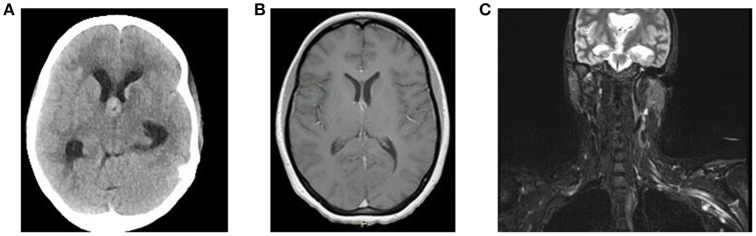
Horner's syndrome is an established clinical finding unique to neoplastic brachial plexopathy. We present the case of a patient who developed Horner's syndrome as the first manifestation of neurolymphomatosis (NL) of the brachial plexus that did not have the usually associated bulky adenopathy/Pancoast syndrome phenotype. We discuss the clinical utility of Horner's syndrome with regards to brachial plexopathy of indeterminate etiology, as well as the utility of other diagnostic modalities in NL. NL, particularly of the brachial plexus, is particularly challenging to diagnose. MRI and CSF studies are often inconclusive. FDG-PET imaging can be difficult to get insurance to approve. The presence of Horner's syndrome in brachial plexopathy of indeterminate etiology, even in the absence of bulky adenopathy, should raise clinical suspicion of NL, possibly prompting such interventions as fascicular nerve biopsy.
霍纳综合征是肿瘤性臂丛神经病特有的一种既定临床发现。我们报告了一例患者,该患者以霍纳综合征作为臂丛神经淋巴瘤(NL)的首发表现,且该患者并无通常与之相关的巨大淋巴结病/潘科斯特综合征表型。我们讨论了霍纳综合征在病因不明的臂丛神经病方面的临床应用价值,以及其他诊断方法在NL诊断中的应用价值。NL,尤其是臂丛神经的NL,诊断起来极具挑战性。MRI和脑脊液检查往往无法得出明确结论。氟代脱氧葡萄糖正电子发射断层显像(FDG-PET)成像通常难以获得保险批准。在病因不明的臂丛神经病中,即使没有巨大淋巴结病,霍纳综合征的出现也应引起临床对NL的怀疑,可能促使采取诸如束状神经活检等干预措施。