Department of Pathology, Dalhousie University, Halifax, NS, Canada.
Department of Microbiology and Immunology, Dalhousie University, Halifax, NS, Canada.
Front Immunol. 2019 Jan 22;10:16. doi: 10.3389/fimmu.2019.00016. eCollection 2019.
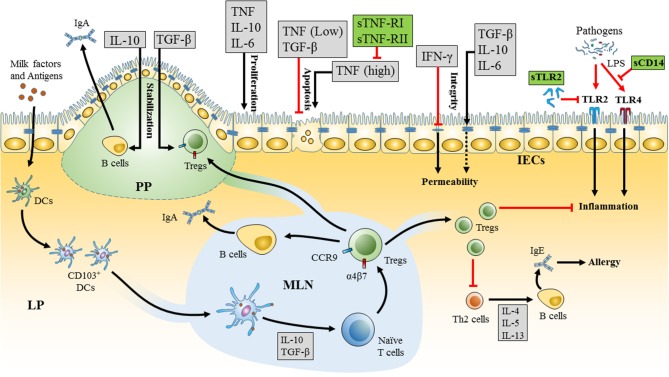
The postpartum period is an important window during which environmental factors can shape the life-long health of the infant. This time period often coincides with substantial milk consumption either in the form of breast milk or from cow's milk sources, such as infant formulas. Although breast milk is the most beneficial source of nutrients for infants during the first 6 months after birth, its role in regulating food allergy development, through regulation of oral tolerance, is still controversial. Breast milk contains several factors that can impact mucosal immune function, including immune cells, antibodies, microbiota, oligosaccharides, cytokines, and soluble receptors. However, there is considerable variation in the assessed levels of cytokines and soluble receptors between studies and across the lactation period. Most of these cytokines and soluble receptors are absent, or only found in limited quantities, in commercial baby formulas. Differences in content of these pluripotent factors, which impact on both the mother and the neonate, could contribute to the controversy surrounding the role of breast milk regulating oral tolerance. This review highlights current knowledge about the importance of cytokines and soluble receptors in breast milk on the development of oral tolerance and tolerance-relateddisorders. Understanding the mechanisms by which such milk components might promote oral tolerance could aid in the development of improved strategies for allergy prevention.
产后时期是一个重要的窗口期,在此期间,环境因素可以塑造婴儿一生的健康。在此期间,婴儿通常会大量摄入母乳或牛奶,如婴儿配方奶粉。虽然母乳是婴儿出生后 6 个月内最有益的营养来源,但它通过调节口腔耐受性来调节食物过敏发展的作用仍存在争议。母乳中含有多种可影响黏膜免疫功能的因子,包括免疫细胞、抗体、微生物群、低聚糖、细胞因子和可溶性受体。然而,在研究和哺乳期内,细胞因子和可溶性受体的评估水平存在很大差异。这些细胞因子和可溶性受体中的大多数在商业婴儿配方奶粉中不存在,或者仅以有限的数量存在。这些影响母婴双方的多功能因子含量的差异可能导致了关于母乳调节口腔耐受性作用的争议。本综述强调了母乳中细胞因子和可溶性受体在口腔耐受性发展和与耐受性相关疾病中的重要性。了解这些牛奶成分促进口腔耐受性的机制可能有助于制定改善过敏预防策略。