de Jonge C S, Coolen B F, Peper E S, Motaal A G, Nio C Y, Somers I, Strijkers G J, Stoker J, Nederveen A J
Department of Radiology and Nuclear Medicine, Amsterdam UMC, location Academic Medical Center, University of Amsterdam, Amsterdam, The Netherlands.
Department of Biomedical Engineering and Physics, Amsterdam UMC, location Academic Medical Center, University of Amsterdam, Amsterdam, The Netherlands.
Eur Radiol Exp. 2019 Feb 6;3(1):7. doi: 10.1186/s41747-018-0079-9.
To investigate the feasibility of compressed sensing and parallel imaging (CS-PI)-accelerated bowel motility magnetic resonance imaging (MRI) and to compare its image quality and diagnostic quality to conventional sensitivity encoding (SENSE) accelerated scans.
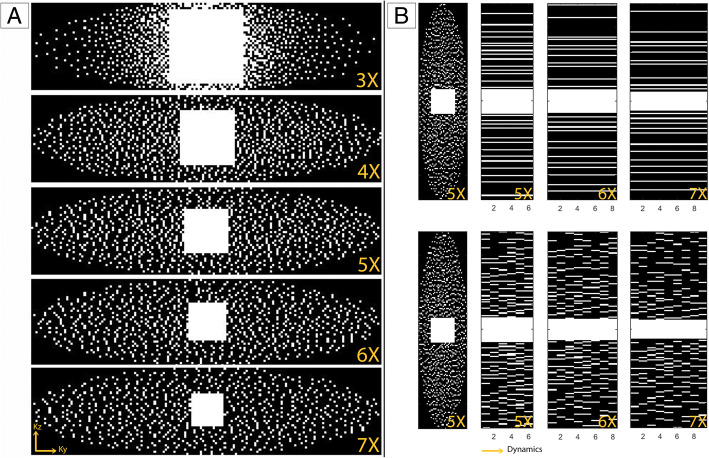
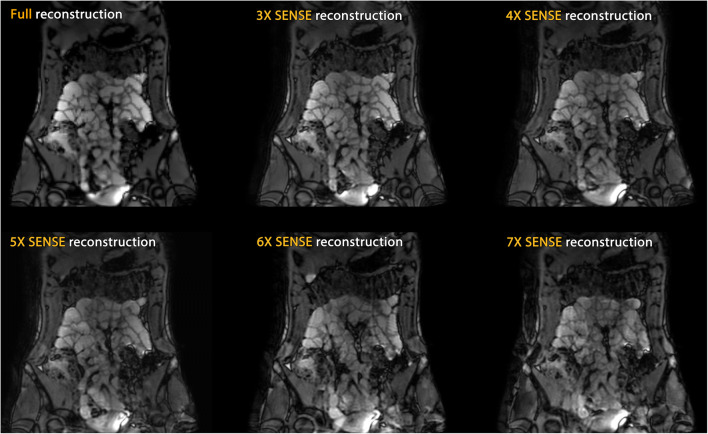
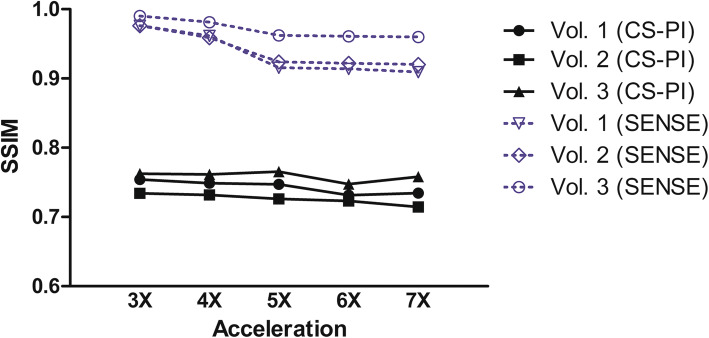
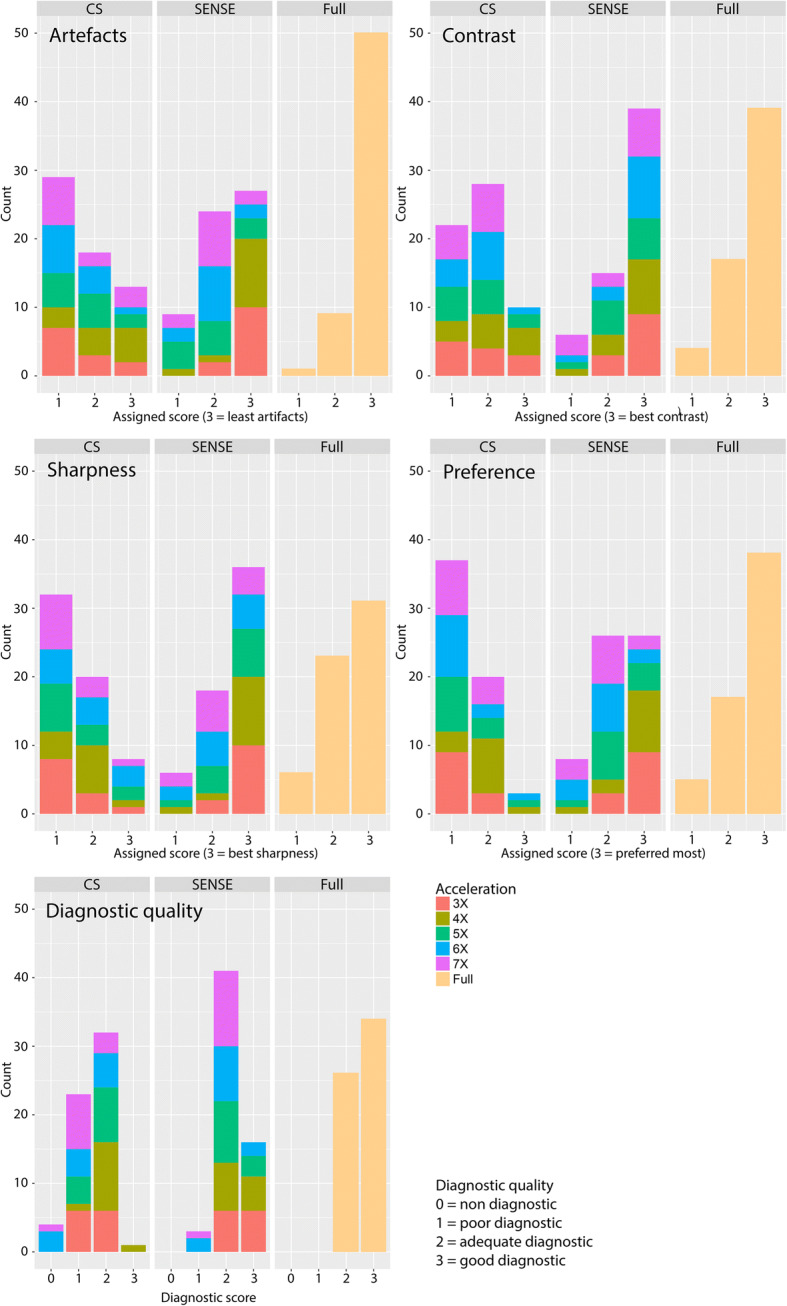
Bowel MRI was performed in six volunteers using a three-dimensional balanced fast field-echo sequence. Static scans were performed after the administration of a spasmolytic agent to prevent bowel motion artefacts. Fully sampled reference scans and multiple prospectively 3× to 7× undersampled CS-PI and SENSE scans were acquired. Additionally, fully sampled CS-PI and SENSE scans were retrospectively undersampled and reconstructed. Dynamic scans were performed using 5× to 7× accelerated scans in the presence of bowel motion. Retrospectively, undersampled scans were compared to fully sampled scans using structural similarity indices. All reconstructions were visually assessed for image quality and diagnostic quality by two radiologists.
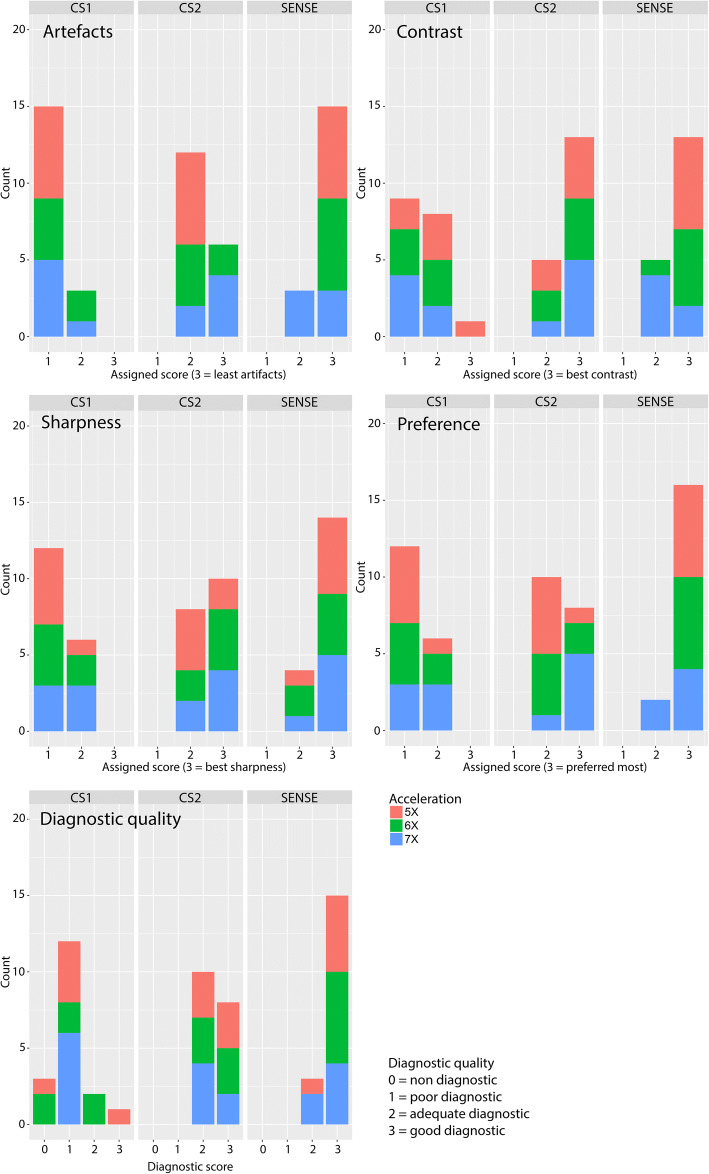
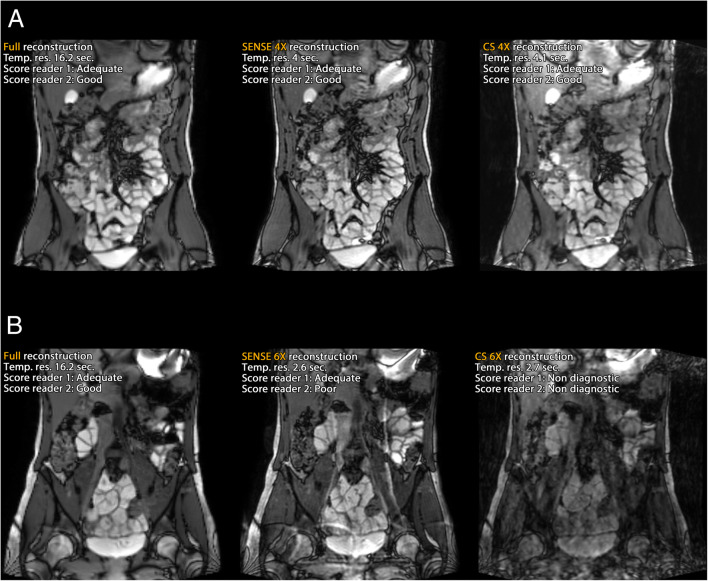
For static imaging, the performance of CS-PI was lower than that of fully sampled and SENSE scans: the diagnostic quality was assessed as adequate or good for 100% of fully sampled scans, 95% of SENSE, but only for 55% of CS-PI scans. For dynamic imaging, CS-PI image quality was scored similar to SENSE at high acceleration. Diagnostic quality of all scans was scored as adequate or good; 55% of CS-PI and 83% of SENSE scans were scored as good.
Compared to SENSE, current implementation of CS-PI performed less or equally good in terms of image quality and diagnostic quality. CS-PI did not show advantages over SENSE for three-dimensional bowel motility imaging.
探讨压缩感知与并行成像(CS-PI)加速肠动力磁共振成像(MRI)的可行性,并将其图像质量和诊断质量与传统的敏感性编码(SENSE)加速扫描进行比较。
对6名志愿者进行肠MRI检查,采用三维平衡快速场回波序列。在给予解痉剂后进行静态扫描,以防止肠运动伪影。采集全采样参考扫描以及多个前瞻性3倍至7倍欠采样的CS-PI和SENSE扫描。此外,对全采样的CS-PI和SENSE扫描进行回顾性欠采样和重建。在存在肠运动的情况下,使用5倍至7倍加速扫描进行动态扫描。回顾性地,使用结构相似性指数将欠采样扫描与全采样扫描进行比较。两名放射科医生对所有重建图像的质量和诊断质量进行视觉评估。
对于静态成像,CS-PI的性能低于全采样和SENSE扫描:100%的全采样扫描、95%的SENSE扫描的诊断质量被评估为足够或良好,但CS-PI扫描仅为55%。对于动态成像,在高加速情况下,CS-PI图像质量得分与SENSE相似。所有扫描的诊断质量得分均为足够或良好;55%的CS-PI扫描和83%的SENSE扫描被评为良好。
与SENSE相比,CS-PI的当前实施方案在图像质量和诊断质量方面表现较差或相当。在三维肠动力成像方面,CS-PI没有显示出优于SENSE的优势。