Santos Nathalia Serafim Dos, Marengo Lívia Luize, Moraes Fabio da Silva, Barberato Filho Silvio
Universidade de Sorocaba. Programa de Pós-Graduação em Ciências Farmacêuticas. Sorocaba, SP, Brasil.
Rev Saude Publica. 2019 Jan 31;53:7. doi: 10.11606/S1518-8787.2019053000781.
Identify and critically evaluate systematic reviews addressing the effectiveness of interventions to reduce the number of prescriptions of potentially inappropriate medication to older patients.
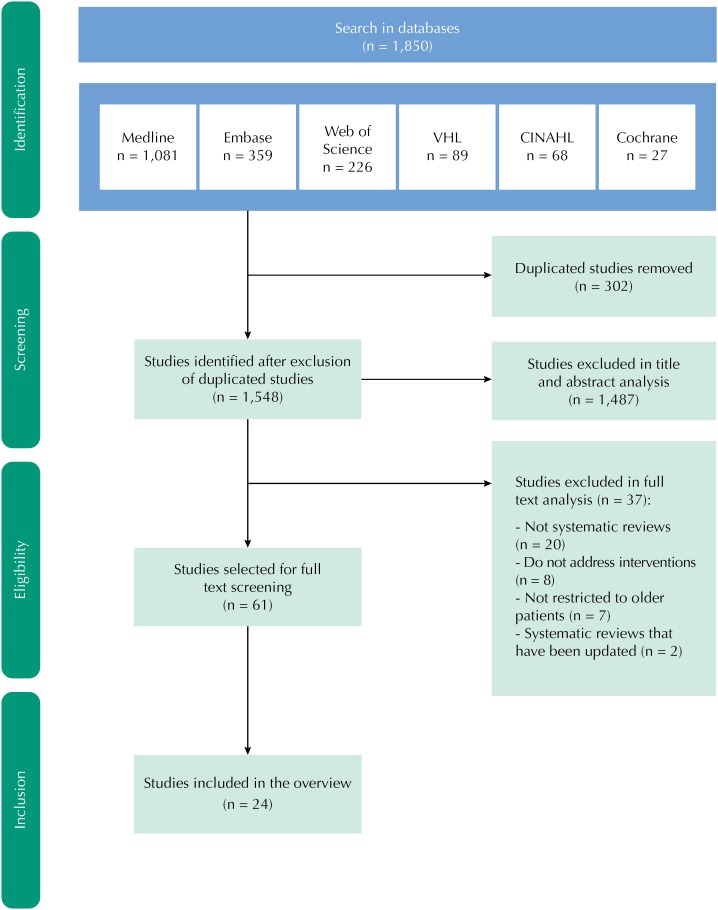
This is an overview of systematic reviews. The studies were searched and selected from Medline, Cochrane Library, Embase, CINAHL, Virtual Health Library, and Web of Science databases, combining the terms aged, prescriptions, inappropriate prescribing and potentially inappropriate medication list with their entry terms and other related descriptors, published by June 2017. This study included systematic reviews with or without meta-analysis that addressed the effectiveness of any intervention or combined interventions to reduce the number of prescriptions of potentially inappropriate medications to older patients, without restriction in terms of design, language or date of publication of primary studies. AMSTAR - A MeaSurement Tool to Assess systematic Reviews - was used to evaluate the methodological quality of selected systematic reviews. Study selection and the methodological quality evaluation were performed by two independent evaluators, who resolved any divergence by consensus. The main findings were grouped into thematic categories, defined after a content analysis and discussed qualitatively as narrative synthesis.
This study analyzed 24 systematic reviews. In terms of study design and methodological quality evaluation, most were systematic reviews of randomized controlled clinical trials and studies of moderate quality, respectively. The interventions were analyzed in five thematic categories: medication review services, pharmaceutical interventions, computerized systems, educational interventions, and others. The interventions analyzed showed good results and most of them helped reduce the number of prescriptions of potentially inappropriate medication to older patients.
The systematic reviews included in this overview showed potential benefits of different interventions. However, it was not possible to determine the most effective intervention. Combined interventions are likely to provide better results than isolated interventions.
识别并严格评估关于减少老年患者潜在不适当药物处方数量干预措施有效性的系统评价。
这是一项系统评价的概述。通过检索和筛选Medline、Cochrane图书馆、Embase、CINAHL、虚拟健康图书馆和科学网数据库,将年龄、处方、不适当处方和潜在不适当药物清单等术语与其入口词及其他相关描述符相结合,检索截至2017年6月发表的研究。本研究纳入了有或没有Meta分析的系统评价,这些评价涉及任何干预措施或联合干预措施减少老年患者潜在不适当药物处方数量的有效性,对原始研究的设计、语言或发表日期没有限制。使用AMSTAR(一种评估系统评价的测量工具)来评估所选系统评价的方法学质量。研究选择和方法学质量评估由两名独立评估者进行,他们通过协商一致解决任何分歧。主要研究结果被归纳为主题类别,在进行内容分析后定义,并作为叙述性综述进行定性讨论。
本研究分析了24项系统评价。在研究设计和方法学质量评估方面,大多数分别是随机对照临床试验的系统评价和中等质量的研究。干预措施被分析为五个主题类别:药物审查服务、药学干预、计算机系统、教育干预和其他。所分析的干预措施显示出良好的效果,其中大多数有助于减少老年患者潜在不适当药物的处方数量。
本概述中纳入的系统评价显示了不同干预措施的潜在益处。然而,无法确定最有效的干预措施。联合干预可能比单独干预产生更好的效果。