Department of Health and Social Management, University of Eastern Finland, Kuopio 70211, Finland.
Department of General Practice, University of Helsinki, Helsinki 00014, Finland.
Age Ageing. 2022 May 1;51(5). doi: 10.1093/ageing/afac112.
Educational interventions can reduce potentially inappropriate medication (PIM) use in older people. Their effectiveness has been measured mainly as changes in PIM use. In this economic evaluation, we analyse the impact of an educational intervention in terms of costs and quality-adjusted life years (QALYs).
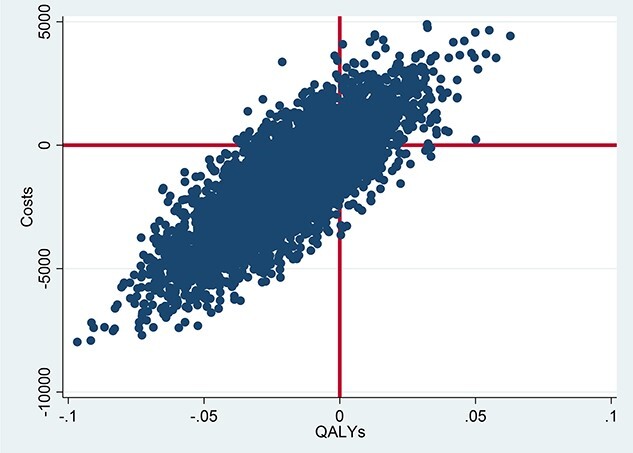
The educational intervention consisted of activating and interactive training sessions for nursing staff and consulting physicians, and was compared with treatment as usual (TAU). Participants (n = 227) in a cluster randomised trial (cRCT) were residents living permanently in assisted living facilities (n = 20 wards). For economic evaluation, participants' healthcare service use costs and costs for the intervention were estimated for a 12 month period.Incremental cost-effectiveness ratios (ICERs) were estimated for QALYs per participant. Cost-effectiveness analysis was conducted from a healthcare perspective. A bootstrapped cost-effectiveness plane and one-way sensitivity analysis were undertaken to analyse the uncertainty surrounding the estimates.
The educational intervention was estimated to be less costly and less effective in terms of QALYs than TAU at the 12 month follow-up [incremental costs -€1,629, confidence interval (CI) -€5,489 to €2,240; incremental effect -0.02, CI -0.06 to 0.02]. The base case ICER was >€80,000/QALY.
The educational intervention was estimated to be less costly and less effective in terms of QALYs compared with TAU, but the results are subject to some uncertainties. Reduction in PIM use or benefits in quality of life did not seem to translate into improvements in QALYs. Our findings emphasise the need for better understanding of the impact of decreasing PIM use on health outcomes.
教育干预可以减少老年人中潜在不适当的药物使用(PIM)。其有效性主要通过 PIM 使用的变化来衡量。在这项经济评价中,我们根据成本和质量调整生命年(QALYs)来分析教育干预的影响。
教育干预包括为护理人员和咨询医生开展激活和互动培训课程,并与常规治疗(TAU)进行比较。在一项集群随机试验(cRCT)中,参与者(n=227)是永久性居住在辅助生活设施中的居民(n=20 个病房)。为了进行经济评价,在 12 个月的时间内,估计了参与者的医疗保健服务使用成本和干预成本。对于每个参与者的 QALYs,估计了增量成本效益比(ICERs)。从医疗保健角度进行了成本效益分析。进行了 bootstrap 成本效益平面和单向敏感性分析,以分析估计值的不确定性。
在 12 个月的随访中,与 TAU 相比,教育干预在成本和 QALYs 方面被估计为更便宜且效果更差[增量成本-€1629,置信区间(CI)-€5489 至 €2240;增量效果-0.02,CI-0.06 至 0.02]。基础病例 ICER 大于 €80000/QALY。
与 TAU 相比,教育干预在成本和 QALYs 方面被估计为更便宜且效果更差,但结果存在一些不确定性。减少 PIM 使用或提高生活质量的益处似乎并未转化为 QALYs 的改善。我们的研究结果强调了更好地理解减少 PIM 使用对健康结果的影响的必要性。