Centro de Biotecnologia e Genética, Departamento de Ciências Biológicas, Universidade Estadual de Santa Cruz, Ilhéus, BA, 45662-900, Brazil.
Centro APTA Citros Sylvio Moreira, Instituto Agronômico, Cordeirópolis, SP, 13490-970, Brazil.
BMC Genomics. 2019 Feb 6;20(1):110. doi: 10.1186/s12864-019-5481-z.
Citrus plants are commercially propagated by grafting, with the rootstock variety influencing a number of horticultural traits, including drought tolerance. Among the different rootstock varieties available for citrus propagation, 'Rangpur' lime is known to confer enhanced tolerance to drought as compared to other citrus rootstocks. The objective of this study was to investigate the poorly understood molecular responses underlying the rootstock-induced drought tolerance in sweet orange.
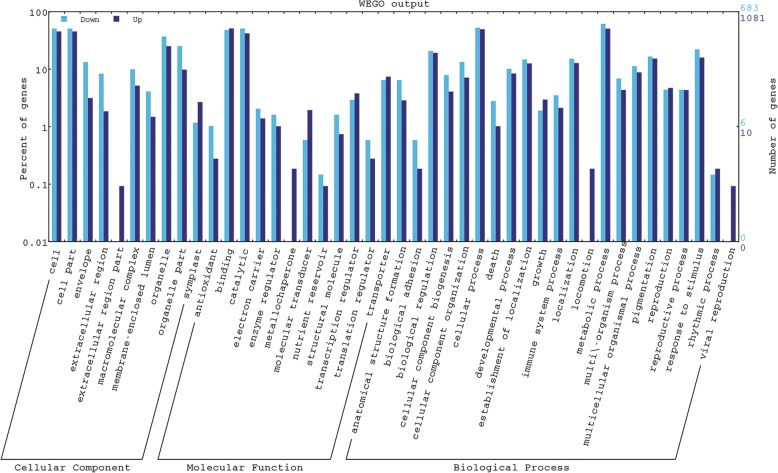
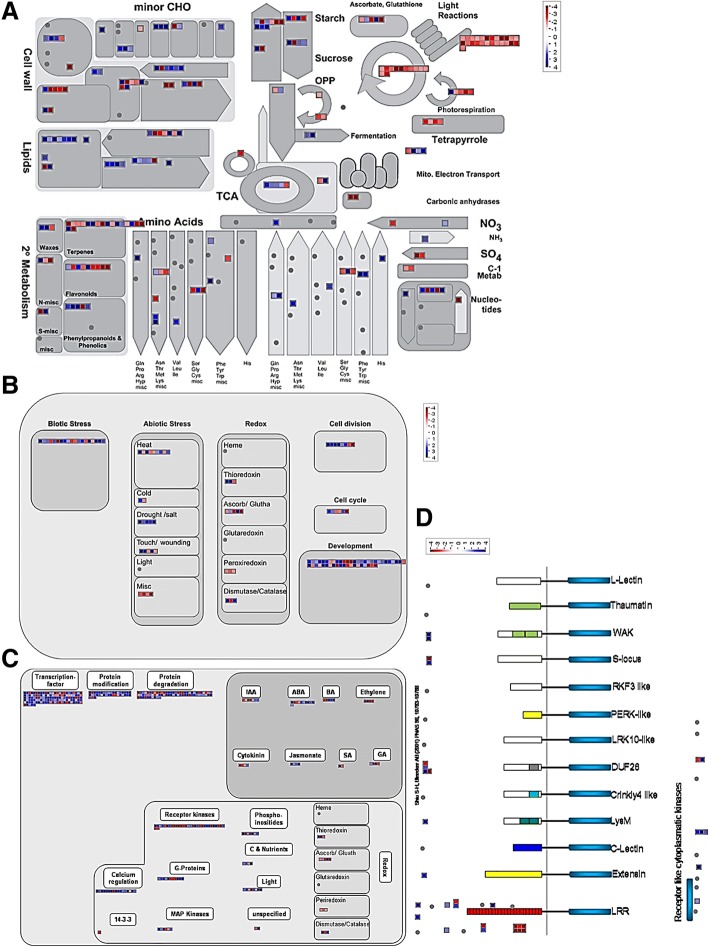
RNA-Seq transcriptome analysis was carried out in leaves of sweet orange grafted on 'Rangpur' lime subjected to control and drought-stress treatments, under greenhouse conditions, using the Illumina HiSeq platform. A total of 41,827 unique transcripts were identified, among which 1764 transcripts showed significant variation (P ≤ 0.001) between the treatments, with 1081 genes induced and 683 repressed by drought-stress treatment. The transcripts were distributed in 44 different categories of cellular component, molecular function and biological process. Several genes related to cell metabolism, including those involved in the metabolisms of cell wall, carbohydrates and antioxidants, light reactions, biotic and abiotic stress responses, as well as genes coding for transcription factors (TFs), protein kinases (PKs) and proteins involved in the abscisic acid (ABA) and ethylene signaling pathways, were differentially regulated by drought stress. RNA-Seq data were validated by quantitative real-time PCR (qPCR) analysis and comparative analysis of expression of the selected genes between sweet orange grafted on drought-tolerant and -sensitive rootstocks revealed new candidate genes for drought tolerance in citrus.
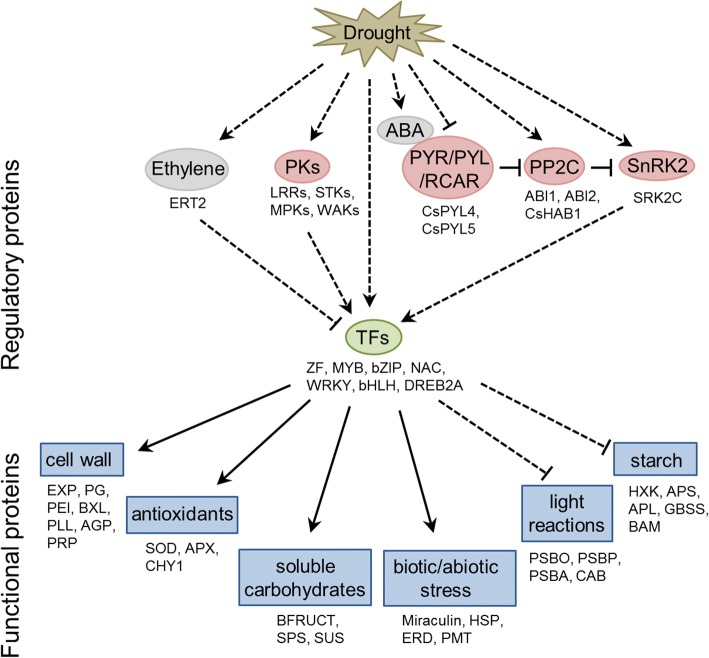
In conclusion, our results showed that only a relatively small but functionally diverse fraction of the sweet orange transcriptome, with functions in metabolism, cellular responses and regulation, was differentially regulated by drought stress. The data suggest that the rootstock-induced drought tolerance in sweet orange includes the transcriptional activation of genes related to the cell wall, soluble carbohydrate and antioxidant metabolisms, biotic and abiotic stress responses, TFs, PKs and ABA signaling pathway, and the downregulation of genes involved in the starch metabolism, light reactions and ethylene signaling. Future efforts to elucidate their functional roles and explore their potential in the citrus genetic improvement should benefit from this data.
柑橘植物通过嫁接进行商业繁殖,砧木品种影响许多园艺特性,包括耐旱性。在可用于柑橘繁殖的不同砧木品种中,与其他柑橘砧木相比,“Rangpur”酸橙被认为可增强耐旱性。本研究的目的是研究砧木诱导甜橙耐旱性的分子反应机制。
在温室条件下,使用 Illumina HiSeq 平台,对嫁接在“Rangpur”酸橙上的甜橙叶片进行 RNA-Seq 转录组分析,分别在对照和干旱胁迫处理下进行。共鉴定出 41827 个独特的转录本,其中 1764 个转录本在处理间差异显著(P≤0.001),1081 个基因受干旱胁迫诱导,683 个基因受干旱胁迫抑制。这些转录本分布在细胞成分、分子功能和生物过程的 44 个不同类别中。一些与细胞代谢相关的基因,包括细胞壁、碳水化合物和抗氧化剂代谢、光反应、生物和非生物胁迫反应以及涉及转录因子(TFs)、蛋白激酶(PKs)和参与脱落酸(ABA)和乙烯信号通路的蛋白的基因,受干旱胁迫的差异调控。通过定量实时 PCR(qPCR)分析对 RNA-Seq 数据进行验证,并对嫁接在耐旱和敏感砧木上的甜橙的选定基因表达进行比较分析,揭示了柑橘耐旱性的新候选基因。
总之,我们的结果表明,只有一小部分转录本(功能多样化)在代谢、细胞反应和调控方面的功能受干旱胁迫的差异调控。数据表明,甜橙的砧木诱导耐旱性包括与细胞壁、可溶性碳水化合物和抗氧化代谢、生物和非生物胁迫反应、TFs、PKs 和 ABA 信号通路相关基因的转录激活,以及与淀粉代谢、光反应和乙烯信号通路相关基因的下调。未来阐明其功能作用并探索其在柑橘遗传改良中的潜力的工作,应受益于这些数据。