Silva Luiz Eduardo Virgilio, Dias Daniel Penteado Martins, da Silva Carlos Alberto Aguiar, Salgado Hélio Cesar, Fazan Rubens
Department of Physiology, Ribeirão Preto Medical School, University of São Paulo, Ribeirão Preto, Brazil.
Barão de Mauá University Center, Ribeirão Preto, Brazil.
Front Neurosci. 2019 Jan 23;13:17. doi: 10.3389/fnins.2019.00017. eCollection 2019.
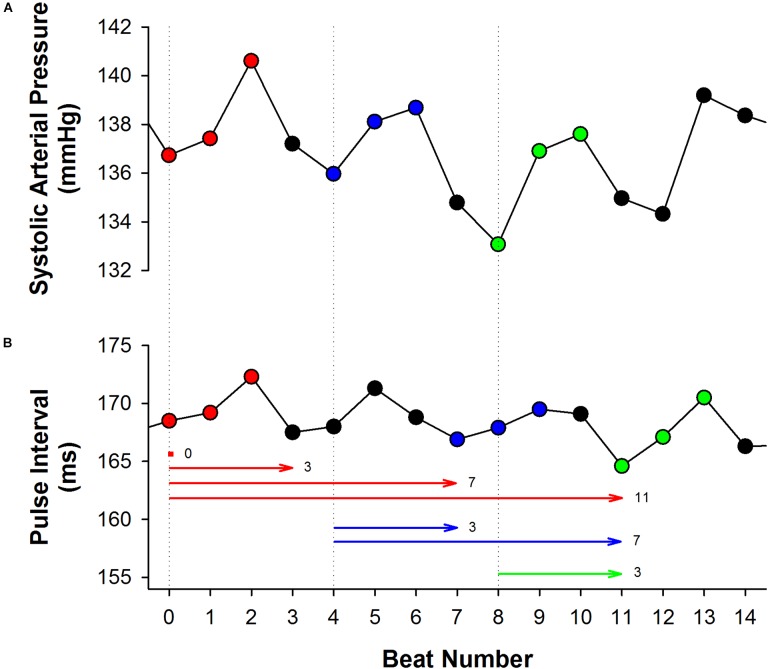
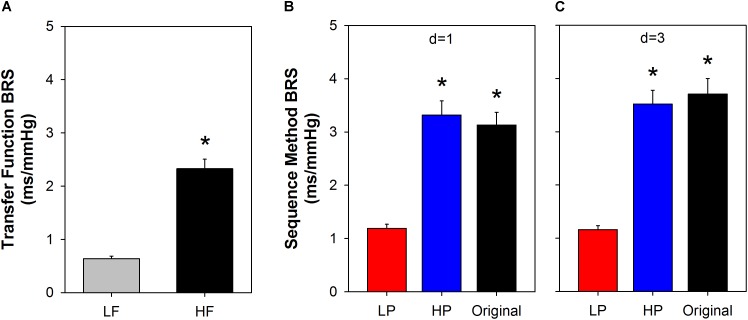
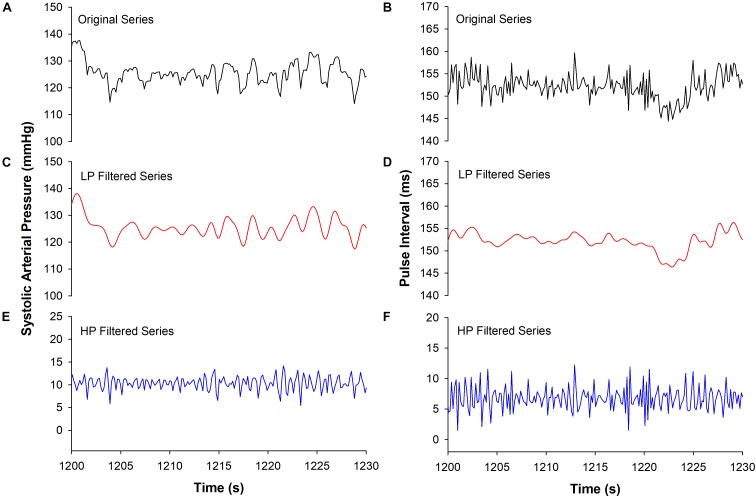
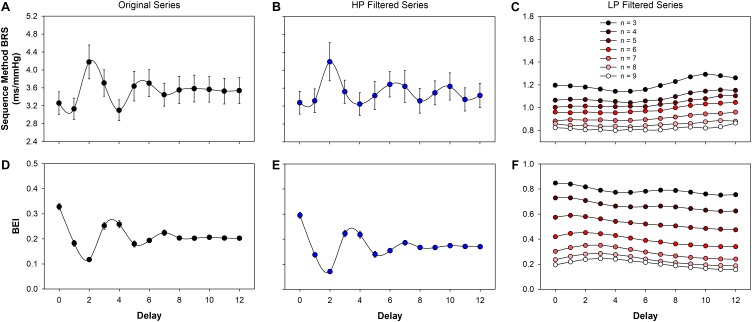
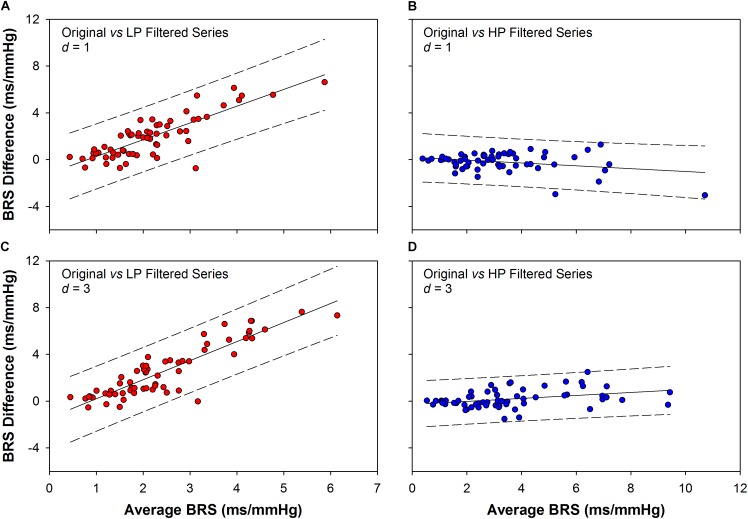
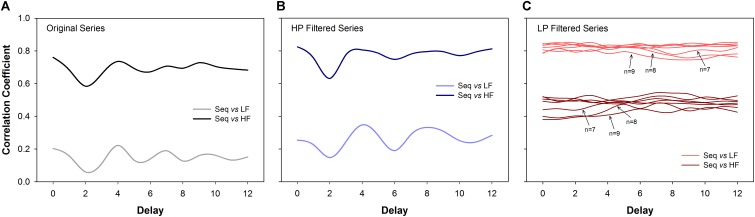
The sequence method is an important approach to assess the baroreflex function, mainly because it is based on the spontaneous fluctuations of beat-by-beat arterial pressure (for example, systolic arterial pressure or SAP) and pulse interval (PI). However, some studies revealed that the baroreflex effectiveness index (BEI), calculated through the sequence method, shows an intriguing oscillatory pattern as function of the delay between SAP and PI. It has been hypothesized that this pattern is related to the respiratory influence on SAP and/or PI variability, limiting the SAP ramps to 3 or 4 beats of length. In this study, this hypothesis was tested by assessing the sequence method using raw (original) and filtered series. Results were contrasted to the well-established transfer function, estimated between SAP and PI. Continuous arterial pressure recordings were obtained from healthy rats ( = 61) and beat-by-beat series of SAP and PI were generated. Low-pass (LP) and high-pass (HP) filtered series of SAP and PI were created by filtering the original series with a cutoff frequency of 0.8 Hz. Original series were analyzed by either the sequence method or cross-spectral analysis (transfer function) at low- (LF) and high- (HF) frequency bands, while filtered series were evaluated only by the sequence method. Baroreflex sensitivity (BRS) and BEI of original series, calculated by sequence method, was highly (85-90%) determined by HP series, with no significant association between original and LP series. A high correlation (>0.7) was found between the BRS estimated from original series (sequence method) and HF band (transfer function), as well as for LP series (sequence method) and LF band (transfer function). These findings confirmed the hypothesis that the sequence method quantifies only the high-frequency components of the baroreflex, neglecting the low-frequency influences, such as the Mayer waves. Therefore, we propose using both the original and LP filtered time series for a broader assessment of the baroreflex function using the sequence method.
序列法是评估压力反射功能的一种重要方法,主要是因为它基于逐搏动脉压(例如,收缩期动脉压或SAP)和脉搏间期(PI)的自发波动。然而,一些研究表明,通过序列法计算得到的压力反射有效性指数(BEI)呈现出一种有趣的振荡模式,它是SAP和PI之间延迟的函数。据推测,这种模式与呼吸对SAP和/或PI变异性的影响有关,将SAP斜坡限制在3或4个心动周期的长度。在本研究中,通过使用原始(未处理)和滤波后的序列评估序列法对这一假设进行了检验。将结果与在SAP和PI之间估计的成熟传递函数进行对比。从健康大鼠(n = 61)获取连续动脉压记录,并生成逐搏的SAP和PI序列。通过用截止频率为0.8 Hz的滤波器对原始序列进行滤波,创建了低通(LP)和高通(HP)滤波后的SAP和PI序列。原始序列在低频(LF)和高频(HF)频段通过序列法或互谱分析(传递函数)进行分析,而滤波后的序列仅通过序列法进行评估。通过序列法计算得到的原始序列的压力反射敏感性(BRS)和BEI,85 - 90%由HP序列高度决定,原始序列和LP序列之间无显著关联。在从原始序列(序列法)估计的BRS与HF频段(传递函数)之间,以及LP序列(序列法)与LF频段(传递函数)之间发现高度相关性(>0.7)。这些发现证实了如下假设:序列法仅量化压力反射的高频成分,而忽略了诸如迈耶波等低频影响。因此,我们建议使用原始和LP滤波后的时间序列,以便通过序列法对压力反射功能进行更全面的评估。