Bargiotas Ioannis, Moreau Albane, Vienne Alienor, Bompaire Flavie, Baruteau Marie, de Laage Marie, Campos Matéo, Psimaras Dimitri, Vayatis Nicolas, Labourdette Christophe, Vidal Pierre-Paul, Ricard Damien, Buffat Stéphane
UMR 8257 Cognition and Action Group (CNRS, Service de Santé des Armées, Université Paris Descartes Paris Sorbonne Cité), Paris, France.
CMLA, ENS Cachan, CNRS, Université Paris-Saclay, Cachan, France.
Front Neurol. 2019 Jan 23;9:1185. doi: 10.3389/fneur.2018.01185. eCollection 2018.
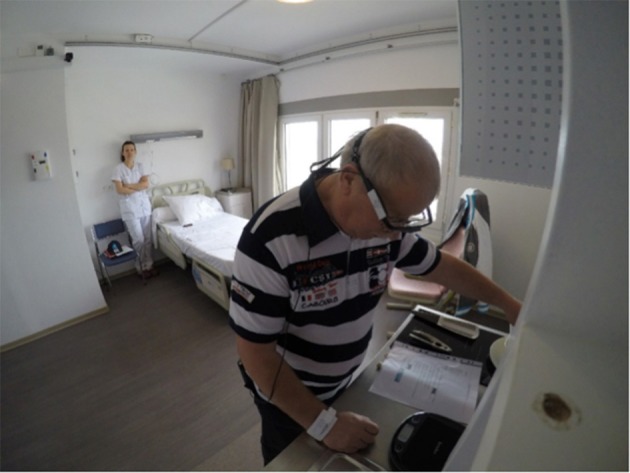
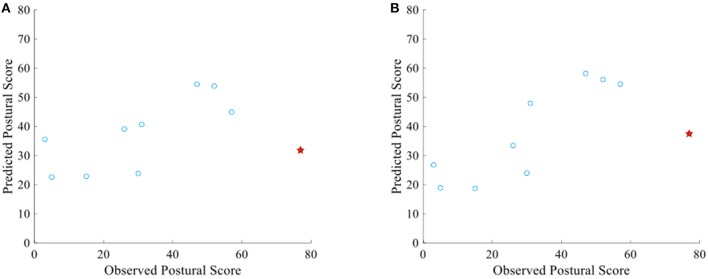
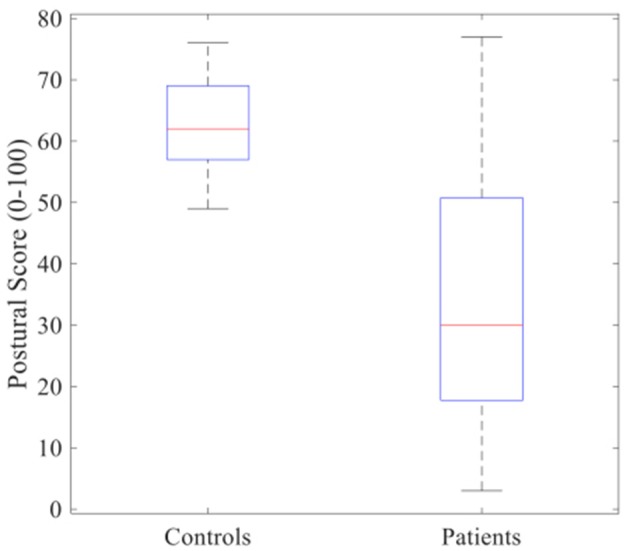
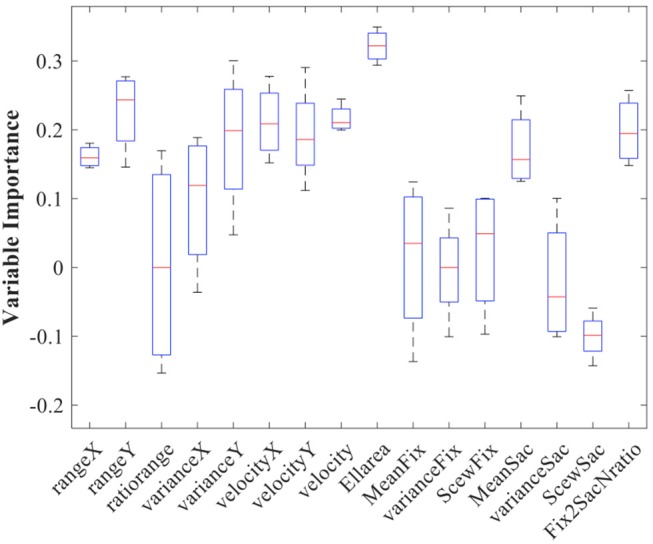
Recent studies have shown that alterations in executive function and attention lead to balance control disturbances. One way of exploring the allocation of attention is to record eye movements. Most experimental data come from a free viewing of static scenes but additional information can be leveraged by recording eye movements during natural tasks. Here, we aimed to provide evidence of a correlation between impaired visual alteration in natural tasks and postural control in patients suffering from Radiation-Induced Leukoencephalopathy (RIL). The study subjects were nine healthy controls and 10 patients who were diagnosed with RIL at an early stage, with isolated dysexecutive syndrome without clinically detectable gait or posture impairment. We performed a balance evaluation and eye movement recording during an ecological task (reading a recipe while cooking). We calculated a postural score and oculomotor parameters already proposed in the literature. We performed a variable selection using an out-of-bag random permutation and a random forest regression algorithm to find: (i) if visual parameters can predict postural deficit and, (ii) which are the most important of them in this prediction. Results were validated using the leave-one-out cross-validation procedure. Postural scores indeed were found significantly lower in patients with RIL than in healthy controls. Visual parameters were found able to predict the postural score of RIL patients with normalized root mean square error (RMSE) of 0.16. The present analysis showed that horizontal and vertical eye movements, as well as the average duration of the saccades and fixations influenced significantly the prediction of the postural score in RIL patients. While two patients with very low MATTIS-Attention sub score showed the lowest postural scores, no statistically significant relationship was found between the two outcomes. These results highlight the significant relationship between the severity of balance deficits and the visual characteristics in RIL patients. It seems that increased balance impairment is coupled with a reduced focusing capacity in ecological tasks. Balance and eye movement recordings during a natural task could be a useful aspect of multidimensional scoring of the dysexecutive syndrome.
最近的研究表明,执行功能和注意力的改变会导致平衡控制障碍。探索注意力分配的一种方法是记录眼球运动。大多数实验数据来自对静态场景的自由观看,但通过在自然任务中记录眼球运动可以利用额外的信息。在此,我们旨在提供证据,证明自然任务中视觉改变受损与放射性脑白质病(RIL)患者的姿势控制之间存在相关性。研究对象为9名健康对照者和10名早期诊断为RIL的患者,这些患者患有孤立性执行功能障碍综合征,临床上未检测到步态或姿势受损。我们在一项生态任务(烹饪时阅读食谱)中进行了平衡评估和眼球运动记录。我们计算了文献中已经提出的姿势评分和眼动参数。我们使用袋外随机排列和随机森林回归算法进行变量选择,以找出:(i)视觉参数是否可以预测姿势缺陷,以及(ii)在该预测中哪些是最重要的视觉参数。使用留一法交叉验证程序对结果进行验证。结果发现,RIL患者的姿势评分确实显著低于健康对照者。发现视觉参数能够以0.16的归一化均方根误差(RMSE)预测RIL患者的姿势评分。本分析表明,水平和垂直眼球运动以及扫视和注视的平均持续时间对RIL患者姿势评分的预测有显著影响。虽然两名MATTIS注意力子评分非常低的患者表现出最低的姿势评分,但在这两个结果之间未发现统计学上的显著关系。这些结果突出了RIL患者平衡缺陷严重程度与视觉特征之间的显著关系。似乎平衡障碍的增加与生态任务中注意力集中能力的降低有关。自然任务中的平衡和眼球运动记录可能是执行功能障碍综合征多维评分的一个有用方面。