Bargiotas Ioannis, Audiffren Julien, Vayatis Nicolas, Vidal Pierre-Paul, Buffat Stephane, Yelnik Alain P, Ricard Damien
CMLA, ENS Cachan, CNRS, Université Paris-Saclay, 94235 Cachan, France.
COGNAG-G UMR 8257, CNRS, SSA, Université Paris Descartes, Paris, France.
PLoS One. 2018 Feb 23;13(2):e0192868. doi: 10.1371/journal.pone.0192868. eCollection 2018.
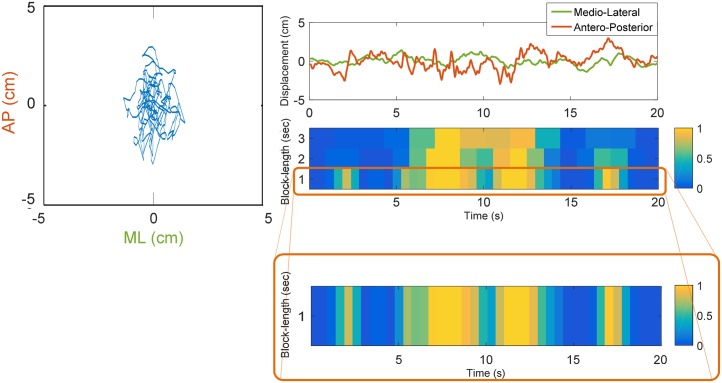
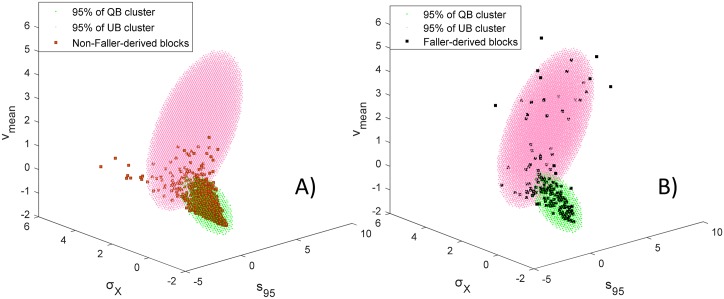
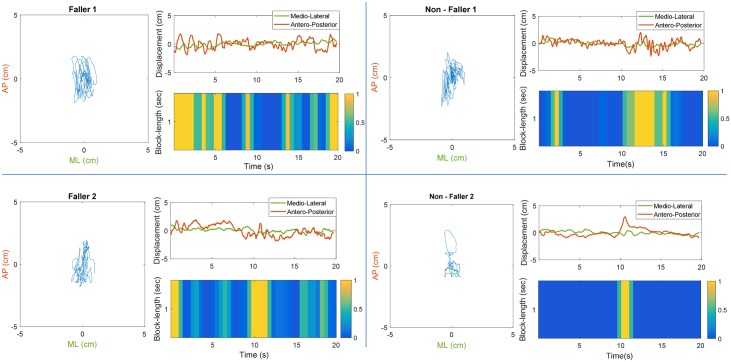
The fact that almost one third of population >65 years-old has at least one fall per year, makes the risk-of-fall assessment through easy-to-use measurements an important issue in current clinical practice. A common way to evaluate posture is through the recording of the center-of-pressure (CoP) displacement (statokinesigram) with force platforms. Most of the previous studies, assuming homogeneous statokinesigrams in quiet standing, used global parameters in order to characterize the statokinesigrams. However the latter analysis provides little information about local characteristics of statokinesigrams. In this study, we propose a multidimensional scoring approach which locally characterizes statokinesigrams on small time-periods, or blocks, while highlighting those which are more indicative to the general individual's class (faller/non-faller). Moreover, this information can be used to provide a global score in order to evaluate the postural control and classify fallers/non-fallers. We evaluate our approach using the statokinesigram of 126 community-dwelling elderly (78.5 ± 7.7 years). Participants were recorded with eyes open and eyes closed (25 seconds each acquisition) and information about previous falls was collected. The performance of our findings are assessed using the receiver operating characteristics (ROC) analysis and the area under the curve (AUC). The results show that global scores provided by splitting statokinesigrams in smaller blocks and analyzing them locally, classify fallers/non-fallers more effectively (AUC = 0.77 ± 0.09 instead of AUC = 0.63 ± 0.12 for global analysis when splitting is not used). These promising results indicate that such methodology might provide supplementary information about the risk of fall of an individual and be of major usefulness in assessment of balance-related diseases such as Parkinson's disease.
事实上,在65岁以上的人群中,近三分之一的人每年至少跌倒一次,这使得通过易于使用的测量方法进行跌倒风险评估成为当前临床实践中的一个重要问题。评估姿势的一种常见方法是通过力平台记录压力中心(CoP)位移(静态运动图)。以前的大多数研究假设安静站立时静态运动图是均匀的,使用全局参数来表征静态运动图。然而,后一种分析几乎没有提供关于静态运动图局部特征的信息。在本研究中,我们提出了一种多维评分方法,该方法在小时间段或块上对静态运动图进行局部表征,同时突出那些更能表明个体总体类别(跌倒者/非跌倒者)的特征。此外,这些信息可用于提供一个全局分数,以评估姿势控制并对跌倒者/非跌倒者进行分类。我们使用126名社区居住老年人(78.5±7.7岁)的静态运动图来评估我们的方法。记录参与者睁眼和闭眼时的情况(每次采集25秒),并收集有关既往跌倒的信息。我们使用受试者工作特征(ROC)分析和曲线下面积(AUC)来评估研究结果的性能。结果表明,将静态运动图分割成较小的块并进行局部分析所提供的全局分数,能更有效地对跌倒者/非跌倒者进行分类(AUC = 0.77±0.09,而不进行分割时全局分析的AUC = 0.63±0.12)。这些有前景的结果表明,这种方法可能会提供关于个体跌倒风险的补充信息,并且在评估帕金森病等与平衡相关的疾病中具有重要作用。