Salminen Iiro Ilmari, Crespi Bernard J, Mokkonen Mikael
Simon Fraser University, Burnaby, BC, Canada.
SAGE Open Med. 2019 Jan 28;7:2050312118823585. doi: 10.1177/2050312118823585. eCollection 2019.
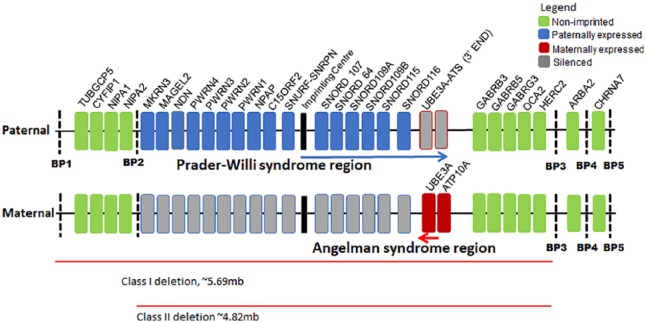
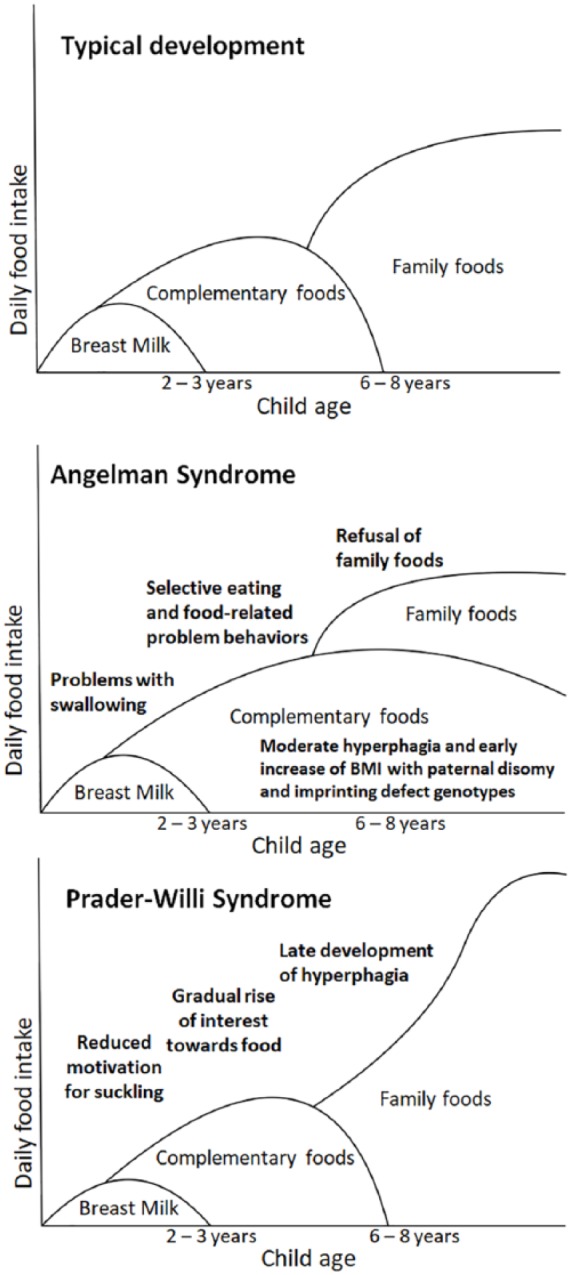
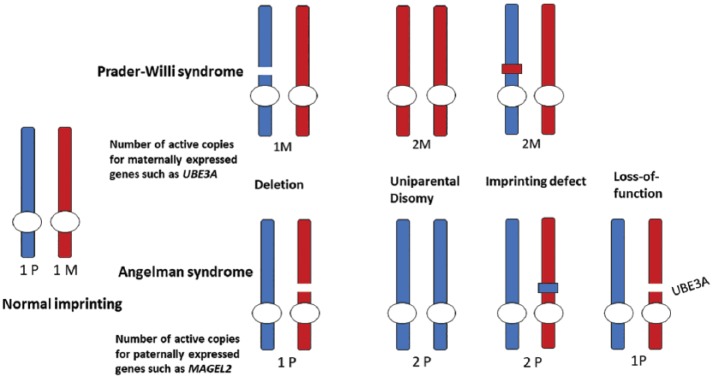
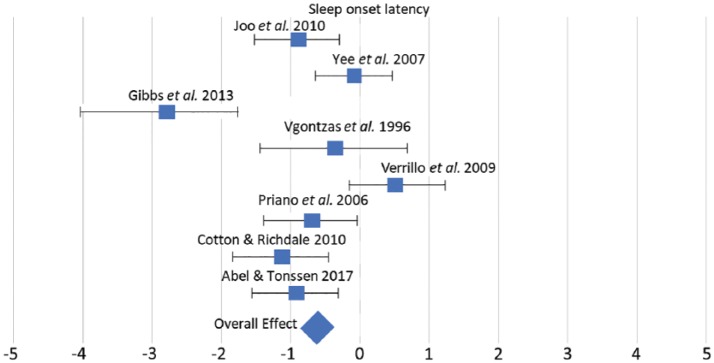
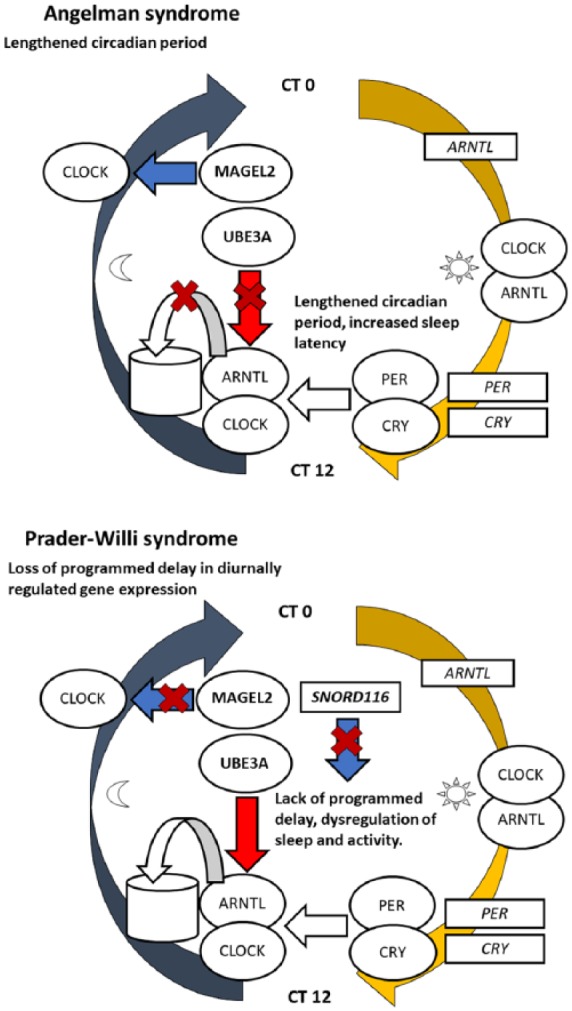
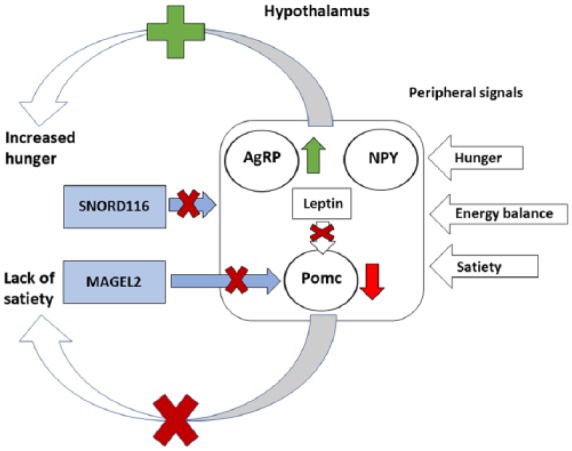
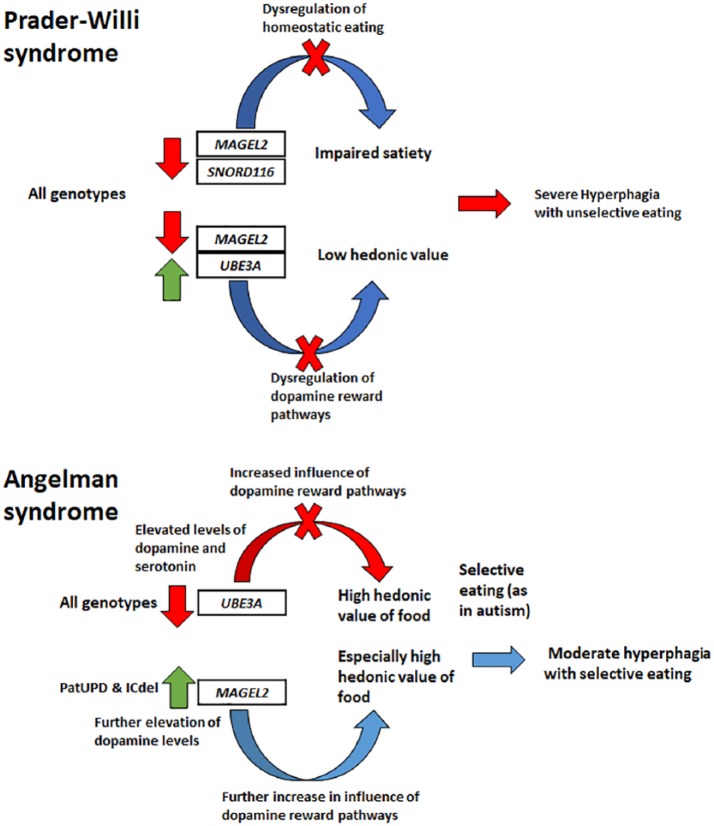
Prader-Willi and Angelman syndromes are often referred to as a sister pair of neurodevelopmental disorders, resulting from different genetic and epigenetic alterations to the same chromosomal region, 15q11-q13. Some of the primary phenotypes of the two syndromes have been suggested to be opposite to one another, but this hypothesis has yet to be tested comprehensively, and it remains unclear how opposite effects could be produced by changes to different genes in one syndrome compared to the other. We evaluated the evidence for opposite effects on sleep and eating phenotypes in Prader-Willi syndrome and Angelman syndrome, and developed physiological-genetic models that represent hypothesized causes of these differences. Sleep latency shows opposite deviations from controls in Prader-Willi and Angelman syndromes, with shorter latency in Prader-Willi syndrome by meta-analysis and longer latency in Angelman syndrome from previous studies. These differences can be accounted for by the effects of variable gene dosages of UBE3A and MAGEL2, interacting with clock genes, and leading to acceleration (in Prader-Willi syndrome) or deceleration (in Angelman syndrome) of circadian rhythms. Prader-Willi and Angelman syndromes also show evidence of opposite alterations in hyperphagic food selectivity, with more paternally biased subtypes of Angelman syndrome apparently involving increased preference for complementary foods ("baby foods"); hedonic reward from eating may also be increased in Angelman syndrome and decreased in Prader-Willi syndrome. These differences can be explained in part under a model whereby hyperphagia and food selectivity are mediated by the effects of the genes SNORD-116, UBE3A and MAGEL2, with outcomes depending upon the genotypic cause of Angelman syndrome. The diametric variation observed in sleep and eating phenotypes in Prader-Willi and Angelman syndromes is consistent with predictions from the kinship theory of imprinting, reflecting extremes of higher resource demand in Angelman syndrome and lower demand in Prader-Willi syndrome, with a special emphasis on social-attentional demands and attachment associated with bedtime, and feeding demands associated with mother-provided complementary foods compared to offspring-foraged family-type foods.
普拉德-威利综合征和安吉尔曼综合征常被称为一对神经发育障碍的姊妹病,它们是由同一染色体区域15q11-q13发生不同的基因和表观遗传改变所致。这两种综合征的一些主要表型被认为是相反的,但这一假说尚未得到全面验证,而且与另一种综合征相比,一种综合征中不同基因的变化如何产生相反的效应仍不清楚。我们评估了普拉德-威利综合征和安吉尔曼综合征对睡眠和饮食表型产生相反效应的证据,并建立了生理遗传模型来表示这些差异的假设原因。睡眠潜伏期在普拉德-威利综合征和安吉尔曼综合征中与对照组相比呈现相反的偏差,通过荟萃分析发现普拉德-威利综合征的潜伏期较短,而先前的研究表明安吉尔曼综合征的潜伏期较长。这些差异可以通过UBE3A和MAGEL2基因剂量变化与生物钟基因相互作用来解释,从而导致昼夜节律加速(在普拉德-威利综合征中)或减速(在安吉尔曼综合征中)。普拉德-威利综合征和安吉尔曼综合征在贪食性食物选择性方面也显示出相反改变的证据,安吉尔曼综合征中更多父系偏向的亚型显然对辅食(“婴儿食品”)的偏好增加;安吉尔曼综合征中进食带来的享乐性奖励可能也会增加,而普拉德-威利综合征中则会减少。这些差异部分可以在一个模型中得到解释,即贪食和食物选择性是由基因SNORD-116、UBE3A和MAGEL2的作用介导的,其结果取决于安吉尔曼综合征的基因型病因。在普拉德-威利综合征和安吉尔曼综合征中观察到的睡眠和饮食表型的截然变化与印记亲属关系理论的预测一致,反映了安吉尔曼综合征中更高资源需求和普拉德-威利综合征中更低需求的极端情况,特别强调与就寝时间相关的社会注意力需求和依恋,以及与母亲提供的辅食相比后代觅食的家庭型食物相关的喂养需求。