Shimasaki Suzuho, Bishop Erin, Guthrie Michelle, Thomas John F Fred
ECHO Colorado, Aurora, CO, USA.
Colorado School of Public Health, University of Colorado - Anschutz Medical Campus, Aurora, CO, USA.
J Med Educ Curric Dev. 2019 Jan 15;6:2382120518820922. doi: 10.1177/2382120518820922. eCollection 2019 Jan-Dec.
Project Extension for Community Health Outcomes (ECHO) was originally developed by the University of New Mexico's Health Science Center (UNMHSC) to build the capacities of primary-care providers and to increase specialty-care access to rural and underserved populations. ECHO Colorado, a replication site at the University of Colorado Anschutz Medical Campus (CUAMC), was developed with the same purpose and to help build the health workforce of Colorado. The CUAMC and its community-based partners recognized that by reducing unnecessary referrals to the medical campus and building primary-care capacity in communities, both would increase their scope and expand overall capacity. This study examines the key factors that influence participant engagement, how participants value the ECHO experience, and the utility of the ECHO Colorado experience according to participants.
This study used a mixed-methods approach including 42 interviews and 34 completed surveys. Transcribed interview recordings were coded in NVivo 11, and codes were queried in NVivo and Excel to identify key themes. Survey responses were analyzed in SPSS. Data were examined between and across four attendance groups and triangulated to assess the reliability of the data and validity of overall findings.
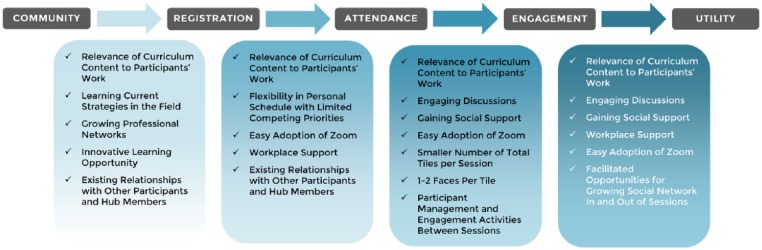
Key factors increasing registrant engagement included relevant and practical curriculum content; strong and supportive relationships among learners, ECHO faculty, and workplace colleagues; and innovative learning approaches that included opportunities for active, virtual participation through technology, participant management activities, and ECHO's unique curriculum design.
Findings from this study validated many of the important elements of ECHO Colorado that make it unique from other iterations of the model being implemented nationally and internationally and identified participant-driven strategies for further amplifying its impact.
社区卫生成果项目拓展(ECHO)最初由新墨西哥大学健康科学中心(UNMHSC)开发,旨在提升初级保健提供者的能力,并增加农村及服务不足人群获得专科护理的机会。科罗拉多州ECHO是科罗拉多大学安舒茨医学校区(CUAMC)的一个复制站点,其开发目的相同,旨在助力打造科罗拉多州的卫生人力队伍。CUAMC及其社区合作伙伴认识到,通过减少不必要的转诊至医学校区以及在社区建立初级保健能力,双方都将扩大其服务范围并提升整体能力。本研究考察了影响参与者参与度的关键因素、参与者如何评价ECHO体验,以及参与者眼中科罗拉多州ECHO体验的效用。
本研究采用混合方法,包括42次访谈和34份完整的调查问卷。转录后的访谈录音在NVivo 11中进行编码,并在NVivo和Excel中查询代码以识别关键主题。调查问卷的回复在SPSS中进行分析。在四个出勤组之间及组内对数据进行检验,并进行三角互证以评估数据的可靠性和总体研究结果的有效性。
提高注册者参与度的关键因素包括相关且实用的课程内容;学习者、ECHO教员和工作场所同事之间牢固且相互支持的关系;以及创新的学习方法,包括通过技术进行积极虚拟参与的机会、参与者管理活动以及ECHO独特的课程设计。
本研究结果验证了科罗拉多州ECHO许多使其有别于在国内和国际实施的该模式其他版本的重要元素,并确定了由参与者驱动的策略以进一步扩大其影响。