Midwestern University, Department of Physiology, Glendale, Arizona, United States of America.
University of Utah, National Center for Voice and Speech, Salt Lake City, Utah, United States of America.
PLoS Biol. 2019 Feb 7;17(2):e2006507. doi: 10.1371/journal.pbio.2006507. eCollection 2019 Feb.
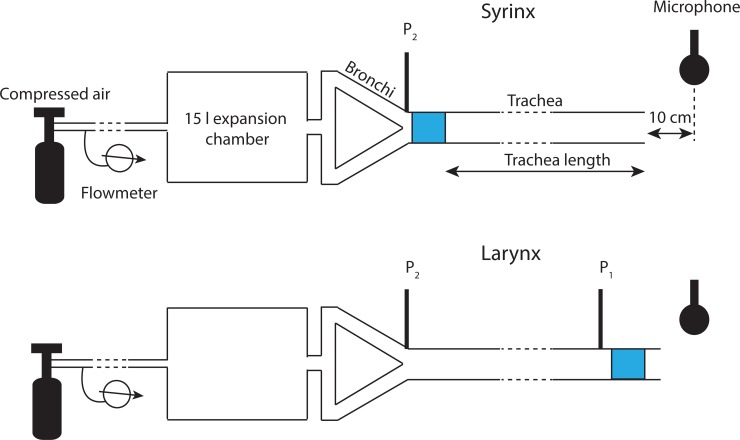
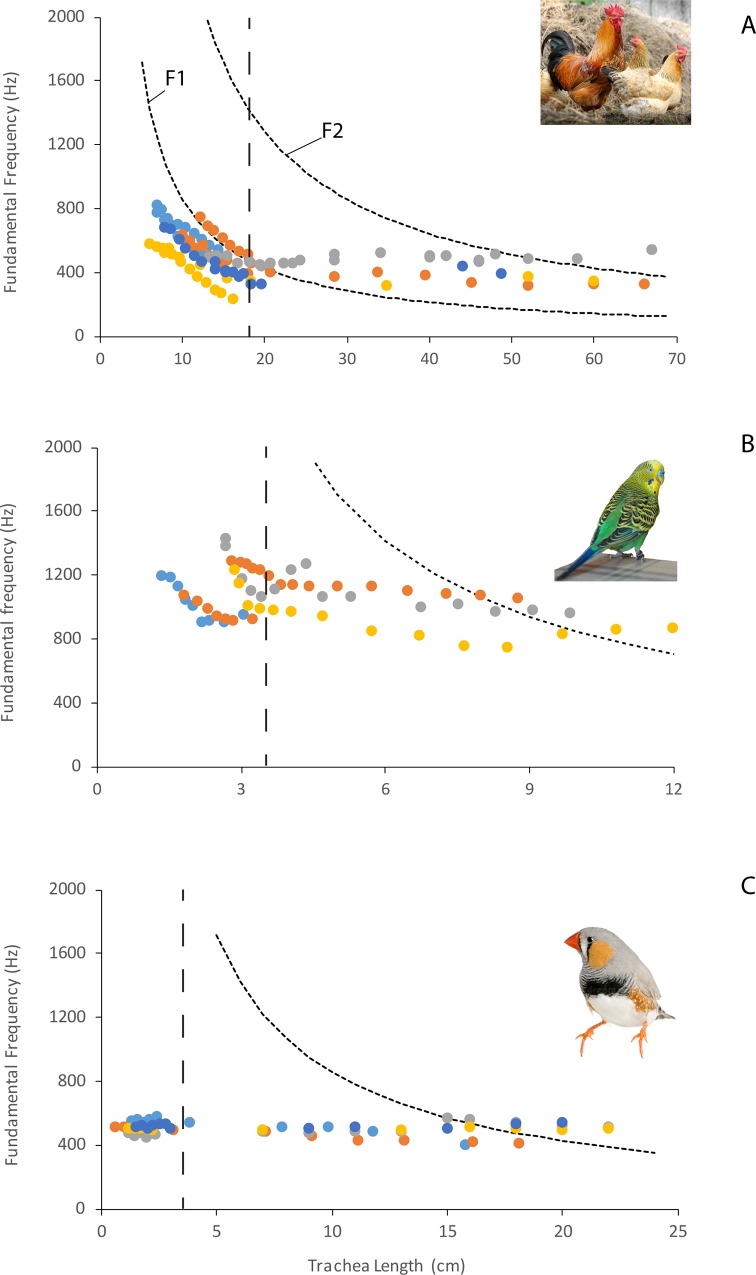
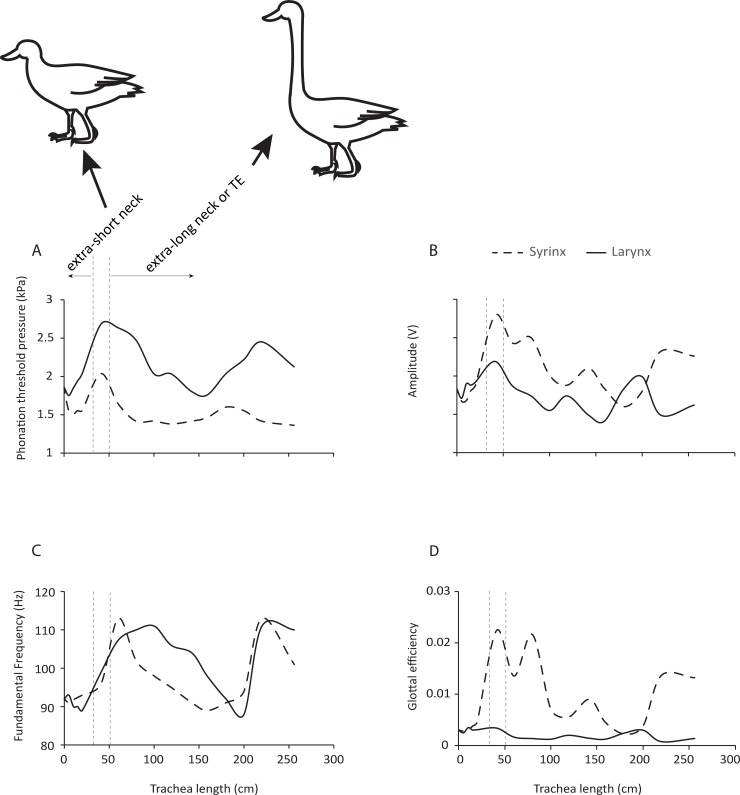
The unique avian vocal organ, the syrinx, is located at the caudal end of the trachea. Although a larynx is also present at the opposite end, birds phonate only with the syrinx. Why only birds evolved a novel sound source at this location remains unknown, and hypotheses about its origin are largely untested. Here, we test the hypothesis that the syrinx constitutes a biomechanical advantage for sound production over the larynx with combined theoretical and experimental approaches. We investigated whether the position of a sound source within the respiratory tract affects acoustic features of the vocal output, including fundamental frequency and efficiency of conversion from aerodynamic energy to sound. Theoretical data and measurements in three bird species suggest that sound frequency is influenced by the interaction between sound source and vocal tract. A physical model and a computational simulation also indicate that a sound source in a syringeal position produces sound with greater efficiency. Interestingly, the interactions between sound source and vocal tract differed between species, suggesting that the syringeal sound source is optimized for its position in the respiratory tract. These results provide compelling evidence that strong selective pressures for high vocal efficiency may have been a major driving force in the evolution of the syrinx. The longer trachea of birds compared to other tetrapods made them likely predisposed for the evolution of a syrinx. A long vocal tract downstream from the sound source improves efficiency by facilitating the tuning between fundamental frequency and the first vocal tract resonance.
鸟类独特的发声器官——鸣管位于气管的尾部。尽管气管的另一端也存在喉头,但鸟类仅通过鸣管发声。为什么只有鸟类在这个位置进化出了新颖的声源,目前仍不得而知,关于其起源的假说也在很大程度上未经检验。在这里,我们通过理论和实验相结合的方法来检验鸣管作为发声的生物力学优势的假说,即它相对于喉头而言,更有利于产生声音。我们研究了声源在呼吸道内的位置是否会影响发声输出的声学特征,包括基频以及气流能量向声音的转化效率。三个鸟类物种的理论数据和测量结果表明,声音频率受到声源和声道之间相互作用的影响。物理模型和计算模拟也表明,位于鸣管位置的声源能产生更高效的声音。有趣的是,声源与声道之间的相互作用在不同物种之间存在差异,这表明鸣管声源针对其在呼吸道中的位置进行了优化。这些结果为强有力地证明了,强烈的高效发声选择性压力可能是鸣管进化的主要驱动力。与其他四足动物相比,鸟类的气管更长,这使得它们更容易进化出鸣管。在声源的下游,较长的声道通过促进基频与第一声道共振之间的调谐,提高了效率。