Department of Agriculture, Food and Environment, University of Pisa, Pisa, Italy.
Department of Agricultural, Food and Environmental Sciences (DSA3), University of Perugia, Perugia, Italy.
PLoS One. 2019 Feb 7;14(2):e0211573. doi: 10.1371/journal.pone.0211573. eCollection 2019.
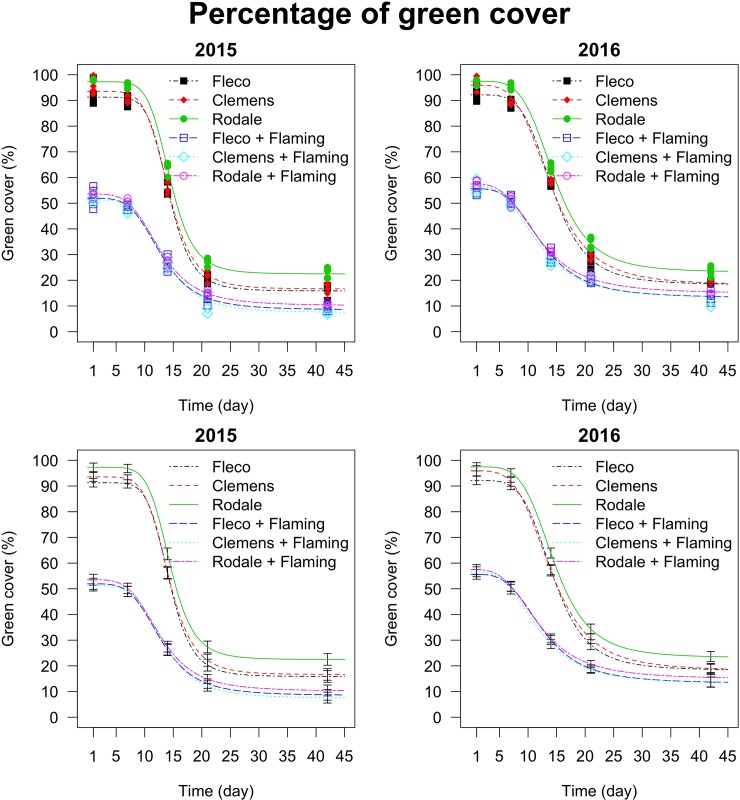
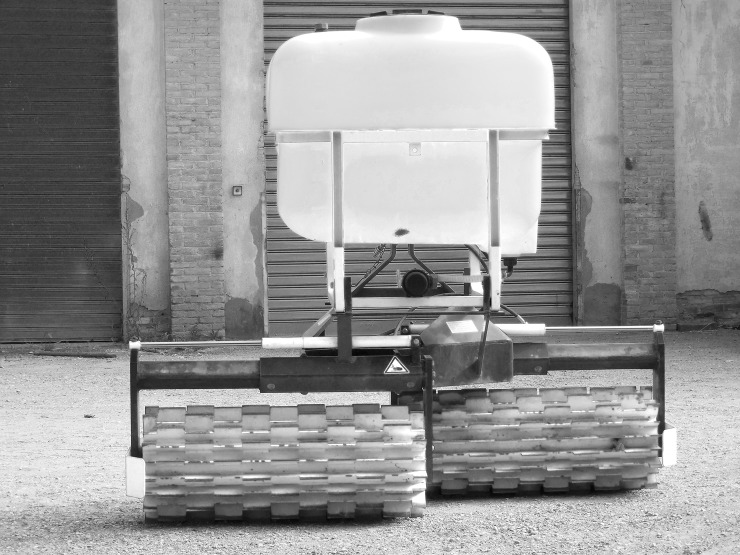
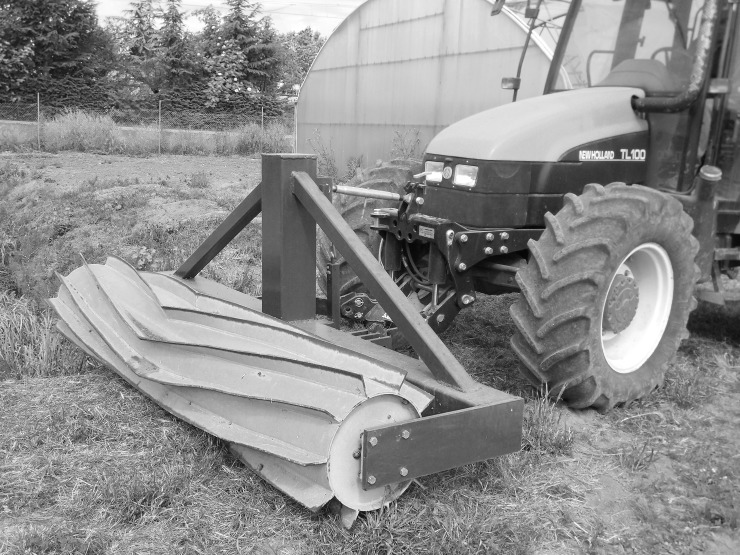
The termination of cover crops in conventional no-till systems is mostly conducted mechanically in combination with herbicides. Combining flaming and roller crimpers could be a viable solution to avoid using herbicides for cover crop termination in farming systems where herbicides are banned, or at least to reduce their use in an integrated management approach. This research tested the effects of flaming used in combination with three different types of roller crimpers to terminate a fall-sown cover crop mixture of winter pea and barley. The cover crop termination rate was visually assessed in terms of percentage of green cover provided by cover crop plants at different intervals from the termination date, and estimated using a log-logistic non-linear regression model with four parameters. Machine performance data are also reported. The results show that, irrespective of the roller type, flaming significantly boosted the effect of the roller crimpers. In fact, an economic threshold for cover crop suppression of 85% was reached only when the rollers were used in combination with flaming. Nevertheless, none of the methods were able to reach the 100% of cover crop suppression. In some case, the combined use of flaming and roller crimpers allowed reaching the 90% of cover crop devitalisation, which happened six weeks after the termination date. More importantly, the use of flaming in combination with rollers shortened the time needed to achieve the estimated levels of devitalisation, compared with the rollers used alone. We conclude that flaming is an effective tool to increase the effectiveness of roller crimpers. Nevertheless, further research is needed to identify solutions to overcome the barrier of the high operational costs of flaming, which is constraining its wider adoption by farmers. Future studies could focus, for instance, on the development of a new prototype of combined machine for crimping and flaming the cover crops simultaneously, which could potentially reduce the operational costs.
传统免耕系统中,覆盖作物的终止大多是与除草剂结合进行机械处理。在禁止使用除草剂或至少在综合管理方法中减少除草剂使用的农业系统中,结合火烧和辊式压捆机能为免耕覆盖作物的终止提供一种可行的解决方案。本研究测试了火烧与三种不同类型的辊式压捆机结合使用来终止秋季播种的冬豌豆和大麦覆盖作物混合物的效果。根据从终止日期开始不同时间间隔的覆盖作物植物提供的绿色覆盖百分比,通过带有四个参数的对数逻辑非线性回归模型对覆盖作物终止率进行了视觉评估,并进行了估计。还报告了机器性能数据。结果表明,无论辊式压捆机的类型如何,火烧都显著增强了辊式压捆机的效果。实际上,只有当滚轮与火烧结合使用时,才能达到 85%的覆盖作物抑制经济阈值。然而,没有一种方法能够达到 100%的覆盖作物抑制。在某些情况下,结合使用火烧和辊式压捆机可以达到 90%的覆盖作物失活,这发生在终止日期后六周。更重要的是,与单独使用辊式压捆机相比,火烧与辊式压捆机的结合使用缩短了达到估计失活水平所需的时间。我们得出结论,火烧是一种提高辊式压捆机效果的有效工具。然而,需要进一步研究以找到克服火烧高运营成本障碍的解决方案,这限制了农民更广泛地采用。未来的研究可以集中于开发一种同时压捆和火烧覆盖作物的新型联合机器的原型,这可能会降低运营成本。