Fernando Margaret, Shrestha Anil
Department of Plant Science, California State University, Fresno, CA 93740, USA.
Plants (Basel). 2023 Feb 8;12(4):752. doi: 10.3390/plants12040752.
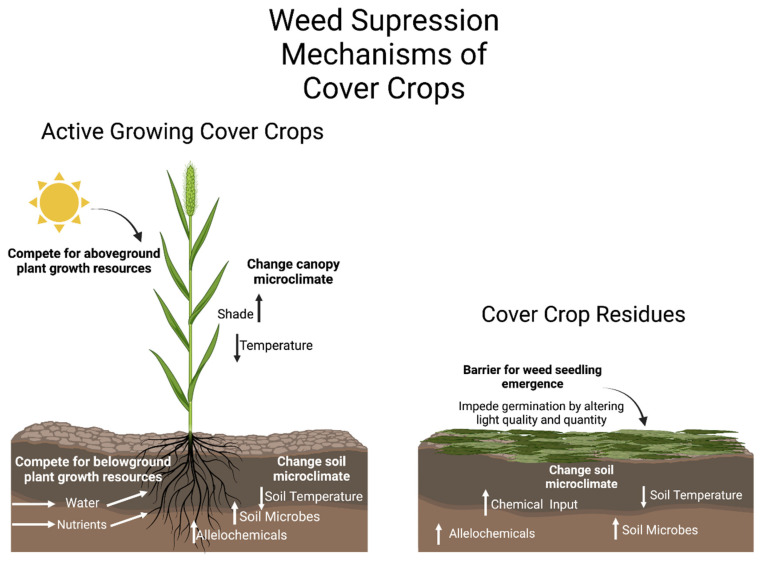
Cover crops are an important component of integrated weed management programs in annual and perennial cropping systems because of their weed suppressive abilities. They influence weed populations using different mechanisms of plant interaction which can be facilitative or suppressive. However, the question often arises if cover crops can be solely relied upon for weed management or not. In this review we have tried to provide examples to answer this question. The most common methods of weed suppression by an actively growing cover crop include competition for limited plant growth resources that result in reduced weed biomass, seed production, and hence reductions in the addition of seeds to the soil seedbank. Cover crop mulches suppress weeds by reducing weed seedling emergence through allelopathic effects or physical effects of shading. However, there is a great degree of variability in the success or failure of cover crops in suppressing weeds that are influenced by the cover crop species, time of planting, cover crop densities and biomass, time of cover crop termination, the cash crop following in the rotation, and the season associated with several climatic variables. Several studies demonstrated that planting date was important to achieve maximum cover crop biomass, and a mixture of cover crop species was better than single cover crop species to achieve good weed suppression. Most of the studies that have demonstrated success in weed suppression have only shown partial success and not total success in weed suppression. Therefore, cover crops as a sole tool may not be sufficient to reduce weeds and need to be supplemented with other weed management tools. Nevertheless, cover crops are an important component of the toolbox for integrated weed management.
覆盖作物因其抑制杂草的能力,是一年生和多年生作物种植系统中综合杂草管理计划的重要组成部分。它们通过不同的植物相互作用机制影响杂草种群,这些机制可能是促进性的或抑制性的。然而,覆盖作物是否能单独用于杂草管理的问题经常出现。在本综述中,我们试图提供实例来回答这个问题。生长旺盛的覆盖作物抑制杂草的最常见方法包括竞争有限的植物生长资源,这会导致杂草生物量和种子产量降低,从而减少土壤种子库中种子的增加。覆盖作物覆盖物通过化感作用或遮荫的物理作用减少杂草幼苗出土,从而抑制杂草。然而,覆盖作物在抑制杂草方面的成败存在很大差异,这受到覆盖作物种类、种植时间、覆盖作物密度和生物量、覆盖作物终止时间、轮作中的后续经济作物以及与几个气候变量相关的季节的影响。几项研究表明,种植日期对于实现最大覆盖作物生物量很重要,混合种植覆盖作物种类比单一覆盖作物种类在抑制杂草方面效果更好。大多数在杂草抑制方面取得成功的研究仅显示了部分成功,而非完全成功。因此,仅将覆盖作物作为一种工具可能不足以减少杂草,需要辅以其他杂草管理工具。尽管如此,覆盖作物是综合杂草管理工具箱的重要组成部分。