Mallinckrodt Institute of Radiology, Washington University School of Medicine, St. Louis, Missouri
Mallinckrodt Institute of Radiology, Washington University School of Medicine, St. Louis, Missouri.
J Nucl Med. 2019 Aug;60(8):1080-1086. doi: 10.2967/jnumed.118.218735. Epub 2019 Feb 7.
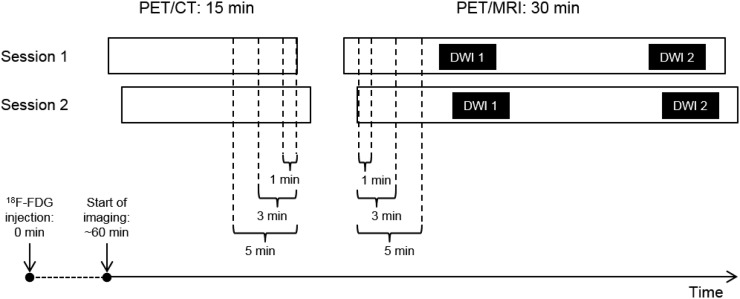
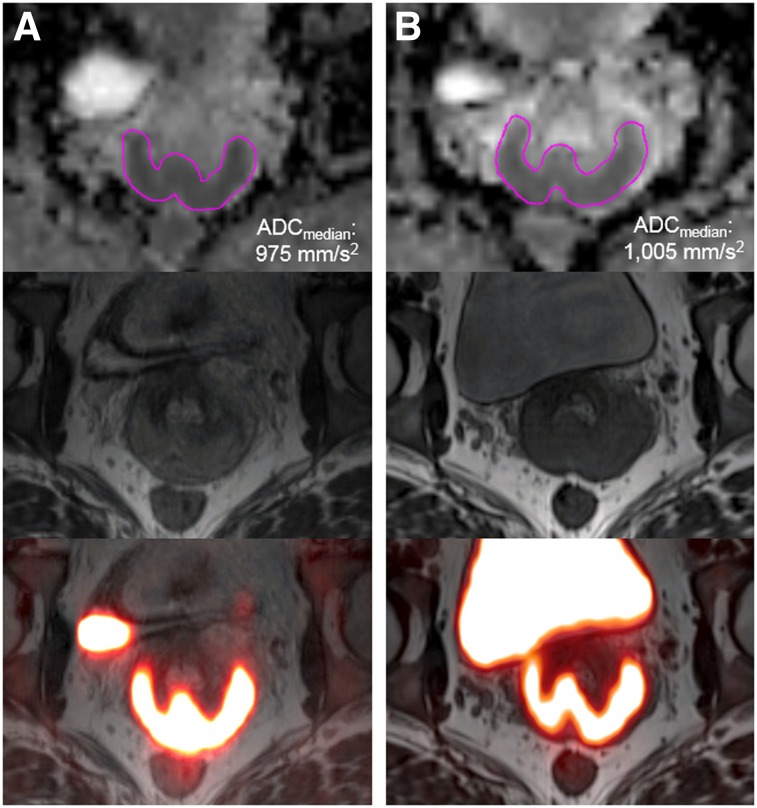
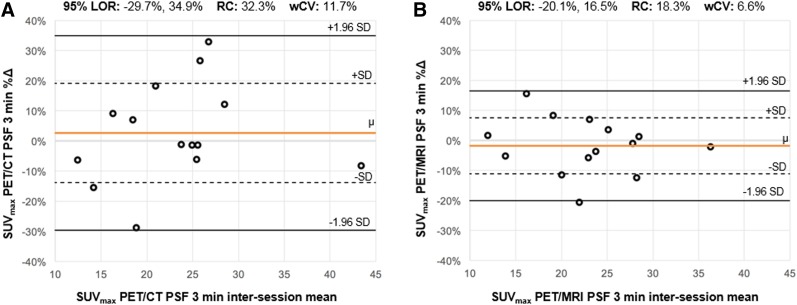
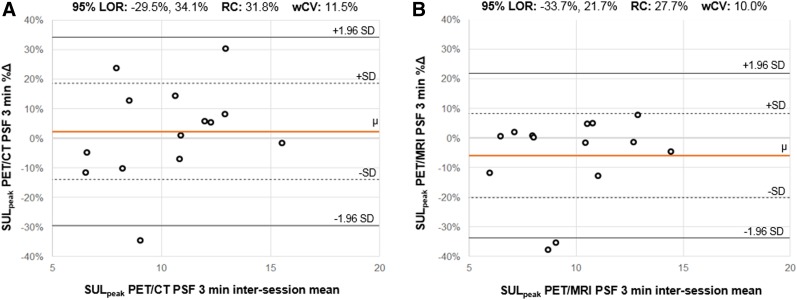
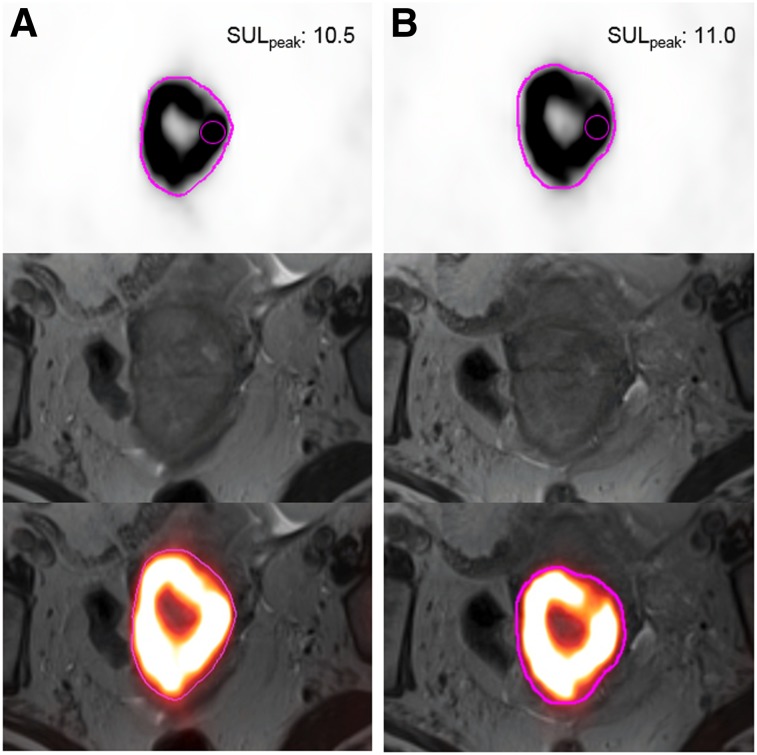
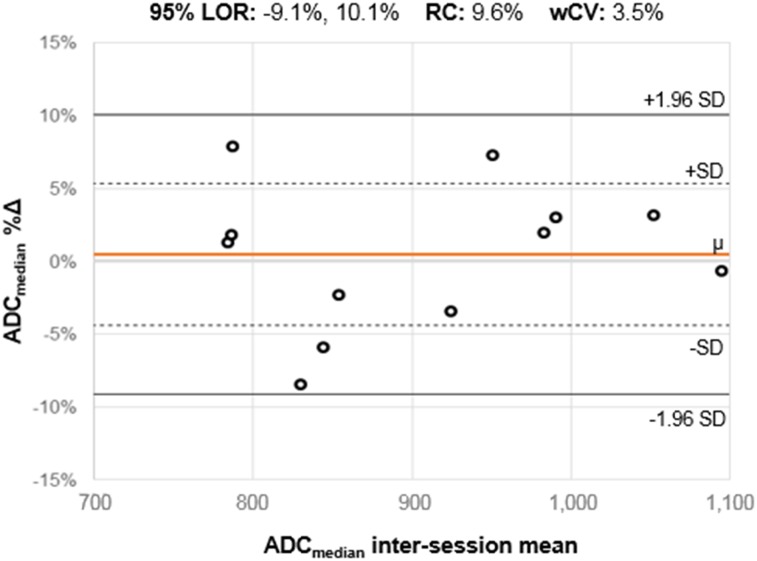
Knowledge of the within-subject variability of F-FDG PET/MRI measurements is necessary for proper interpretation of quantitative PET or MRI metrics in the context of therapeutic efficacy assessments with integrated PET/MRI scanners. The goal of this study was to determine the test-retest repeatability of these metrics on PET/MRI, with comparison to similar metrics acquired by PET/CT. This prospective study enrolled subjects with pathology-proven pelvic malignancies. Baseline imaging consisted of PET/CT immediately followed by PET/MRI, using a single 370-MBq F-FDG dose. Repeat imaging was performed within 7 d using an identical imaging protocol, with no oncologic therapy between sessions. PET imaging on both scanners consisted of a list-mode acquisition at a single pelvic station. The MRI consisted of 2-point Dixon imaging for attenuation correction, standard sequences for anatomic correlation, and diffusion-weighted imaging. PET data were statically reconstructed using various frame durations and minimizing uptake time differences between sessions. SUV metrics were extracted for both PET/CT and PET/MRI in each imaging session. Apparent diffusion coefficient (ADC) metrics were extracted for both PET/MRI sessions. The study cohort consisted of 14 subjects (13 female, 1 male) with various pelvic cancers (11 cervical, 2 rectal, 1 endometrial). For SUV, the within-subject coefficient of variation (wCV) appeared higher for PET/CT (8.5%-12.8%) than PET/MRI (6.6%-8.7%) across all PET reconstructions, though with no significant repeatability differences (all values ≥ 0.08) between modalities. For lean body mass-adjusted SUV, the wCVs appeared similar for PET/CT (9.9%-11.5%) and PET/MRI (9.2%-11.3%) across all PET reconstructions, again with no significant repeatability differences (all values ≥ 0.14) between modalities. For PET/MRI, the wCV for ADC of 3.5% appeared lower than the wCVs for SUV (6.6%-8.7%) and SUL (9.2%-11.3%), though without significant repeatability differences (all values ≥ 0.23). For solid tumors of the pelvis, the repeatability of the evaluated SUV and ADC metrics on F-FDG PET/MRI is both acceptably high and similar to previously published values for F-FDG PET/CT and MRI, supporting the use of F-FDG PET/MRI for quantitative oncologic treatment response assessments.
在使用集成 PET/MRI 扫描仪进行治疗效果评估的情况下,为了正确解释定量 PET 或 MRI 指标,需要了解 F-FDG PET/MRI 测量的个体内可变性。本研究的目的是确定这些指标在 PET/MRI 上的测试-重测可重复性,并与通过 PET/CT 获得的类似指标进行比较。这项前瞻性研究纳入了经病理证实的盆腔恶性肿瘤患者。基线成像包括 PET/CT 立即后紧接着进行 PET/MRI,使用单次 370-MBq F-FDG 剂量。在没有肿瘤治疗的情况下,在 7 天内使用相同的成像方案进行重复成像。两台扫描仪上的 PET 成像均采用单盆腔站的列表模式采集。MRI 包括 2 点 Dixon 成像用于衰减校正、标准序列用于解剖相关以及扩散加权成像。使用各种帧持续时间和最小化会话之间摄取时间差异对 PET 数据进行静态重建。在每个成像会话中,均从 PET/CT 和 PET/MRI 中提取 SUV 指标。从两次 PET/MRI 会话中提取表观扩散系数 (ADC) 指标。研究队列包括 14 名患者(13 名女性,1 名男性),患有各种盆腔癌(11 名宫颈癌、2 名直肠癌、1 名子宫内膜癌)。对于 SUV,所有 PET 重建中,PET/CT 的个体内变异系数(wCV)(8.5%-12.8%)似乎高于 PET/MRI(6.6%-8.7%),尽管两种模式之间的重复性差异无统计学意义(所有 值≥0.08)。对于瘦体重校正后的 SUV,所有 PET 重建中,PET/CT(9.9%-11.5%)和 PET/MRI(9.2%-11.3%)的 wCV 似乎相似,两种模式之间的重复性差异也无统计学意义(所有 值≥0.14)。对于 PET/MRI,3.5%的 ADC 的 wCV 似乎低于 SUV(6.6%-8.7%)和 SUL(9.2%-11.3%)的 wCV,尽管没有统计学意义(所有 值≥0.23)。对于骨盆的实体肿瘤,在 F-FDG PET/MRI 上评估的 SUV 和 ADC 指标的重复性均较高且与之前发表的 F-FDG PET/CT 和 MRI 结果相似,支持使用 F-FDG PET/MRI 进行定量肿瘤治疗反应评估。