Institute of Macromolecular Chemistry, Czech Academy of Sciences, Heyrovského nám. 2, 162 06, Prague 6, Czech Republic.
Department of Nanobiotechnology, Biology Centre, ISB, Czech Academy of Sciences, Na Sádkách 7, 370 05, České Budějovice, Czech Republic.
Sci Rep. 2019 Feb 7;9(1):1543. doi: 10.1038/s41598-018-38012-5.
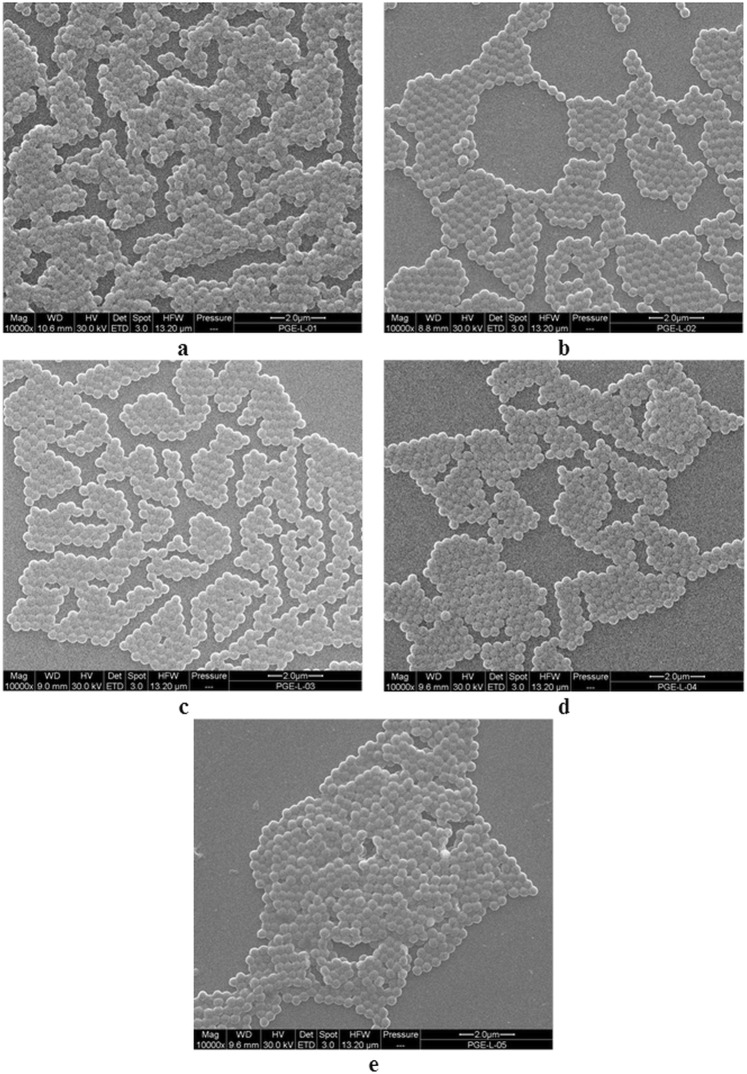
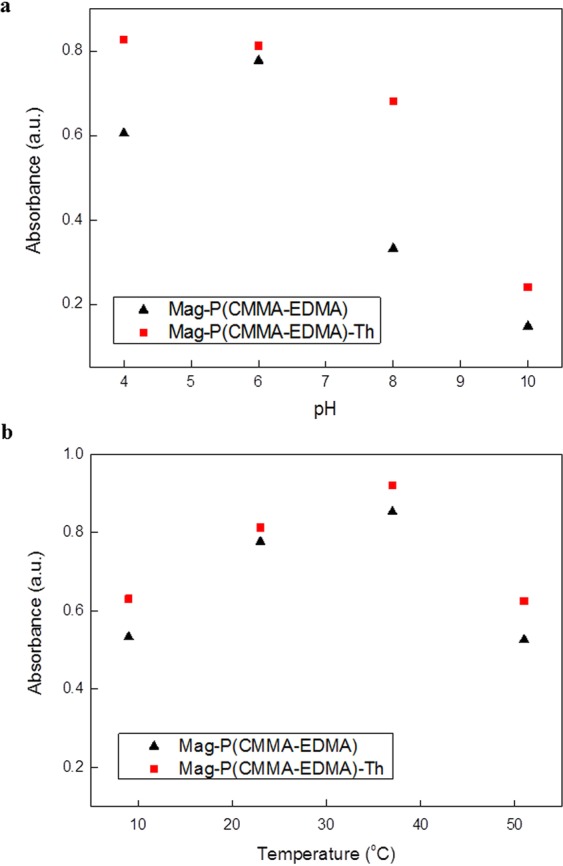
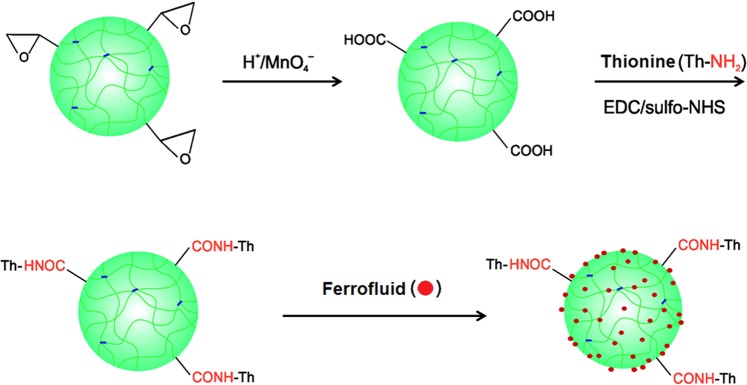
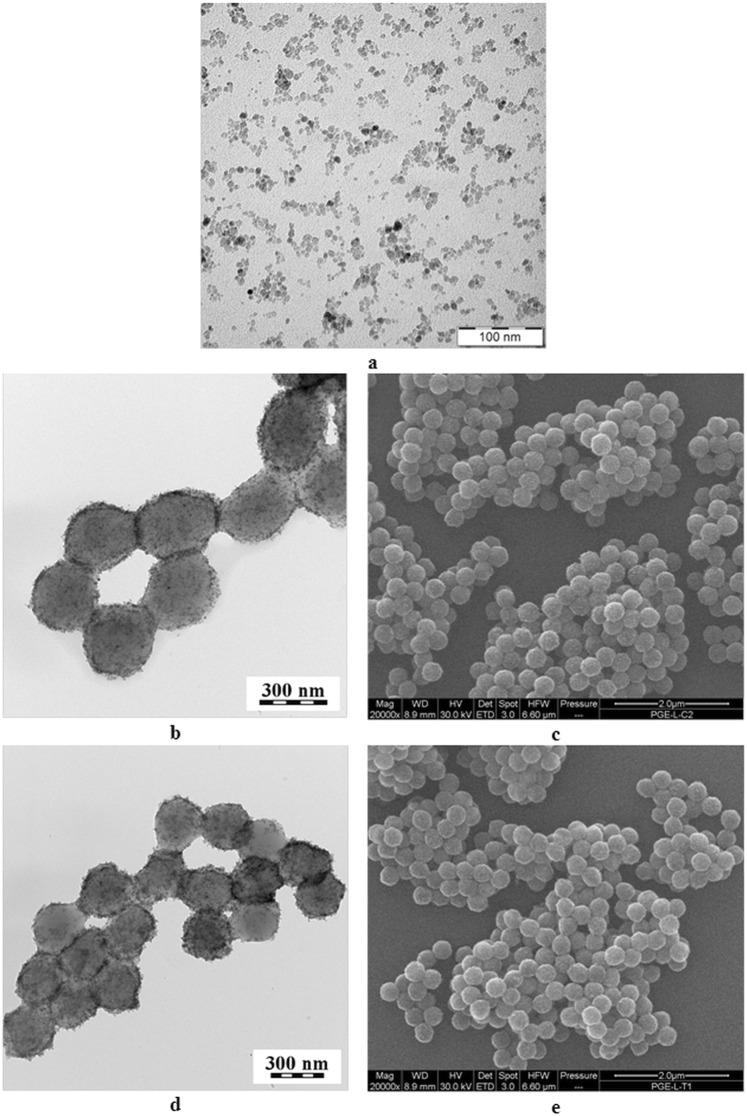
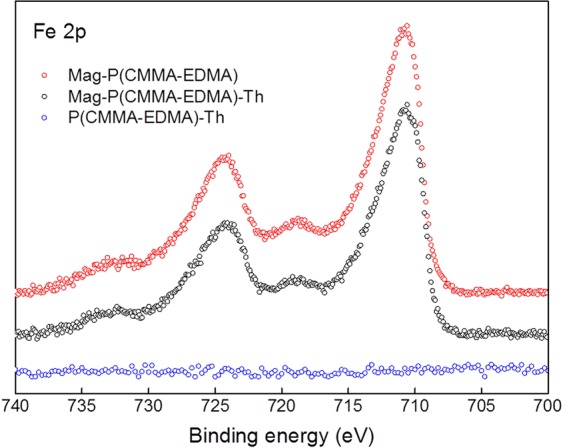
Poly(glycidyl methacrylate) (PGMA) is prone to modifications with different functional groups, magnetic fluids or direct coupling with biological molecules. The purpose of this research was to synthesize new magnetically responsive particles with peroxidase-like activity. Poly(glycidyl methacrylate-co-ethylene dimethacrylate) [P(GMA-EDMA)] particles containing carboxyl groups were obtained by emulsifier-free emulsion polymerization and hydrolysis and oxidation of PGMA with KMnO, resulting in poly(carboxymethyl methacrylate-co-ethylene dimethacrylate) [P(CMMA-EDMA)] particles. Thionine (Th) was also attached to the particles [(P(CMMA-EDMA)-Th] via EDC/NHS chemistry to observe its effect on electron transfer during the oxidation reaction. Finally, the particles were coated with a nitric acid-stabilized ferrofluid in methanol. The resulting magnetic particles were characterized by several methods, including scanning and transmission electron microscopy, X-ray photoelectron spectroscopy, and vibrating sample magnetometry. The effect of EDMA on the P(CMMA-EDMA) particle size and size distribution was investigated; the particle size changed from 300 to 340 nm, and the particles were monodispersed with a saturation magnetization of 11 Am/kg. Finally, the effects of temperature and pH on the peroxidase-like activity of the magnetic P(CMMA-EDMA) and P(CMMA-EDMA)-Th particles were investigated. The particles, which exhibited a high activity at pH 4-6 and at ∼37 °C, represent a highly sensitive sensor component potentially useful in enzyme-based immunoassays.
聚(甲基丙烯酸缩水甘油酯)(PGMA)易于与不同的官能团、磁性流体或生物分子进行直接偶联进行修饰。本研究旨在合成具有过氧化物酶样活性的新型磁响应性颗粒。通过无乳化剂乳液聚合以及 PGMA 与 KMnO4 的水解和氧化,得到含有羧基的聚(甲基丙烯酸缩水甘油酯-共-乙二醇二甲基丙烯酸酯)[P(GMA-EDMA)]颗粒,然后将其氧化为聚(甲基丙烯酸羧甲酯-共-乙二醇二甲基丙烯酸酯)[P(CMMA-EDMA)]颗粒。通过 EDC/NHS 化学将硫堇(Th)也连接到颗粒上[(P(CMMA-EDMA)-Th],以观察其在氧化反应过程中对电子转移的影响。最后,将颗粒在甲醇中用硝酸稳定的铁磁流体进行包覆。通过几种方法对所得磁性颗粒进行了表征,包括扫描电子显微镜和透射电子显微镜、X 射线光电子能谱和振动样品磁强计。研究了 EDMA 对 P(CMMA-EDMA)颗粒尺寸和尺寸分布的影响;颗粒尺寸从 300nm 变为 340nm,并且颗粒具有单分散性,饱和磁化强度为 11 Am/kg。最后,研究了温度和 pH 值对磁性 P(CMMA-EDMA)和 P(CMMA-EDMA)-Th 颗粒过氧化物酶样活性的影响。该颗粒在 pH 值为 4-6 和约 37°C 时表现出高活性,代表了一种在基于酶的免疫分析中可能有用的高灵敏度传感器组件。