Department of Psychology, University of Potsdam, Karl-Liebknechtstraße 24/25, 14476, Potsdam, Germany.
Neural Information Processing Group, University of Tübingen, Sand 6, 72076, Tübingen, Germany.
Sci Rep. 2019 Feb 7;9(1):1635. doi: 10.1038/s41598-018-37548-w.
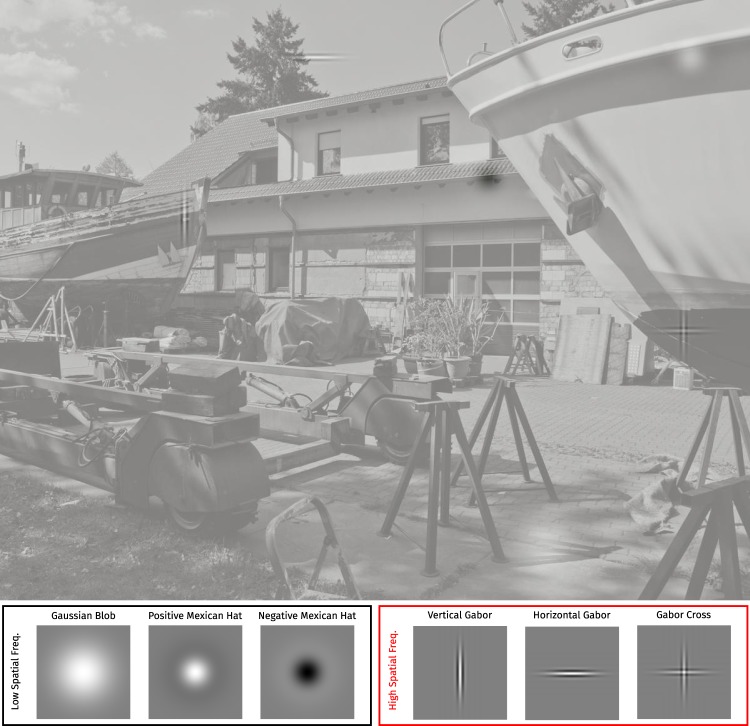
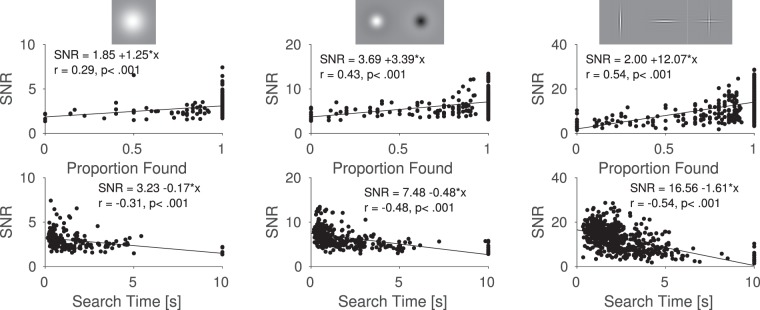
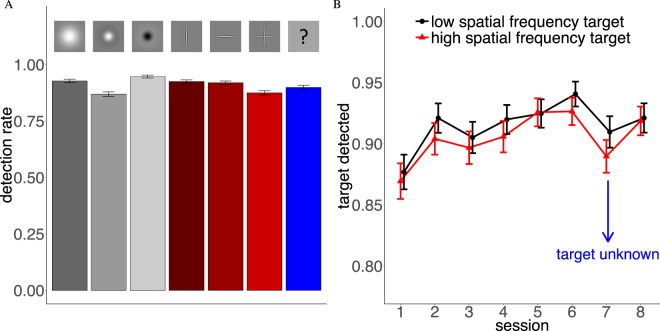
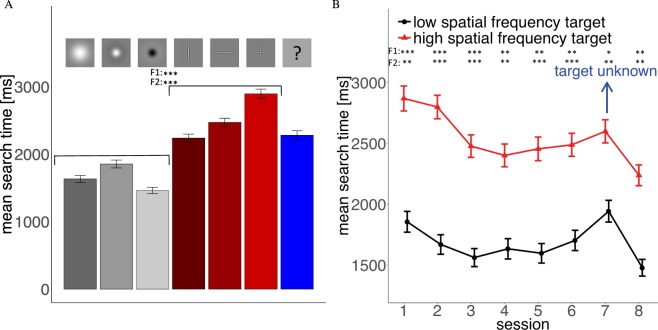
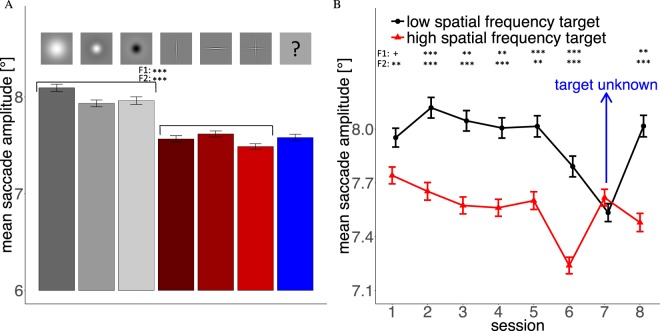
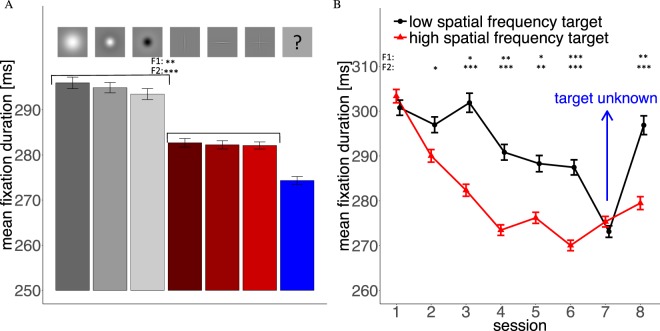
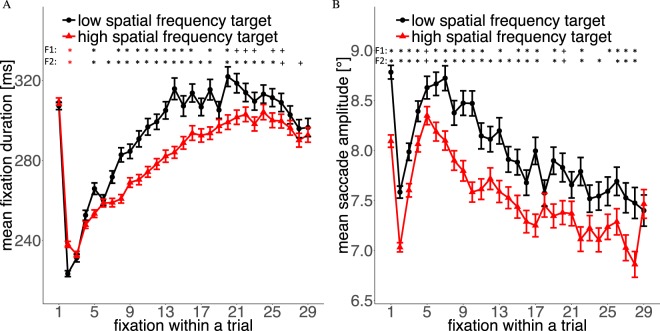
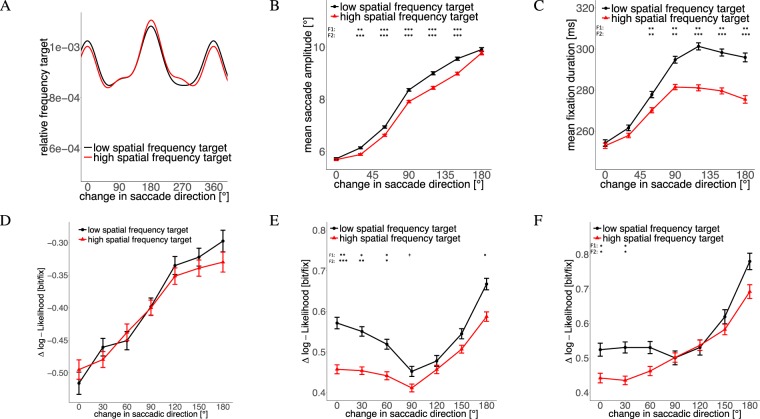
When searching a target in a natural scene, it has been shown that both the target's visual properties and similarity to the background influence whether and how fast humans are able to find it. So far, it was unclear whether searchers adjust the dynamics of their eye movements (e.g., fixation durations, saccade amplitudes) to the target they search for. In our experiment, participants searched natural scenes for six artificial targets with different spatial frequency content throughout eight consecutive sessions. High-spatial frequency targets led to smaller saccade amplitudes and shorter fixation durations than low-spatial frequency targets if target identity was known. If a saccade was programmed in the same direction as the previous saccade, fixation durations and successive saccade amplitudes were not influenced by target type. Visual saliency and empirical fixation density at the endpoints of saccades which maintain direction were comparatively low, indicating that these saccades were less selective. Our results suggest that searchers adjust their eye movement dynamics to the search target efficiently, since previous research has shown that low-spatial frequencies are visible farther into the periphery than high-spatial frequencies. We interpret the saccade direction specificity of our effects as an underlying separation into a default scanning mechanism and a selective, target-dependent mechanism.
当在自然场景中搜索目标时,已经表明目标的视觉属性和与背景的相似性都会影响人类是否以及多快能够找到目标。到目前为止,还不清楚搜索者是否会根据他们要搜索的目标来调整他们的眼球运动(例如注视持续时间、眼跳幅度)的动态。在我们的实验中,参与者在八个连续的会话中搜索了具有不同空间频率内容的六个人工目标的自然场景。如果已知目标身份,高空间频率目标比低空间频率目标导致更小的眼跳幅度和更短的注视持续时间。如果一个眼跳与前一个眼跳在相同的方向上编程,那么注视持续时间和连续的眼跳幅度不会受到目标类型的影响。保持方向的眼跳端点处的视觉显着性和经验性注视密度相对较低,这表明这些眼跳的选择性较低。我们的结果表明,搜索者可以有效地调整他们的眼球运动动态来搜索目标,因为先前的研究表明,低空间频率比高空间频率在更远的外围处可见。我们将我们的效果的眼跳方向特异性解释为默认扫描机制和选择性、目标依赖机制的潜在分离。