• 文献检索
  • 文档翻译
  • 深度研究
  • 学术资讯
  • Suppr Zotero 插件Zotero 插件
  • 邀请有礼
  • 套餐&价格
  • 历史记录
应用&插件
Suppr Zotero 插件Zotero 插件浏览器插件Mac 客户端Windows 客户端微信小程序
定价
高级版会员购买积分包购买API积分包
服务
文献检索文档翻译深度研究API 文档MCP 服务
关于我们
关于 Suppr公司介绍联系我们用户协议隐私条款
关注我们

Suppr 超能文献

核心技术专利:CN118964589B侵权必究
粤ICP备2023148730 号-1Suppr @ 2026

文献检索

告别复杂PubMed语法,用中文像聊天一样搜索,搜遍4000万医学文献。AI智能推荐,让科研检索更轻松。

立即免费搜索

文件翻译

保留排版,准确专业,支持PDF/Word/PPT等文件格式,支持 12+语言互译。

免费翻译文档

深度研究

AI帮你快速写综述,25分钟生成高质量综述,智能提取关键信息,辅助科研写作。

立即免费体验

频谱加权是感知声音升高的基础。

Spectral Weighting Underlies Perceived Sound Elevation.

机构信息

Biophysics Department, Donders Institute for Brain, Cognition, and Behaviour, Radboud University, 6525 AJ, Nijmegen, The Netherlands.

Department of Bioengineering, University of Pennsylvania, Philadelphia, PA, USA.

出版信息

Sci Rep. 2019 Feb 7;9(1):1642. doi: 10.1038/s41598-018-37537-z.

DOI:10.1038/s41598-018-37537-z
PMID:30733476
原文链接:https://pmc.ncbi.nlm.nih.gov/articles/PMC6367479/
Abstract

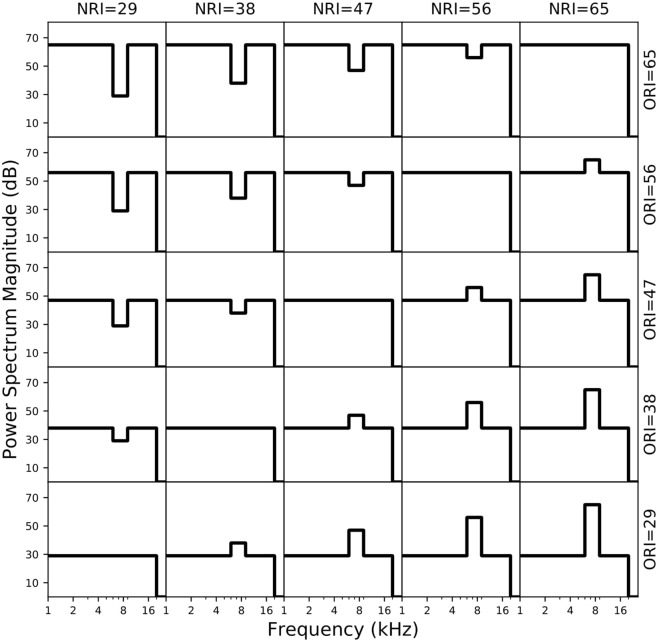
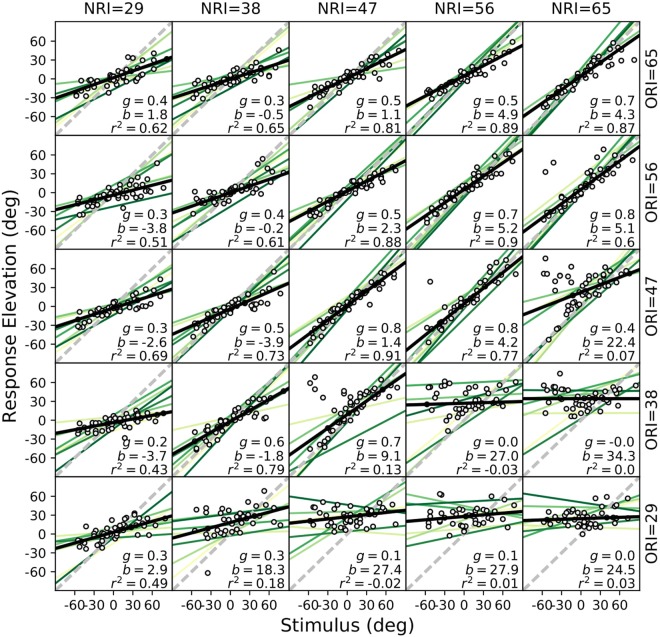
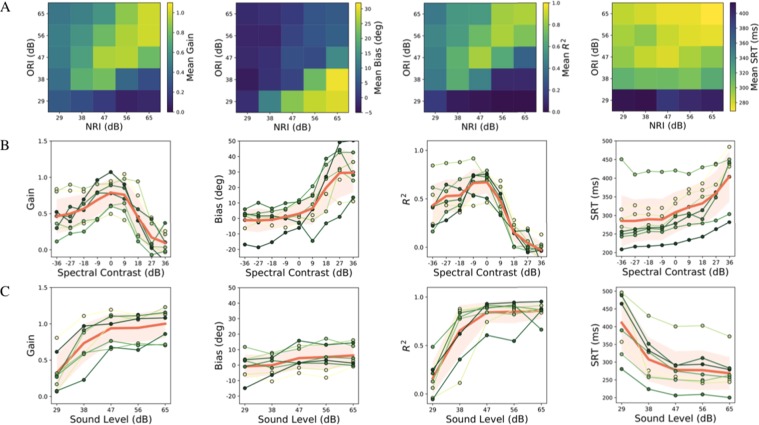
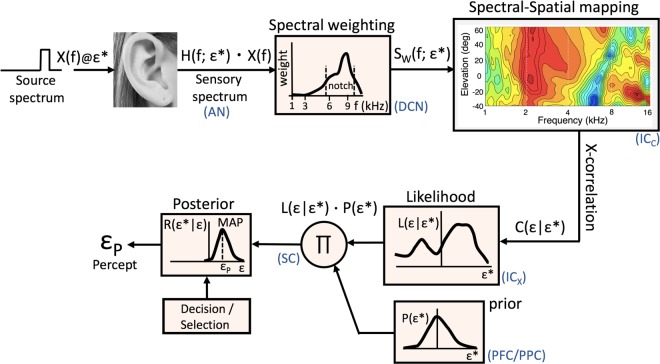
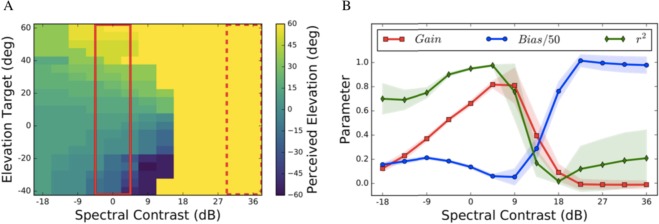
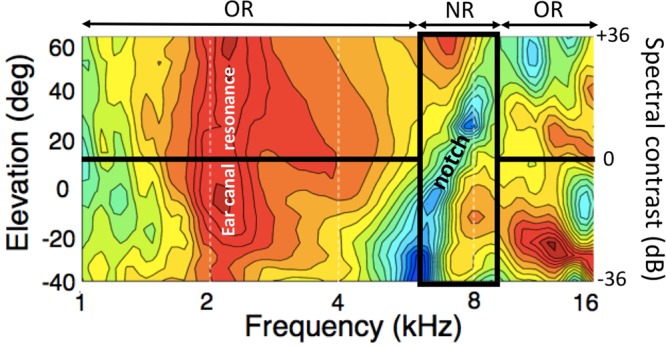
The brain estimates the two-dimensional direction of sounds from the pressure-induced displacements of the eardrums. Accurate localization along the horizontal plane (azimuth angle) is enabled by binaural difference cues in timing and intensity. Localization along the vertical plane (elevation angle), including frontal and rear directions, relies on spectral cues made possible by the elevation dependent filtering in the idiosyncratic pinna cavities. However, the problem of extracting elevation from the sensory input is ill-posed, since the spectrum results from a convolution between source spectrum and the particular head-related transfer function (HRTF) associated with the source elevation, which are both unknown to the system. It is not clear how the auditory system deals with this problem, or which implicit assumptions it makes about source spectra. By varying the spectral contrast of broadband sounds around the 6-9 kHz band, which falls within the human pinna's most prominent elevation-related spectral notch, we here suggest that the auditory system performs a weighted spectral analysis across different frequency bands to estimate source elevation. We explain our results by a model, in which the auditory system weighs the different spectral bands, and compares the convolved weighted sensory spectrum with stored information about its own HRTFs, and spatial prior assumptions.

摘要

大脑通过鼓膜的压力感应位移来估算二维声音方向。通过时间和强度的双耳差异线索,可以实现水平方向(方位角)的精确定位。垂直方向(仰角)的定位,包括前后方向,依赖于耳廓特有的、因仰角而异的滤波作用产生的频谱线索。然而,从感觉输入中提取仰角的问题是不适定的,因为频谱是由源频谱和与源仰角相关的特定头部相关传递函数(HRTF)之间的卷积产生的,而系统对这两者都一无所知。听觉系统如何处理这个问题,或者它对源频谱做出了哪些隐含假设,目前还不清楚。通过改变位于人类耳廓最显著的仰角相关频谱凹口内的 6-9 kHz 频带周围的宽带声音的频谱对比度,我们在此提出,听觉系统会在不同的频带之间进行加权频谱分析,以估计声源的仰角。我们通过一个模型来解释我们的结果,在该模型中,听觉系统对不同的频谱带进行加权,并将卷积后的加权感觉频谱与关于自身 HRTF 和空间先验假设的存储信息进行比较。
https://cdn.ncbi.nlm.nih.gov/pmc/blobs/cdd7/6367479/980c13f2ae2e/41598_2018_37537_Fig6_HTML.jpg
https://cdn.ncbi.nlm.nih.gov/pmc/blobs/cdd7/6367479/555c4e525d45/41598_2018_37537_Fig1_HTML.jpg
https://cdn.ncbi.nlm.nih.gov/pmc/blobs/cdd7/6367479/b347cf11dfc9/41598_2018_37537_Fig2_HTML.jpg
https://cdn.ncbi.nlm.nih.gov/pmc/blobs/cdd7/6367479/92e159663596/41598_2018_37537_Fig3_HTML.jpg
https://cdn.ncbi.nlm.nih.gov/pmc/blobs/cdd7/6367479/1740fdd63a1b/41598_2018_37537_Fig4_HTML.jpg
https://cdn.ncbi.nlm.nih.gov/pmc/blobs/cdd7/6367479/cab527bb3a02/41598_2018_37537_Fig5_HTML.jpg
https://cdn.ncbi.nlm.nih.gov/pmc/blobs/cdd7/6367479/980c13f2ae2e/41598_2018_37537_Fig6_HTML.jpg
https://cdn.ncbi.nlm.nih.gov/pmc/blobs/cdd7/6367479/555c4e525d45/41598_2018_37537_Fig1_HTML.jpg
https://cdn.ncbi.nlm.nih.gov/pmc/blobs/cdd7/6367479/b347cf11dfc9/41598_2018_37537_Fig2_HTML.jpg
https://cdn.ncbi.nlm.nih.gov/pmc/blobs/cdd7/6367479/92e159663596/41598_2018_37537_Fig3_HTML.jpg
https://cdn.ncbi.nlm.nih.gov/pmc/blobs/cdd7/6367479/1740fdd63a1b/41598_2018_37537_Fig4_HTML.jpg
https://cdn.ncbi.nlm.nih.gov/pmc/blobs/cdd7/6367479/cab527bb3a02/41598_2018_37537_Fig5_HTML.jpg
https://cdn.ncbi.nlm.nih.gov/pmc/blobs/cdd7/6367479/980c13f2ae2e/41598_2018_37537_Fig6_HTML.jpg

相似文献

1
Spectral Weighting Underlies Perceived Sound Elevation.频谱加权是感知声音升高的基础。
Sci Rep. 2019 Feb 7;9(1):1642. doi: 10.1038/s41598-018-37537-z.
2
Reconstructing spectral cues for sound localization from responses to rippled noise stimuli.从对波纹噪声刺激的反应中重建用于声音定位的频谱线索。
PLoS One. 2017 Mar 23;12(3):e0174185. doi: 10.1371/journal.pone.0174185. eCollection 2017.
3
Differential effect of near-threshold stimulus intensities on sound localization performance in azimuth and elevation in normal human subjects.近阈刺激强度对正常人类受试者在方位角和仰角上声音定位表现的差异效应。
J Assoc Res Otolaryngol. 2001 Sep;2(3):246-56. doi: 10.1007/s101620010073.
4
Differential Adaptation in Azimuth and Elevation to Acute Monaural Spatial Hearing after Training with Visual Feedback.在有视觉反馈的训练后,对急性单耳空间听觉的方位和高度的差异适应。
eNeuro. 2019 Nov 1;6(6). doi: 10.1523/ENEURO.0219-19.2019. Print 2019 Nov/Dec.
5
Binaural weighting of pinna cues in human sound localization.人类声音定位中耳廓线索的双耳加权
Exp Brain Res. 2003 Feb;148(4):458-70. doi: 10.1007/s00221-002-1320-5. Epub 2002 Dec 6.
6
Relearning sound localization with a new ear.用新耳朵重新学习声音定位。
J Neurosci. 2005 Jun 1;25(22):5413-24. doi: 10.1523/JNEUROSCI.0850-05.2005.
7
The role of spectral modulation cues in virtual sound localization.频谱调制线索在虚拟声音定位中的作用。
J Acoust Soc Am. 2008 Jan;123(1):302-14. doi: 10.1121/1.2804698.
8
Elevation localization and head-related transfer function analysis at low frequencies.
J Acoust Soc Am. 2001 Mar;109(3):1110-22. doi: 10.1121/1.1349185.
9
Influence of head position on the spatial representation of acoustic targets.头部位置对声学目标空间表征的影响。
J Neurophysiol. 1999 Jun;81(6):2720-36. doi: 10.1152/jn.1999.81.6.2720.
10
Sound localization under perturbed binaural hearing.双耳听觉受扰情况下的声音定位
J Neurophysiol. 2007 Jan;97(1):715-26. doi: 10.1152/jn.00260.2006. Epub 2006 Oct 25.

引用本文的文献

1
The role of spatial perception in auditory looming bias: neurobehavioral evidence from impossible ears.空间感知在听觉逼近偏向中的作用:来自虚拟耳朵的神经行为学证据
Front Neurosci. 2025 Aug 25;19:1645936. doi: 10.3389/fnins.2025.1645936. eCollection 2025.
2
Spectral Weighting of Monaural Cues for Auditory Localization in Sagittal Planes.矢状面听觉定位中双耳线索的频谱加权
Trends Hear. 2025 Jan-Dec;29:23312165251317027. doi: 10.1177/23312165251317027. Epub 2025 Mar 18.
3
Ideal-observer model of human sound localization of sources with unknown spectrum.

本文引用的文献

1
Learning to localise weakly-informative sound spectra with and without feedback.学习在有和没有反馈的情况下对弱信息量声音频谱进行定位。
Sci Rep. 2018 Dec 18;8(1):17933. doi: 10.1038/s41598-018-36422-z.
2
Accuracy-Precision Trade-off in Human Sound Localisation.人类声音定位中的精度-准确度权衡。
Sci Rep. 2018 Nov 6;8(1):16399. doi: 10.1038/s41598-018-34512-6.
3
Reconstructing spectral cues for sound localization from responses to rippled noise stimuli.从对波纹噪声刺激的反应中重建用于声音定位的频谱线索。
具有未知频谱声源的人类声音定位理想观察者模型。
Sci Rep. 2025 Mar 1;15(1):7289. doi: 10.1038/s41598-025-91001-3.
4
Age and Auditory Spatial Perception in Humans: Review of Behavioral Findings and Suggestions for Future Research.人类的年龄与听觉空间感知:行为学研究结果综述及未来研究建议
Front Psychol. 2022 Feb 16;13:831670. doi: 10.3389/fpsyg.2022.831670. eCollection 2022.
5
Adaptive Response Behavior in the Pursuit of Unpredictably Moving Sounds.追求不可预测移动声音的自适应反应行为。
eNeuro. 2021 May 6;8(3). doi: 10.1523/ENEURO.0556-20.2021. Print 2021 May-Jun.
6
Differential Adaptation in Azimuth and Elevation to Acute Monaural Spatial Hearing after Training with Visual Feedback.在有视觉反馈的训练后,对急性单耳空间听觉的方位和高度的差异适应。
eNeuro. 2019 Nov 1;6(6). doi: 10.1523/ENEURO.0219-19.2019. Print 2019 Nov/Dec.
7
Learning to localise weakly-informative sound spectra with and without feedback.学习在有和没有反馈的情况下对弱信息量声音频谱进行定位。
Sci Rep. 2018 Dec 18;8(1):17933. doi: 10.1038/s41598-018-36422-z.
PLoS One. 2017 Mar 23;12(3):e0174185. doi: 10.1371/journal.pone.0174185. eCollection 2017.
4
Accommodating to new ears: the effects of sensory and sensory-motor feedback.适应新的听觉:感觉和感觉运动反馈的作用。
J Acoust Soc Am. 2014 Apr;135(4):2002-11. doi: 10.1121/1.4868369.
5
The plastic ear and perceptual relearning in auditory spatial perception.塑料耳朵与听觉空间感知中的知觉再学习。
Front Neurosci. 2014 Aug 6;8:237. doi: 10.3389/fnins.2014.00237. eCollection 2014.
6
Modeling sound-source localization in sagittal planes for human listeners.模拟人类听众在矢状面中的声源定位。
J Acoust Soc Am. 2014 Aug;136(2):791-802. doi: 10.1121/1.4887447.
7
Natural auditory scene statistics shapes human spatial hearing.自然听觉场景统计规律塑造了人类的空间听觉。
Proc Natl Acad Sci U S A. 2014 Apr 22;111(16):6104-8. doi: 10.1073/pnas.1322705111. Epub 2014 Apr 7.
8
An ideal-observer model of human sound localization.人类声音定位的理想观察者模型。
Biol Cybern. 2014 Apr;108(2):169-81. doi: 10.1007/s00422-014-0588-4. Epub 2014 Feb 26.
9
Age-related hearing loss and ear morphology affect vertical but not horizontal sound-localization performance.年龄相关性听力损失和耳部形态影响垂直而非水平声源定位性能。
J Assoc Res Otolaryngol. 2013 Apr;14(2):261-73. doi: 10.1007/s10162-012-0367-7. Epub 2013 Jan 15.
10
Mechanism for generating peaks and notches of head-related transfer functions in the median plane.头相关传递函数中中平面峰和凹口的产生机制。
J Acoust Soc Am. 2012 Dec;132(6):3832-41. doi: 10.1121/1.4765083.