Beijing Key Laboratory of Wood Science and Engineering, College of Material Science and Technology, Beijing Forestry University, No. 35, Qinghua East Road, Haidian District, Beijing, 100083, P.R. China.
Faculty of Forestry, University of Toronto, 33 Willcocks Street, Toronto, Ontario, M5S 3B3, Canada.
Sci Rep. 2019 Feb 7;9(1):1601. doi: 10.1038/s41598-018-38317-5.
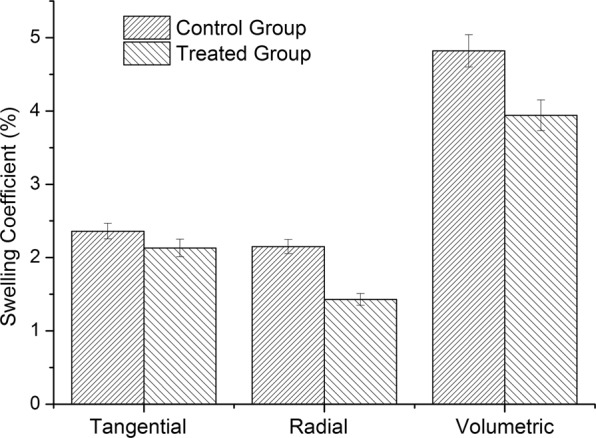
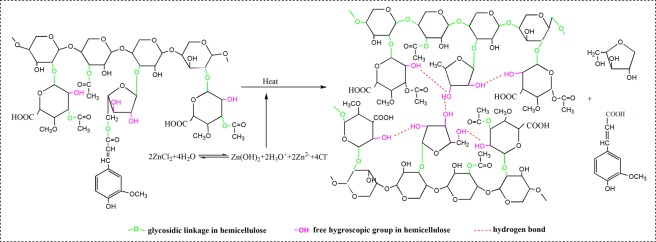
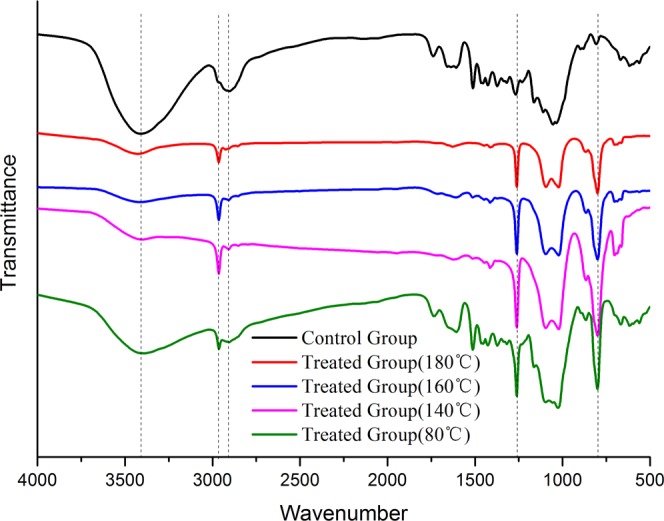
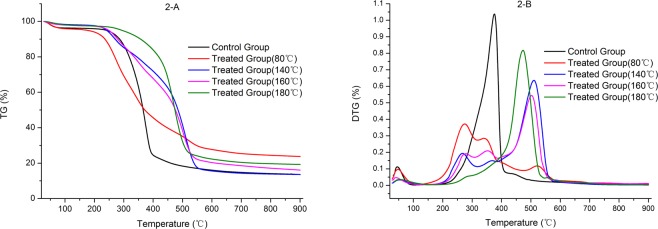
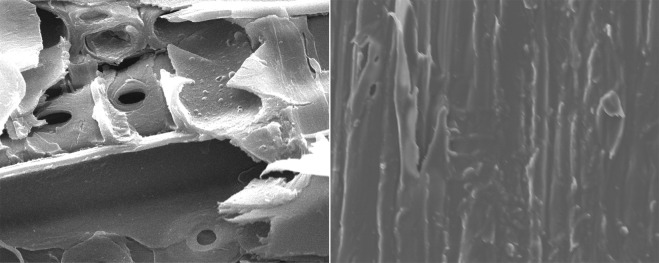
The hygroexpansion and anisotropy of wood limit its application in construction and wood products industry. Zinc chloride-silicone oil was use to decrease the hygroscopicity and improve the dimensional stability of wood at 80 °C, 140 °C, 160 °C and 180 °C. The effects of the treatment on the dimensional stability, chemical structure, thermal degradation, morphology of wood were evaluated, and the mechanism was determined. Results indicated that the zinc chloride-silicone oil treatment at 80 °C improved the dimensional stability and decreased the hygroscopicity of wood. The tangential, radial, and volumetric swelling coefficients of the treated wood decreased by 9.7%, 33.5%, and 18.2%, respectively, relative to those of the untreated wood. Zinc chloride-silicone oil treatment also changed the chemical structure of wood by degrading the wood components and decreasing the moisture absorption groups. Moreover, zinc chloride-silicone oil treatment significantly influenced the thermal degradation of wood, as samples treated with zinc chloride-silicone oil at 140 °C, 160 °C and 180 °C presented sharp peaks around 511 °C, 501 °C and 473 °C. The control group exhibited a more common derivative thermogravimetric curve with a sharp peak at 375 °C. In addition, the silicone oil could impregnate wood, occlude moisture passage, and prevent the movement of moisture in wood. This method can be applied in building and wood industries to expand the applications of wood products.
木材的吸湿膨胀和各向异性限制了其在建筑和木制品行业的应用。在 80°C、140°C、160°C 和 180°C 下,使用氯化锌-硅油来降低木材的吸湿性并提高其尺寸稳定性。评估了处理对木材尺寸稳定性、化学结构、热降解、形态的影响,并确定了其机制。结果表明,80°C 下的氯化锌-硅油处理提高了木材的尺寸稳定性并降低了其吸湿性。与未处理的木材相比,处理后的木材的弦向、径向和体积膨胀系数分别降低了 9.7%、33.5%和 18.2%。此外,氯化锌-硅油处理还通过降解木材成分和减少吸湿基团改变了木材的化学结构。而且,氯化锌-硅油处理显著影响了木材的热降解,因为在 140°C、160°C 和 180°C 下用氯化锌-硅油处理的样品在 511°C、501°C 和 473°C 左右呈现出明显的峰值。而对照组则呈现出更常见的导数热重曲线,在 375°C 处有一个明显的峰值。此外,硅油可以渗透木材,封闭水分通道,并防止木材中的水分移动。这种方法可以应用于建筑和木材行业,以扩大木制品的应用范围。