Fan Pi-Chuan, Kuo Ping-Hung, Lee Ming Tatt, Chang Shu-Hui, Chiou Lih-Chu
Department of Pediatrics, National Taiwan University Hospital, Taipei, Taiwan.
Clinical Center for Neuroscience and Behavior, National Taiwan University Hospital, Taipei, Taiwan.
Front Neurol. 2019 Jan 24;10:10. doi: 10.3389/fneur.2019.00010. eCollection 2019.
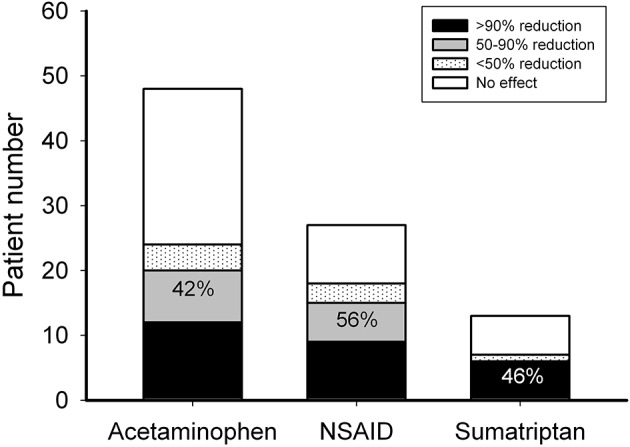
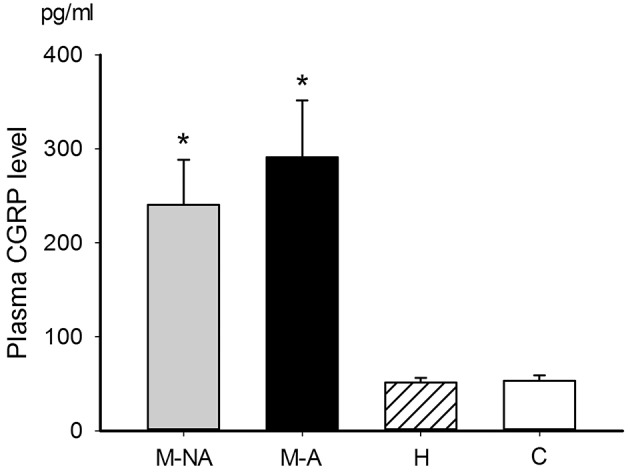
Plasma calcitonin gene-related peptide (CGRP) plays a key role in the migraine pathophysiology. This study aimed to investigate its role in predicting diagnosis and outcome of pharmacotherapy in pediatric migraine. We prospectively recruited 120 subjects, who never took migraine-preventive agents in a pediatric clinic, including 68 patients with migraine, 30 with non-migraine headache (NM), and 22 non-headache (NH) age-matched controls. Short-term therapeutic response was measured for at least 2 weeks after the start of therapy. Responders were defined with >50% headache reduction. Plasma CGRP concentrations were measured by ELISA. In the migraine group, more patients required acute therapy, as compared to the NM group (62/68, 91% vs. 5/30, 15%, = 0.001). The mean plasma CGRP level in migraineurs either during (291 ± 60 pg/ml) or between (240 ± 48) attacks was higher than in NM patients (51 ± 5 pg/ml, = 0.006 and 0.018, respectively) and NH controls (53 ± 6 pg/ml, = 0.016 and 0.045, respectively). Forty-seven patients (69%) needed preventive treatments and had higher plasma CGRP levels (364 ± 62 pg/ml, = 47) than those not (183 ± 54 pg/ml, = 21) ( = 0.031). Topiramate responders had higher plasma CGRP levels than non-responders (437 ± 131 pg/ml, = 14 vs. 67 ± 19 pg/ml, = 6, = 0.021). Survival curves of plasma CGRP levels also showed those with higher CGRP levels responded better to topiramate. Differences were not found in the other preventives. The plasma CGRP level can differentiate migraine from non-migraine headache. It may also serve as a reference for the therapeutic strategy since it is higher in patients requiring migraine prevention and responsive to short-term topiramate treatment. These results are clinically significant, especially for the young children who cannot clearly describe their headache symptoms and may provide new insights into the clinical practice for the diagnosis and treatment of pediatric migraine.
血浆降钙素基因相关肽(CGRP)在偏头痛的病理生理学中起关键作用。本研究旨在探讨其在预测儿童偏头痛药物治疗的诊断及预后方面的作用。我们前瞻性招募了120名受试者,这些受试者均未在儿科诊所服用过偏头痛预防药物,其中包括68例偏头痛患者、30例非偏头痛性头痛(NM)患者以及22例年龄匹配的无头痛(NH)对照者。在治疗开始后至少2周测量短期治疗反应。治疗有效者定义为头痛减轻>50%。采用酶联免疫吸附测定法(ELISA)测量血浆CGRP浓度。与NM组相比,偏头痛组更多患者需要急性治疗(62/68,91% 对5/30,15%,P = 0.001)。偏头痛患者发作期间(291±60 pg/ml)及发作间期(240±48 pg/ml)的血浆CGRP平均水平高于NM患者(51±5 pg/ml,P分别为0.006和0.018)及NH对照者(53±6 pg/ml,P分别为0.016和0.045)。47例患者(69%)需要预防性治疗,其血浆CGRP水平(364±62 pg/ml,n = 47)高于不需要预防性治疗的患者(183±54 pg/ml,n = 21)(P = 0.031)。托吡酯治疗有效者的血浆CGRP水平高于无效者(437±131 pg/ml,n = 14对67±19 pg/ml,n = 6,P = 0.021)。血浆CGRP水平的生存曲线也显示CGRP水平较高者对托吡酯反应更好。在其他预防药物方面未发现差异。血浆CGRP水平可区分偏头痛与非偏头痛性头痛。它也可作为治疗策略的参考,因为在需要偏头痛预防及对短期托吡酯治疗有反应的患者中其水平较高。这些结果具有临床意义,尤其对于无法清晰描述头痛症状的幼儿,可能为儿童偏头痛的临床诊断和治疗提供新的见解。