Grodzka Olga, Łagowski Wiktor, Eyileten Ceren, Domitrz Izabela
Department of Neurology, Faculty of Medicine and Dentistry, Medical University of Warsaw, Ceglowska 80, Warsaw, 01-809, Poland.
Doctoral School, Medical University of Warsaw, Żwirki i Wigury 61, Warsaw, 02-091, Poland.
J Headache Pain. 2025 Apr 11;26(1):73. doi: 10.1186/s10194-025-02023-1.
According to the International Classification of Headache Disorders, 3rd edition (ICHD-3), headache disorders can be divided into two main groups: primary, which are not caused by any other disease, and secondary, which are symptomatic of underlying disease. Differentiating between both groups is crucial for the patient's prognosis. The diagnosis of primary headache disorders relies solely on official clinical criteria, with no additional diagnostic tools available. Therefore, they usually remain underdiagnosed, decreasing the patient's quality of life.
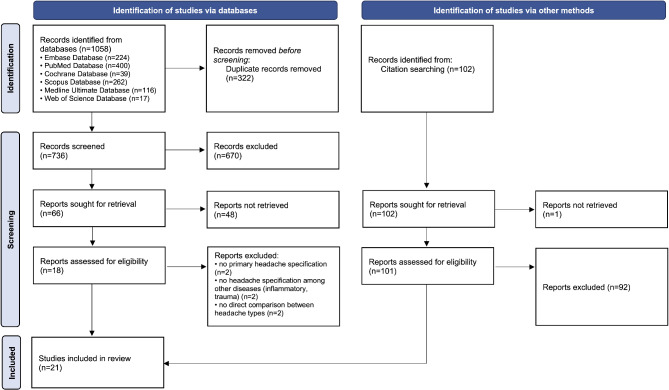
This systematic review aimed to analyse the available literature on the topic of biomarkers in the differentiation between different types of headaches. To be included, a primary study had to cover the abovementioned topic. Studies comparing one type of headache to healthy controls were excluded since the review focused on differential diagnosis. Articles to be considered had to describe original research and be written in English or Polish. No publication year limits were applied. A selection process was performed between October 19th, 2024, and January 1st, 2025, through six databases (PubMed, Embase, Scopus, Cochrane, Web of Science, Medline Ultimate), according to the PRISMA 2020. The risk of bias was assessed accordingly using the Prediction Model Risk of Bias Assessment Tool (PROBAST), and data synthesis was performed narratively. The review was registered in PROSPERO.
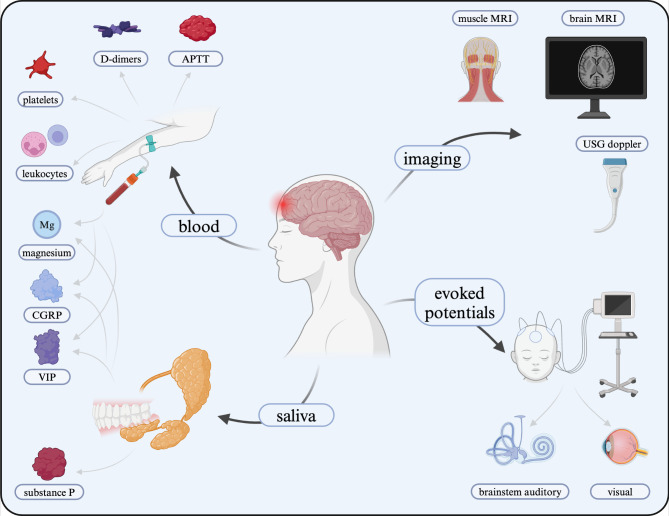
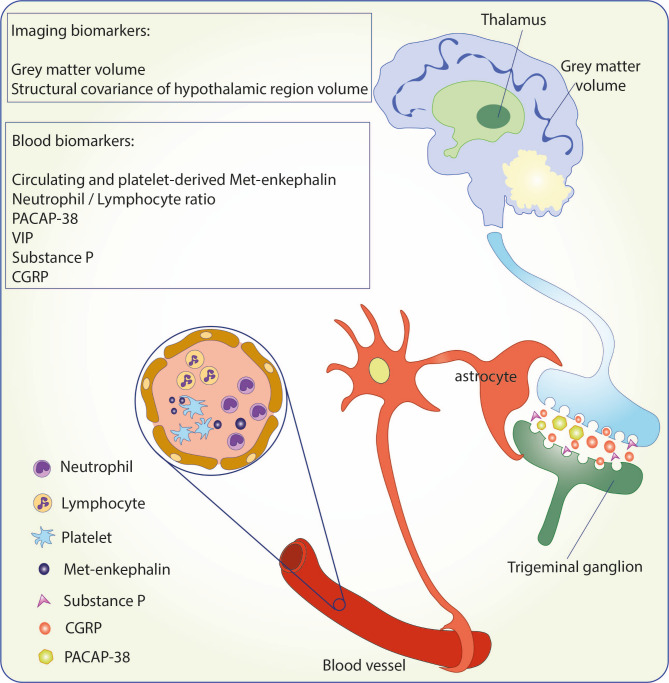
The findings from 21 included studies (with a wide range of publication years between 1990 and 2023) demonstrated several biomarkers, mainly comparing migraine to other primary headaches, tension-type headaches and cluster headaches, and some secondary headaches: medication-overuse headaches and post-traumatic headaches. The main types of biomarkers were blood biomarkers and imaging biomarkers. Among the former, molecules such as magnesium and calcitonin gene-related peptide (CGRP) or inflammatory markers could be found. The latter group focused mainly on assessing volumes or functional connections in brain magnetic resonance imaging and seem to have a significant impact in the nearest future. Saliva analyses were covered only by two research groups, showing the putative role of magnesium and CGRP. Similarly, two research groups described evoked potentials' value only in the paediatric population.
There is a clear gap in the literature regarding biomarkers for the differential diagnosis of headaches. However, an analysis of the most recent studies suggests that imaging biomarkers are the most promising group since they have gained the most attention in the past few years. Finding high-value biomarkers can simplify differential diagnosis of headaches, especially when clinical presentation is atypical. Nevertheless, more research on biomarkers of all types is highly needed.
Registration ID: CRD42024603632.
根据《国际头痛疾病分类》第三版(ICHD - 3),头痛疾病可分为两大类:原发性头痛,即不是由任何其他疾病引起的头痛;继发性头痛,即潜在疾病的症状性头痛。区分这两类头痛对患者的预后至关重要。原发性头痛疾病的诊断仅依赖官方临床标准,没有其他可用的诊断工具。因此,它们通常仍未得到充分诊断,降低了患者的生活质量。
本系统评价旨在分析关于生物标志物在不同类型头痛鉴别诊断方面的现有文献。纳入的原始研究必须涵盖上述主题。由于本评价聚焦于鉴别诊断,因此排除了将一种头痛类型与健康对照进行比较的研究。纳入的文章必须描述原创研究且用英文或波兰文撰写。不设发表年份限制。根据PRISMA 2020,于2024年10月19日至2025年1月1日期间通过六个数据库(PubMed、Embase、Scopus、Cochrane、Web of Science、Medline Ultimate)进行筛选。使用预测模型偏倚风险评估工具(PROBAST)相应地评估偏倚风险,并进行叙述性数据合成。本评价已在PROSPERO注册。
21项纳入研究(发表年份跨度从1990年到2023年)的结果表明了几种生物标志物,主要是比较偏头痛与其他原发性头痛、紧张型头痛和丛集性头痛,以及一些继发性头痛:药物过量使用性头痛和创伤后头痛。主要的生物标志物类型是血液生物标志物和影像生物标志物。在前者中,可以发现诸如镁、降钙素基因相关肽(CGRP)等分子或炎症标志物。后者主要侧重于评估脑磁共振成像中的体积或功能连接,并且在不久的将来似乎会产生重大影响。唾液分析仅由两个研究小组涉及,显示了镁和CGRP的假定作用。同样,两个研究小组仅描述了诱发电位在儿科人群中的价值。
关于头痛鉴别诊断的生物标志物,文献中存在明显空白。然而,对最新研究的分析表明,影像生物标志物是最有前景的类别,因为它们在过去几年中受到了最多关注。找到高价值的生物标志物可以简化头痛的鉴别诊断,尤其是当临床表现不典型时。尽管如此,迫切需要对所有类型的生物标志物进行更多研究。
注册号:CRD42024603632。