Urology and Nephrology Research Center, Shahid Beheshti University of Medical Sciences, Tehran, Iran.
Int Braz J Urol. 2019 Mar-Apr;45(2):340-346. doi: 10.1590/S1677-5538.IBJU.2018.0522.
Hypercalciuria is one of the risk factors for calcium kidney stone formation (the most common type of urinary stones). Although vitamin D deficiency is prevalent among urolithiasis patients, the effect of vitamin D supplementation on urine calcium in these patients is still unclear.
In this retrospective study, medical and laboratory tests records of 26 patients with recurrent calcium kidney stones and vitamin D deficiency treated with 50000IU vitamin D per week for 8-12 weeks were analyzed. The changes in 24-hour urine calcium (24-h Ca), serum 25-hydroxyvitamin D (25 (OH) D), serum parathormone (PTH), other 24-hour urine metabolites and calculated relative supersaturations of calcium oxalate (CaOxSS), calcium phosphate (CaPSS) and uric acid (UASS) were assessed. Moreover, correlations between changes in 24-h Ca and other aforementioned variables were assessed.
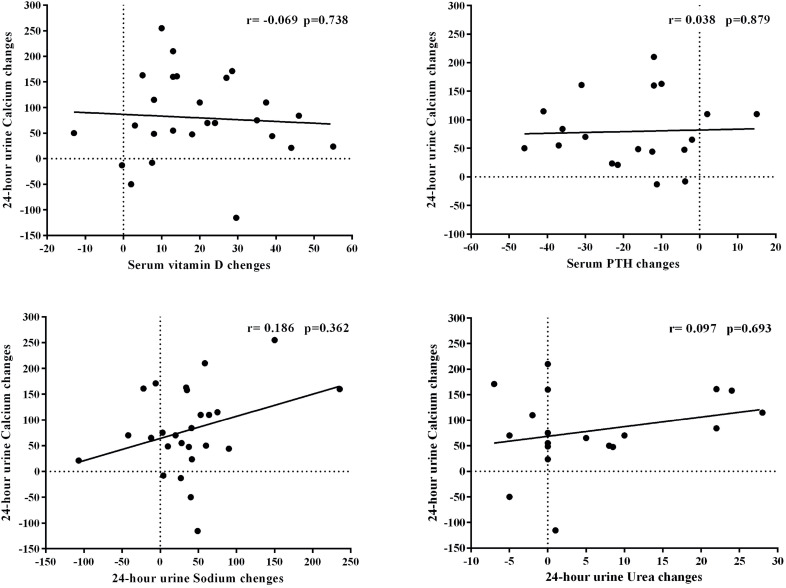
Serum 25 (OH) D and 24-h Ca increased after vitamin D supplementation, while serum PTH decreased (p < 0.001, for all analyses). The levels of 24-hour urine sodium and urea increased significantly (p = 0.005 and p = 0.031, respectively). The levels of CaOxSS and CaPSS increased, but the changes were not significant (p = 0.177, and p = 0.218, respectively). There were no correlations between the changes in 24-h Ca and serum 25 (OH) D or PTH.
The result of current study suggests that although urine Ca increased in vitamin D supplemented patients, this increase was not associated with the increase in serum vitamin D and may be due to other factors such as dietary factors. Further randomized clinical trials considering other factors associated with urine Ca are warranted.
高钙尿症是钙肾结石形成的危险因素之一(最常见的尿路结石类型)。尽管维生素 D 缺乏在尿路结石患者中很常见,但维生素 D 补充对这些患者尿液钙的影响仍不清楚。
在这项回顾性研究中,分析了 26 例接受每周 50000IU 维生素 D 治疗 8-12 周的复发性钙肾结石和维生素 D 缺乏症患者的医学和实验室检查记录。评估了 24 小时尿钙(24-h Ca)、血清 25-羟维生素 D(25(OH)D)、血清甲状旁腺激素(PTH)、其他 24 小时尿代谢物和计算的草酸钙(CaOxSS)、磷酸钙(CaPSS)和尿酸(UASS)相对过饱和度的变化。此外,评估了 24-h Ca 变化与其他上述变量之间的相关性。
维生素 D 补充后血清 25(OH)D 和 24-h Ca 增加,而血清 PTH 降低(p<0.001,所有分析)。24 小时尿钠和尿素水平显著增加(p=0.005 和 p=0.031)。CaOxSS 和 CaPSS 水平增加,但变化不显著(p=0.177 和 p=0.218)。24-h Ca 变化与血清 25(OH)D 或 PTH 之间无相关性。
本研究结果表明,尽管维生素 D 补充患者的尿钙增加,但这种增加与血清维生素 D 增加无关,可能是由于饮食等其他因素。需要进一步的随机临床试验考虑与尿钙相关的其他因素。