Department of Psychotherapy and Psychosomatic Medicine, Medizinische Fakultät Carl Gustav Carus, Technische Universität Dresden, 01307, Dresden, Germany.
Institute of Medical Psychology and Medical Sociology, Clinic and Polyclinic for Psychosomatic Medicine and Psychotherapy, University Medical Center of the Johannes Gutenberg University, Mainz, Germany.
Crit Care. 2019 Feb 8;23(1):39. doi: 10.1186/s13054-019-2321-0.
Survivors of an acute critical illness with continuing organ dysfunction and uncontrolled inflammatory responses are prone to become chronically critically ill. As mental sequelae, a post-traumatic stress disorder and an associated decrease in the health-related quality of life (QoL) may occur, not only in the patients but also in their partners. Currently, research on long-term mental distress in chronically critically ill patient-partner dyads, using appropriate dyadic analysis strategies (patients and partners being measured and linked on the same variables) and controlling for contextual factors, is lacking.
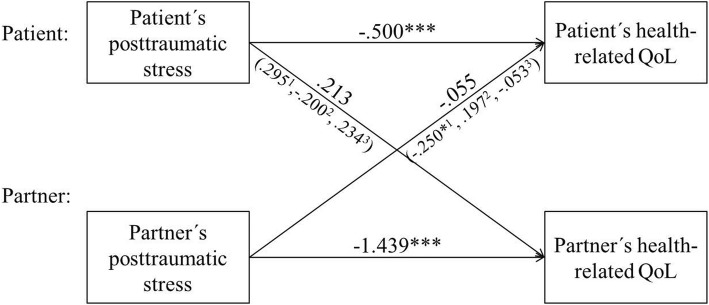
The present study investigates the interdependence of post-traumatic stress symptoms (PTSS) and the health-related QoL in n = 70 dyads of chronically critically ill patients and their partners, using the Actor-Partner-Interdependence Model (APIM) under consideration of contextual factors (age, gender, length of partnership). The Post-traumatic Stress Scale (PTSS-10) and Euro-Quality of Life (EQ-5D-3L) were applied in both the patients and their partners, within up to 6 months after the transfer from acute care ICU to post-acute ICU.
Clinically relevant post-traumatic stress symptoms were reported by 17.1% of the patients and 18.6% of the partners. Both the chronically critically ill patients and their partners with more severe post-traumatic stress symptoms also showed a decreased health-related QoL. The latter was more pronounced in male partners compared to female partners or female patients. In younger partners (≤ 57 years), higher values of post-traumatic stress symptoms were associated with a decreased QoL in the patients.
Mental health screening and psychotherapeutic treatment options should be offered to both the chronically critically ill patients and their partners. Future research is required to address the special needs of younger patient-partner dyads, following protracted ICU treatment.
German Clinical Trials Register No. DRKS00003386 . Registered 13 November 2011.
患有急性危重病且持续存在器官功能障碍和未得到控制的炎症反应的幸存者更容易成为慢性危重病患者。作为精神后遗症,创伤后应激障碍以及相关的健康相关生活质量(QoL)下降不仅会发生在患者身上,也会发生在他们的伴侣身上。目前,对于慢性危重病患者-伴侣对偶体中长期精神困扰的研究,使用适当的对偶分析策略(患者和伴侣在相同变量上进行测量和关联)并控制背景因素,还很缺乏。
本研究使用 Actor-Partner-Interdependence Model(APIM),在考虑背景因素(年龄、性别、伴侣关系长度)的情况下,对 n=70 例慢性危重病患者及其伴侣的创伤后应激症状(PTSS)和健康相关 QoL 的相互依赖性进行了研究。在急性重症监护病房(ICU)转至急性后 ICU 后最多 6 个月内,对患者及其伴侣均应用创伤后应激量表(PTSS-10)和欧洲生活质量(EQ-5D-3L)。
17.1%的患者和 18.6%的伴侣报告有临床相关的创伤后应激症状。慢性危重病患者和创伤后应激症状更严重的伴侣的健康相关 QoL 也降低。与女性伴侣或女性患者相比,年轻伴侣(≤57 岁)的男性伴侣中,创伤后应激症状更严重,QoL 降低更为明显。在年轻伴侣中(≤57 岁),创伤后应激症状较高与患者 QoL 下降相关。
应向慢性危重病患者及其伴侣提供心理健康筛查和心理治疗选择。需要进一步研究,以满足接受长期 ICU 治疗的年轻患者-伴侣对偶体的特殊需求。
德国临床试验注册中心编号 DRKS00003386。于 2011 年 11 月 13 日注册。