Institute for Implementation Science in Health Care, Faculty of Medicine, University of Zurich, Universitätsstrasse 84, 8006, Zurich, Switzerland.
Centre of Clinical Nursing Science, University Hospital Zurich, Rämistrasse 100, 8091, Zurich, Switzerland.
Trials. 2022 Jun 27;23(1):533. doi: 10.1186/s13063-022-06454-y.
Family members of critically ill patients face considerable uncertainty and distress during their close others' intensive care unit (ICU) stay. About 20-60% of family members experience adverse mental health outcomes post-ICU, such as symptoms of anxiety, depression, and posttraumatic stress. Guidelines recommend structured family inclusion, communication, and support, but the existing evidence base around protocolized family support interventions is modest and requires substantiation.
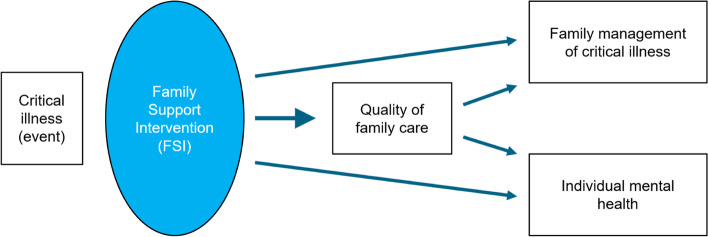
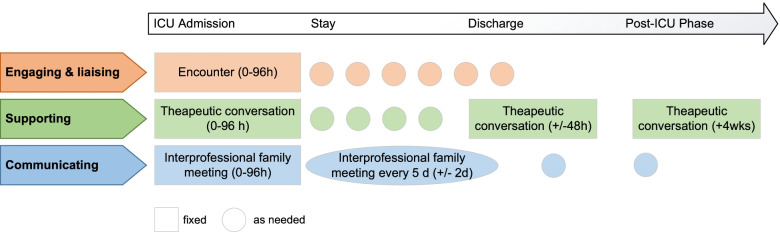
To test the clinical effectiveness and explore the implementation of a multicomponent, nurse-led family support intervention in ICUs, we will undertake a parallel, cluster-randomized, controlled, multicenter superiority hybrid-type 1 trial. It will include eight clusters (ICUs) per study arm, with a projected total sample size of 896 family members of adult, critically ill patients treated in the German-speaking part of Switzerland. The trial targets family members of critically ill patients with an expected ICU stay of 48 h or longer. Families in the intervention arm will receive a family support intervention in addition to usual care. The intervention consists of specialist nurse support that is mapped to the patient pathway with follow-up care and includes psycho-educational and relationship-focused family interventions, and structured, interprofessional communication, and shared decision-making with families. Families in the control arm will receive usual care. The primary study endpoint is quality of family care, operationalized as family members' satisfaction with ICU care at discharge. Secondary endpoints include quality of communication and nurse support, family management of critical illness (functioning, resilience), and family members' mental health (well-being, psychological distress) measured at admission, discharge, and after 3, 6, and 12 months. Data of all participants, regardless of protocol adherence, will be analyzed using linear mixed-effects models, with the individual participant as the unit of inference.
This trial will examine the effectiveness of the family support intervention and generate knowledge of its implementability. Both types of evidence are necessary to determine whether the intervention works as intended in clinical practice and could be scaled up to other ICUs. The study findings will make a significant contribution to the current body of knowledge on effective ICU care that promotes family participation and well-being.
ClinicalTrials.gov NCT05280691 . Prospectively registered on 20 February 2022.
危重症患者的家属在其亲人入住重症监护病房(ICU)期间会面临相当大的不确定性和困扰。大约 20-60%的家属在 ICU 后会出现不良心理健康结局,如焦虑、抑郁和创伤后应激。指南建议进行结构化的家庭参与、沟通和支持,但现有的针对协议化家庭支持干预措施的证据基础有限,需要证实。
为了测试多组分、护士主导的家庭支持干预在 ICU 中的临床效果并探索其实施情况,我们将进行一项平行、集群随机、对照、多中心优势混合类型 1 试验。每个研究臂将包括 8 个集群(ICU),预计总样本量为在瑞士德语区接受治疗的成年危重症患者的 896 名家属。该试验针对 ICU 入住时间预计为 48 小时或更长时间的危重症患者的家属。干预组的家属除接受常规护理外,还将接受家庭支持干预。该干预包括与患者路径相匹配的专科护士支持,包括心理教育和以家庭为中心的干预措施,以及与家庭进行结构化的、跨专业的沟通和共同决策。对照组的家属将接受常规护理。主要研究终点是家庭护理质量,具体表现为出院时家属对 ICU 护理的满意度。次要终点包括沟通和护士支持质量、家庭对危重病的管理(功能、恢复力)以及家属在入院时、出院时和 3、6、12 个月后的心理健康(幸福感、心理困扰)。所有参与者的数据,无论其是否遵守方案,都将使用线性混合效应模型进行分析,以个体参与者为推断单位。
该试验将检验家庭支持干预的有效性,并生成其可实施性的知识。这两种类型的证据对于确定干预措施在临床实践中的效果以及是否可以扩展到其他 ICU 都是必要的。研究结果将为促进家庭参与和幸福感的有效 ICU 护理的现有知识体系做出重大贡献。
ClinicalTrials.gov NCT05280691。于 2022 年 2 月 20 日前瞻性注册。