1Norwegian Advisory Unit for Antibiotic Use in Hospitals, Department of Research and Development, Haukeland University Hospital, Haukelandsveien 22, 5021 Bergen, Norway.
2Department of Clinical Science, University of Bergen, Jonas Lies vei 87, 5020 Bergen, Norway.
Antimicrob Resist Infect Control. 2019 Feb 4;8:28. doi: 10.1186/s13756-019-0480-z. eCollection 2019.
Effective use of microbiology test results may positively influence patient outcomes and limit the use of broad-spectrum antibiotics. However, studies indicate that their potential is not fully utilized. We investigated microbiology test ordering practices and the use of test results for antibiotic decision-making in hospitals.
A multicentre cohort study was conducted during five months in 2014 in Medical departments across three hospitals in Western Norway. Patients treated with antibiotics for sepsis, urinary tract infections, skin and soft tissue infections, lower respiratory tract infections or acute exacerbations of chronic obstructive pulmonary disease were included in the analysis. Primary outcome measures were degree of microbiology test ordering, compliance with microbiology testing recommendations in the national antibiotic guideline and proportion of microbiology test results used to inform antibiotic treatment. Data was obtained from electronic- and paper medical records and charts and laboratory information systems.
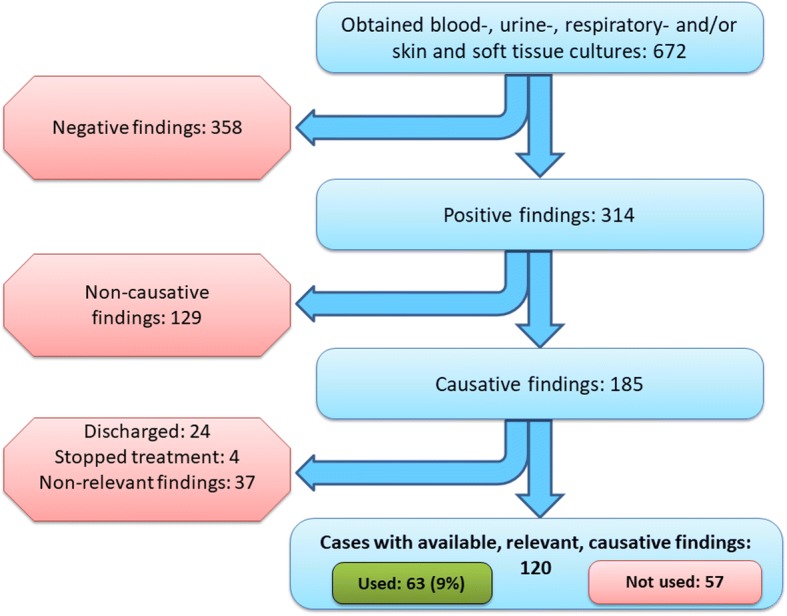
Of the 1731 patient admissions during the study period, mean compliance with microbiology testing recommendations in the antibiotic guideline was 89%, ranging from 81% in patients with acute exacerbations of chronic obstructive pulmonary disease to 95% in patients with sepsis. Substantial additional testing was performed beyond the recommendations with 298/606 (49%) of patients with lower respiratory tract infections having urine cultures and 42/194 (22%) of patients with urinary tract infections having respiratory tests. Microbiology test results from one of the hospitals showed that 18% (120/672) of patient admissions had applicable test results, but only half of them were used for therapy guidance, i.e. in total, 9% (63/672) of patient admissions had test results informing prescription of antibiotic therapy.
This study showed that despite a large number of microbiology test orders, only a limited number of tests informed antibiotic treatment. To ensure that microbiology tests are used optimally, there is a need to review the utility of existing microbiology tests, test ordering practices and use of test results through a more targeted and overarching approach.
有效利用微生物学检验结果可能会对患者的治疗结果产生积极影响,并限制广谱抗生素的使用。然而,研究表明,其潜在作用尚未得到充分发挥。我们调查了医院微生物学检验申请的情况以及检验结果在抗生素决策中的应用。
这是一项在 2014 年五个月期间,在挪威西部三家医院的医学科进行的多中心队列研究。纳入接受抗生素治疗的脓毒症、尿路感染、皮肤软组织感染、下呼吸道感染或慢性阻塞性肺疾病急性加重患者。主要观察指标为微生物学检验申请的程度、国家抗生素指南中微生物学检验推荐的符合程度以及微生物学检验结果用于指导抗生素治疗的比例。数据来源于电子病历和纸质病历、图表和实验室信息系统。
在研究期间的 1731 例患者入院中,抗生素指南中微生物学检验推荐的符合率为 89%,范围从慢性阻塞性肺疾病急性加重患者的 81%到脓毒症患者的 95%。在推荐之外进行了大量的额外检验,606 例下呼吸道感染患者中有 298 例(49%)进行了尿液培养,194 例尿路感染患者中有 42 例(22%)进行了呼吸检验。一家医院的微生物学检验结果表明,18%(120/672)的患者入院时有适用的检验结果,但只有一半的检验结果用于指导治疗,即总共 9%(63/672)的患者入院时的检验结果用于指导抗生素治疗。
本研究表明,尽管进行了大量的微生物学检验申请,但只有少数检验结果用于指导抗生素治疗。为了确保微生物学检验得到最佳利用,需要通过更有针对性和全面的方法,来审查现有微生物学检验的实用性、检验申请的情况以及检验结果的应用。