Department of Clinical Pharmacy, Pharmacology and Toxicology, Zuyderland Medical Centre, Sittard-Geleen - Heerlen, The Netherlands.
Department of Rheumatology, Leiden University Medical Center, Leiden, The Netherlands.
RMD Open. 2019 Jan 22;5(1):e000836. doi: 10.1136/rmdopen-2018-000836. eCollection 2019.
We aimed to evaluate the effects of methotrexate (MTX) comedication added to biological disease-modifying antirheumatic drugs (bDMARD) on disease activity measures in patients with rheumatoid arthritis (RA) in routine care.
Patients with RA on treatment with either bDMARDs or conventional synthetic DMARDs were included in this prospective cohort study. The effect of (time-varying) combination therapy with bDMARD and MTX compared with bDMARD monotherapy was tested in longitudinal generalised estimating equation models using as outcomes: (1) the likelihood to be in remission according to the 28-joint Disease Activity Score (DAS28) erythrocyte sedimentation rate (ESR) (<2.6) and to the Routine Assessment of Patient Index Data 3 (RAPID3) (0-30; ≤3), a patient-reported outcome measure about RA symptoms; and (2) DAS28-ESR and RAPID3 as continuous variables. All models were adjusted for potential confounders: age, gender, drugs for comorbidities (yes/no), oral steroids (yes/no) and non-steroidal anti-inflammatory drug (yes/no).
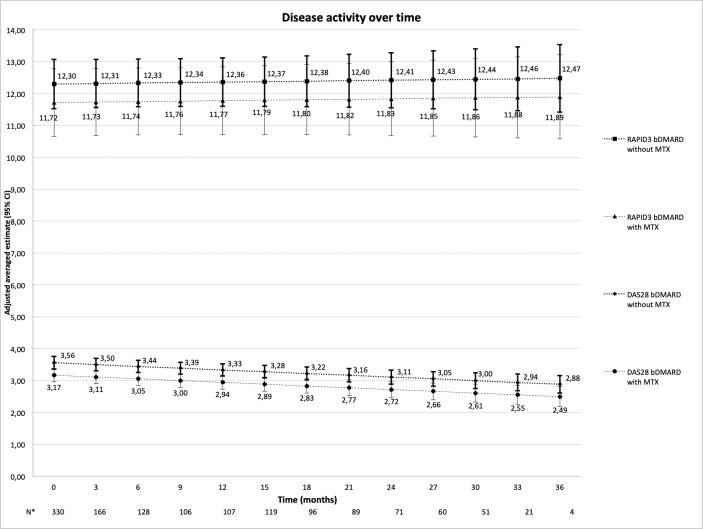
In total, 330 patients were included (mean (SD) follow-up; 10.7 (9.7) months). Compared with bDMARD monotherapy, MTX combination therapy was significantly associated with a 55% higher likelihood to be in DAS28 remission, but not RAPID3 remission, over time. Combination therapy resulted in slightly, but statistically significant, lower levels of DAS28-ESR over time (β=-0.42 (95% CI -0.67 to - 0.17)), but not RAPID3 (β=-0.58 (95% CI -0.65 to 0.49)). The effect on DAS28-ESR was entirely explained by lower swollen joint counts and was persistent after correction for confounders.
These results give support to the policy that MTX should be continued in routine care patients with RA on biological therapy since this leads to better objective but not subjective clinical outcomes.
我们旨在评估在常规治疗中,甲氨蝶呤(MTX)联合生物改善病情抗风湿药物(bDMARD)治疗对类风湿关节炎(RA)患者疾病活动指标的影响。
本前瞻性队列研究纳入了接受 bDMARD 或传统合成 DMARD 治疗的 RA 患者。使用纵向广义估计方程模型检验 bDMARD 和 MTX(时变)联合治疗与 bDMARD 单药治疗相比的效果,结局为:(1)根据 28 关节疾病活动评分(DAS28)红细胞沉降率(ESR)(<2.6)和常规评估患者指数数据 3(RAPID3)(0-30;≤3)判断的缓解可能性,RAPID3 是一种关于 RA 症状的患者报告结局测量;(2)DAS28-ESR 和 RAPID3 作为连续变量。所有模型均调整了潜在混杂因素:年龄、性别、合并症药物(是/否)、口服类固醇(是/否)和非甾体抗炎药(是/否)。
共纳入 330 例患者(平均(SD)随访时间;10.7(9.7)个月)。与 bDMARD 单药治疗相比,MTX 联合治疗与 DAS28 缓解的可能性在时间上显著增加 55%,但与 RAPID3 缓解无关。联合治疗在时间上导致 DAS28-ESR 略有但具有统计学意义的降低(β=-0.42(95%CI-0.67 至-0.17)),但对 RAPID3 没有影响(β=-0.58(95%CI-0.65 至 0.49))。这种对 DAS28-ESR 的影响完全由肿胀关节计数的降低解释,并且在纠正混杂因素后仍然存在。
这些结果支持在接受生物治疗的 RA 常规治疗患者中继续使用 MTX 的政策,因为这可以带来更好的客观但非主观的临床结局。