Ralff Marie D, El-Deiry Wafik S
MD/PhD Program, Lewis Katz School of Medicine, Temple University, Philadelphia, PA.
Laboratory of Translational Oncology and Experimental Cancer Therapeutics, Department of Hematology/Oncology and Molecular Therapeutics Program, Fox Chase Cancer Center, Philadelphia, PA.
Expert Rev Precis Med Drug Dev. 2018;3(3):197-204. doi: 10.1080/23808993.2018.1476062. Epub 2018 May 28.
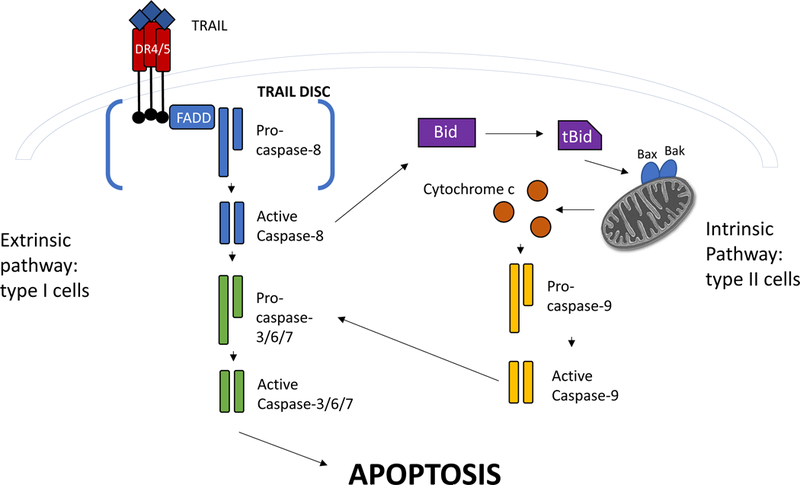
Despite decades of focused research efforts, cancer remains a significant cause of morbidity and mortality. Tumor necrosis factor(TNF)-related apoptosis-inducing ligand (TRAIL) is capable of inducing cell death selectively in cancer cells while sparing normal cells.
In this review, the authors cover TRA therapy and strategies that have been undertaken to improve their efficacy, as well as unconventional approaches to TRAIL pathway activation including TRAIL-inducing small molecules. They also discuss mechanisms of resistance to TRAIL and the use of combination strategies to overcome it.
Targeting the TRAIL pathway has been of interest in oncology, and although initial clinical trials of TRAIL receptor agonists (TRAs) showed limitations, novel approaches represent the future of TRAIL-based therapy.
尽管经过数十年的专注研究努力,癌症仍然是发病和死亡的重要原因。肿瘤坏死因子(TNF)相关凋亡诱导配体(TRAIL)能够在癌细胞中选择性地诱导细胞死亡,同时使正常细胞免受影响。
在本综述中,作者涵盖了TRAIL疗法以及为提高其疗效而采取的策略,以及TRAIL途径激活的非常规方法,包括诱导TRAIL的小分子。他们还讨论了对TRAIL的耐药机制以及使用联合策略来克服它。
靶向TRAIL途径一直是肿瘤学领域感兴趣的内容,尽管TRAIL受体激动剂(TRAs)的初步临床试验显示出局限性,但新方法代表了基于TRAIL治疗的未来。