Massachusetts General Hospital, Boston, Massachusetts.
The Children's Hospital of Philadelphia, Philadelphia, Pennsylvania.
Epilepsia. 2019 Mar;60(3):419-428. doi: 10.1111/epi.14670. Epub 2019 Feb 11.
Patients with Lennox-Gastaut syndrome (LGS) who completed 1 of 2 randomized, double-blind, placebo-controlled trials of add-on cannabidiol (CBD) (GWPCARE3, NCT02224560 or GWPCARE4, NCT02224690) were invited to enroll in an open-label extension (OLE) study evaluating the long-term safety and efficacy of CBD (GWPCARE5, NCT02224573). Herein we present an interim analysis of the safety, efficacy, and patient-reported outcomes from this trial.
Patients received a pharmaceutical formulation of highly purified CBD oral solution (Epidiolex; 100 mg/mL), titrated from 2.5 to 20 mg/kg/d over a 2-week titration period, in addition to their existing medications. Doses could be reduced if not tolerated or increased up to 30 mg/kg/d if thought to be of benefit.
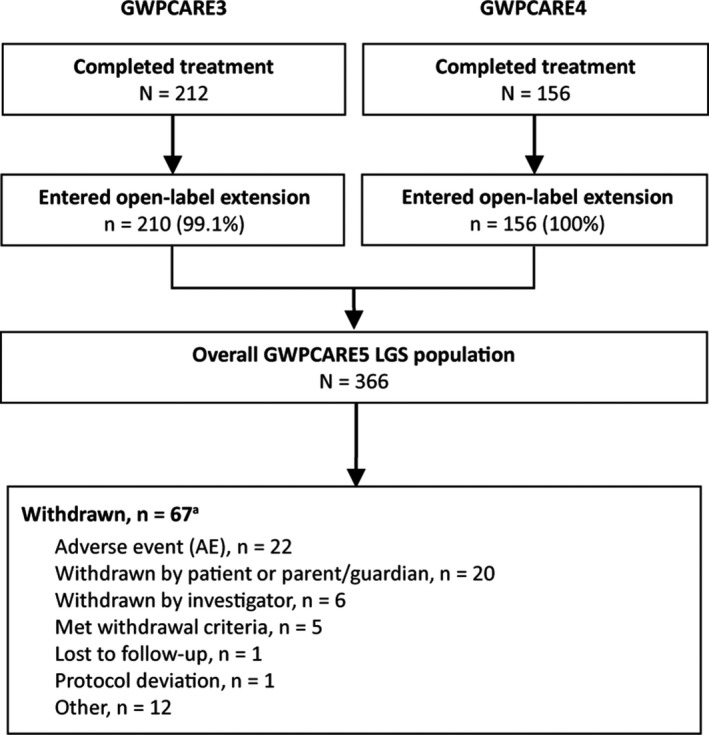
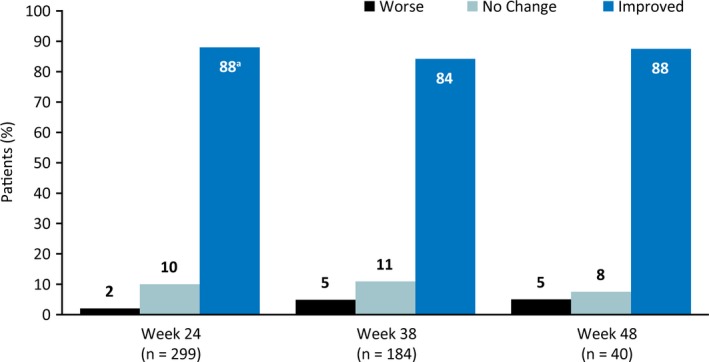
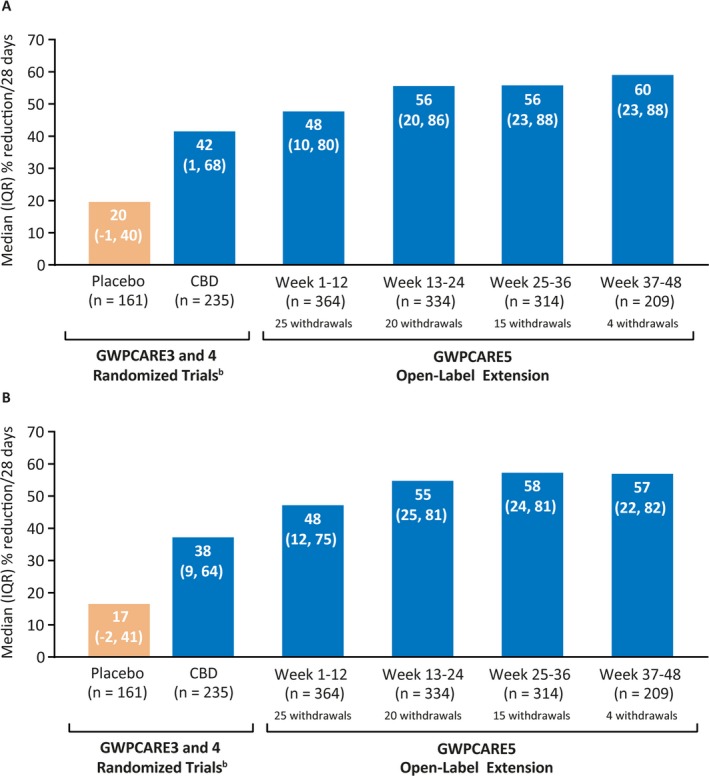
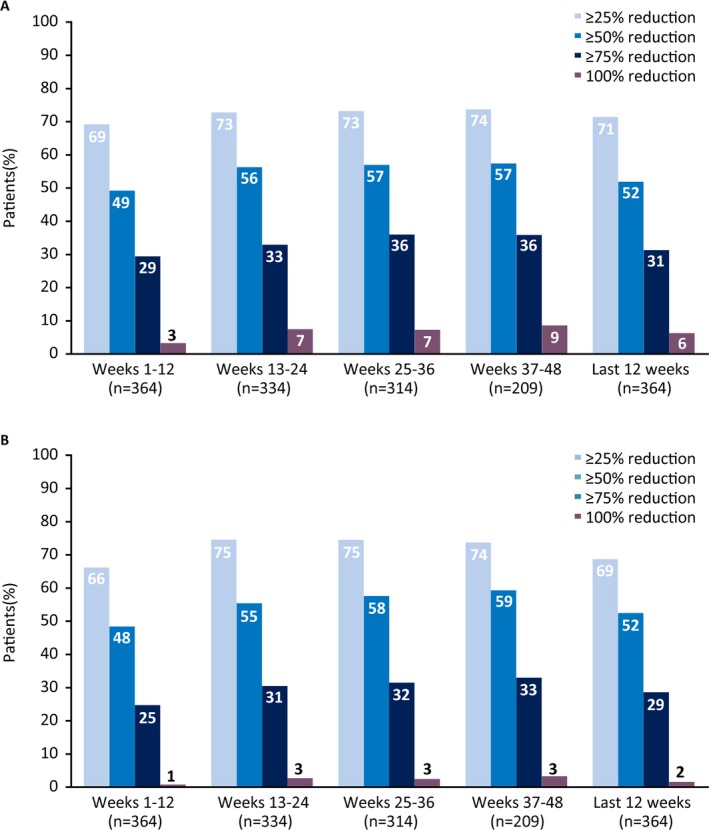
This interim analysis was based on a November 2016 data cut. Of 368 patients who completed treatment in GWPCARE3 and GWPCARE4, 366 (99.5%) enrolled in the OLE study (GWPCARE5). Median treatment duration was 38 weeks at a mean modal dose of 23 mg/kg/d. Most patients (92.1%) experienced adverse events (AEs), primarily of mild (32.5%) or moderate (43.4%) severity. The most common AEs were diarrhea (26.8%), somnolence (23.5%), and convulsion (21.3%). Thirty-five patients (9.6%) discontinued treatment due to AEs. Liver transaminase elevations were reported in 37 patients (10.1%), of whom 29 were receiving concomitant valproic acid; 34 cases resolved spontaneously or with dose modification of CBD or concomitant medication. Median reduction from baseline in drop seizure frequency (quantified monthly over 12-week periods) ranged from 48% to 60% through week 48. Median reduction in monthly total seizure frequency ranged from 48% to 57% across all 12-week periods through week 48. Eighty-eight percent of patients/caregivers reported an improvement in the patient's overall condition per the Subject/Caregiver Global Impression of Change scale.
In this study, long-term add-on CBD treatment had an acceptable safety profile in patients with LGS and led to sustained reductions in seizures.
完成了添加用大麻二酚(CBD)的 2 项随机、双盲、安慰剂对照试验(GWPCARE3,NCT02224560 或 GWPCARE4,NCT02224690)之一的 Lennox-Gastaut 综合征(LGS)患者受邀参加了添加用 CBD 的开放性扩展(OLE)研究(GWPCARE5,NCT02224573),以评估 CBD 的长期安全性和疗效。在此,我们报告了该试验的安全性、疗效和患者报告结果的中期分析。
患者接受高度纯化的 CBD 口服溶液(Epidiolex;100mg/mL)的药物配方治疗,在 2 周的滴定期内从 2.5 至 20mg/kg/d 滴定,同时服用其现有药物。如果不能耐受,可以减少剂量,如果认为有好处,可以增加至 30mg/kg/d。
本中期分析基于 2016 年 11 月的数据截止日期。在 GWPCARE3 和 GWPCARE4 中完成治疗的 368 名患者中,有 366 名(99.5%)患者入组了 OLE 研究(GWPCARE5)。中位治疗持续时间为 38 周,平均剂量为 23mg/kg/d。大多数患者(92.1%)出现不良反应(AE),主要为轻度(32.5%)或中度(43.4%)严重程度。最常见的 AE 是腹泻(26.8%)、嗜睡(23.5%)和癫痫发作(21.3%)。35 名患者(9.6%)因 AE 而停止治疗。37 名患者(10.1%)报告肝转氨酶升高,其中 29 名患者正在服用丙戊酸;34 例病例自行解决或 CBD 或伴随药物剂量调整。从基线开始,每月发作性癫痫发作频率(每 12 周量化一次)中位数降低 48%至 60%,持续 48 周。所有 12 周期间每月总癫痫发作频率中位数降低 48%至 57%,持续 48 周。根据患者/照顾者对变化的总体印象量表,88%的患者/照顾者报告患者的整体状况有所改善。
在这项研究中,LGS 患者长期添加用 CBD 治疗具有可接受的安全性,并导致癫痫发作持续减少。