Department of Physics, Florida State University, Tallahassee, FL, 32306, USA.
Condensed Matter Science, National High Magnetic Field Laboratory, Tallahassee, FL, 32310, USA.
Nat Commun. 2019 Feb 11;10(1):695. doi: 10.1038/s41467-019-08610-6.
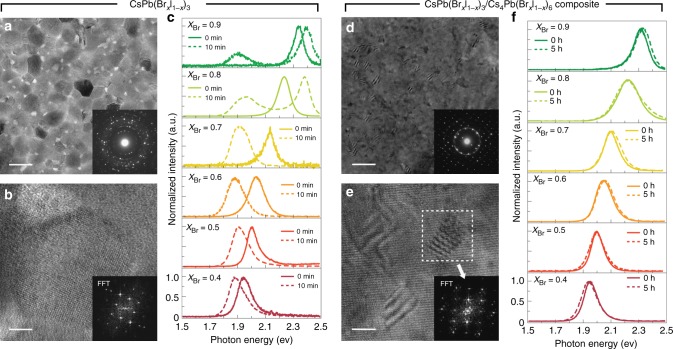
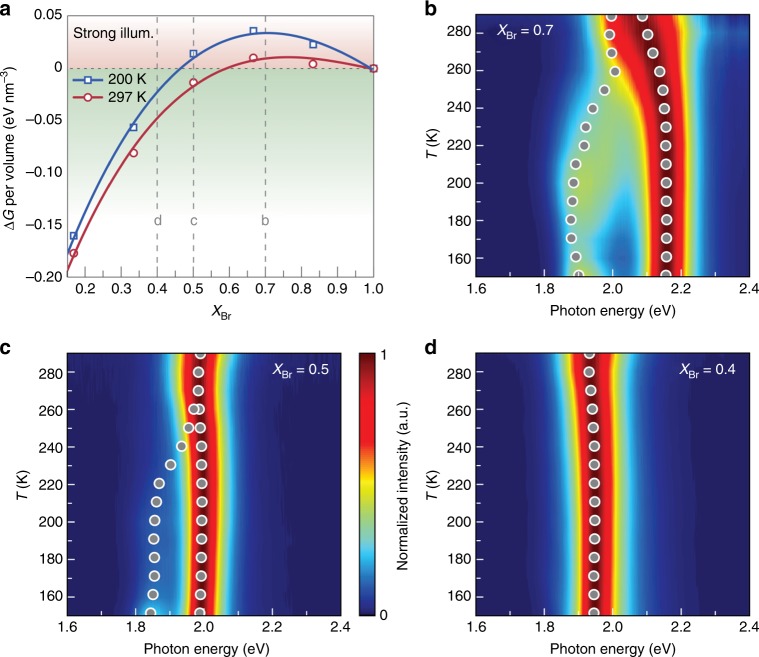
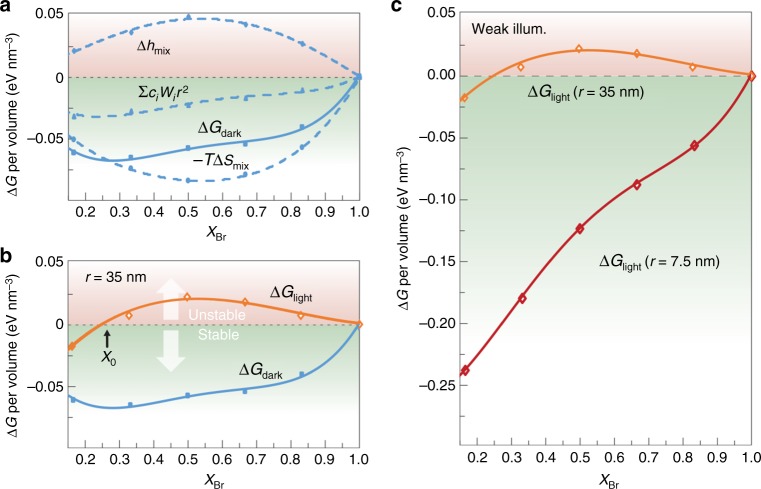
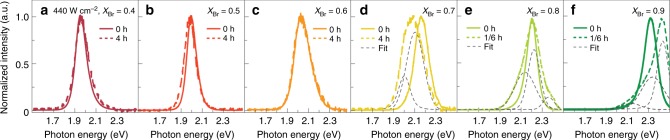
The functionality and performance of a semiconductor is determined by its bandgap. Alloying, as for instance in InGaN, has been a mainstream strategy for tuning the bandgap. Keeping the semiconductor alloys in the miscibility gap (being homogeneous), however, is non-trivial. This challenge is now being extended to halide perovskites - an emerging class of photovoltaic materials. While the bandgap can be conveniently tuned by mixing different halogen ions, as in CsPb(BrI), the so-called mixed-halide perovskites suffer from severe phase separation under illumination. Here, we discover that such phase separation can be highly suppressed by embedding nanocrystals of mixed-halide perovskites in an endotaxial matrix. The tuned bandgap remains remarkably stable under extremely intensive illumination. The agreement between the experiments and a nucleation model suggests that the size of the nanocrystals and the host-guest interfaces are critical for the photo-stability. The stabilized bandgap will be essential for the development of perovskite-based optoelectronics, such as tandem solar cells and full-color LEDs.
半导体的功能和性能取决于其带隙。合金化,例如在 InGaN 中,一直是调谐带隙的主流策略。然而,将半导体合金保持在混溶性间隙(均匀)中并非易事。现在,这一挑战正在扩展到卤化物钙钛矿——一类新兴的光伏材料。虽然通过混合不同的卤离子(如 CsPb(BrI))可以方便地调谐带隙,但所谓的混合卤化物钙钛矿在光照下会严重发生相分离。在这里,我们发现通过将混合卤化物钙钛矿纳米晶嵌入外延基质中,可以高度抑制这种相分离。在极其强烈的光照下,调谐后的带隙仍然非常稳定。实验与成核模型之间的一致性表明,纳米晶的尺寸和主客体界面对于光稳定性至关重要。稳定的带隙对于基于钙钛矿的光电的发展至关重要,例如串联太阳能电池和全色 LED。