Powell Lauren, Edwards Kate M, Bauman Adrian, Guastella Adam J, Drayton Bradley, Stamatakis Emmanuel, McGreevy Paul
Charles Perkins Centre, Prevention Research Collaboration, Sydney School of Public Health, Faculty ofMedicine and Health, University of Sydney, Sydney, NSW 2050, Australia.
Charles Perkins Centre, Faculty of Health Sciences, University of Sydney, Sydney, NSW 2050, Australia.
Animals (Basel). 2019 Feb 8;9(2):51. doi: 10.3390/ani9020051.
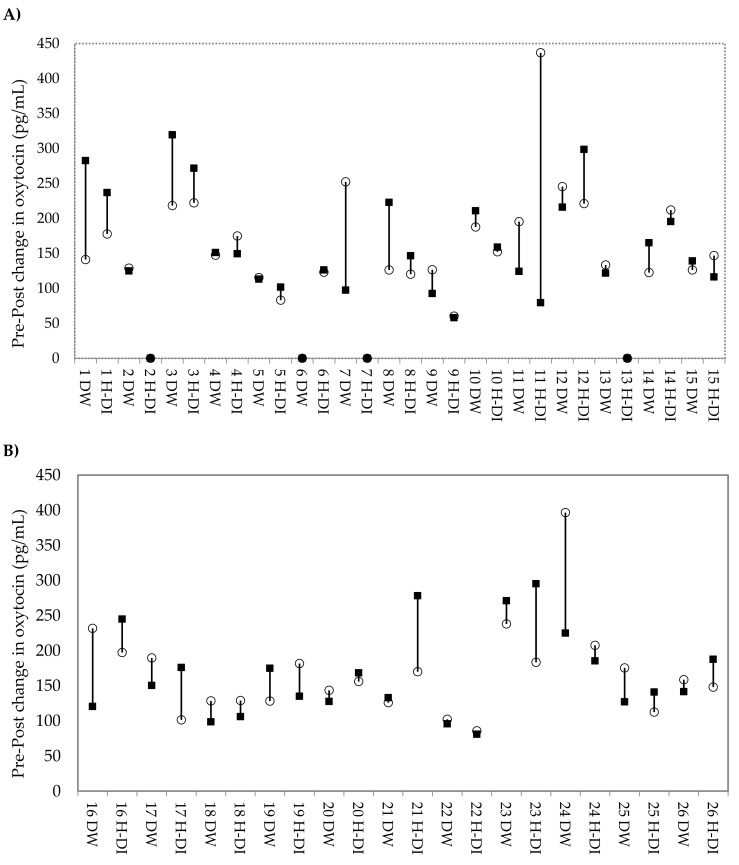
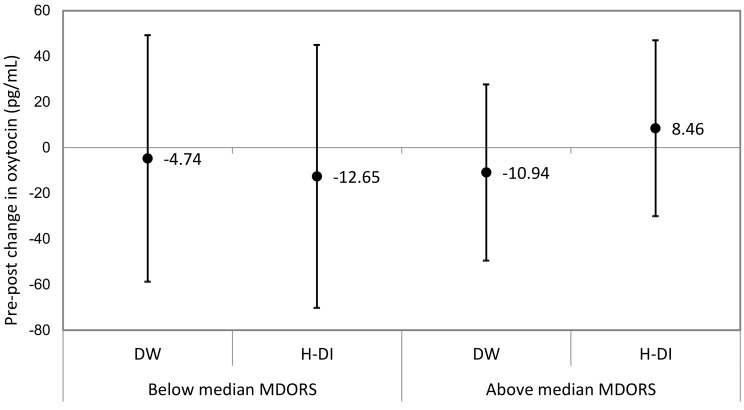
Several studies suggest human⁻dog interactions elicit a positive effect on canine oxytocin concentrations. However, empirical investigations are scant and the joint influence of human⁻dog interaction and physical activity remains unexplored. The aims of the current study were to (a) examine the canine endogenous oxytocin response to owner-led dog-walking and affiliative human⁻dog interactions and (b) investigate the moderating effect of the owner-reported strength of the human⁻dog bond on such responses. Twenty-six dogs took part in a random order cross-over trial, involving dog-walking and human⁻dog interactions. Urinary samples were collected before and after each condition. The data were analyzed using linear mixed models with condition, order of conditions, condition duration, and latency from initiation of condition to urine sample collection considered as fixed effects, and the participant was considered a random effect. Canine urinary oxytocin concentrations did not differ significantly following dog-walking (mean change: -14.66 pg/mg Cr; 95% CI: -47.22, 17.90) or affiliative human⁻dog interactions (mean change: 6.94 pg/mg Cr; 95% CI: -26.99, 40.87). The reported strength of the human⁻dog bond did not significantly moderate the canine oxytocin response to either experimental condition. Contrary to our hypothesis, we did not observe evidence for a positive oxytocin response to dog-walking or human⁻dog interactions.
多项研究表明,人与狗的互动会对犬类的催产素浓度产生积极影响。然而,实证研究很少,人与狗的互动和身体活动的联合影响仍未得到探索。本研究的目的是:(a)研究犬类内源性催产素对主人带领的遛狗活动和亲密的人与狗互动的反应;(b)调查主人报告的人与狗之间亲密关系的强度对这种反应的调节作用。26只狗参与了一项随机顺序交叉试验,包括遛狗和人与狗的互动。在每种情况前后收集尿液样本。使用线性混合模型分析数据,将情况、情况顺序、情况持续时间以及从情况开始到尿液样本采集的延迟视为固定效应,将参与者视为随机效应。遛狗(平均变化:-14.66 pg/mg Cr;95%置信区间:-47.22,17.90)或亲密的人与狗互动(平均变化:6.94 pg/mg Cr;95%置信区间:-26.99,40.87)后,犬类尿液中的催产素浓度没有显著差异。报告的人与狗之间亲密关系的强度并没有显著调节犬类对任何一种实验条件的催产素反应。与我们的假设相反,我们没有观察到对遛狗或人与狗互动产生积极催产素反应的证据。