Centre de recherche en organogénèse expérimentale/LOEX, Regenerative Medicine Division, CHU de Québec-Université Laval Research Center, QC, Québec, Canada.
Department of Surgery, Faculty of Medicine, Laval University, QC, Quebec, Canada.
BMC Cancer. 2019 Feb 11;19(1):137. doi: 10.1186/s12885-019-5353-6.
Cancer-associated fibroblasts (CAFs), activated by tumour cells, are the predominant type of stromal cells in cancer tissue and play an important role in interacting with neoplastic cells to promote cancer progression. Epithelial-mesenchymal transition (EMT) is a key feature of metastatic cells. However, the mechanism by which CAFs induce EMT program in bladder cancer cells remains unclear.
To investigate the role of CAFs in bladder cancer progression, healthy primary bladder fibroblasts (HFs) were induced into CAFs (iCAFs) by bladder cancer-derived exosomes. Effect of conditioned medium from iCAFs (CM ) on EMT markers expression of non-invasive RT4 bladder cancer cell line was determined by qPCR and Western blot. IL6 expression in iCAFs was evaluated by ELISA and Western blot. RT4 cell proliferation, migration and invasion were assessed in CM +/- anti-IL6 neutralizing antibody using cyQUANT assay, scratch test and transwell chamber respectively. We investigated IL6 expression relevance for bladder cancer progression by querying gene expression datasets of human bladder cancer specimens from TCGA and GEO genomic data platforms.
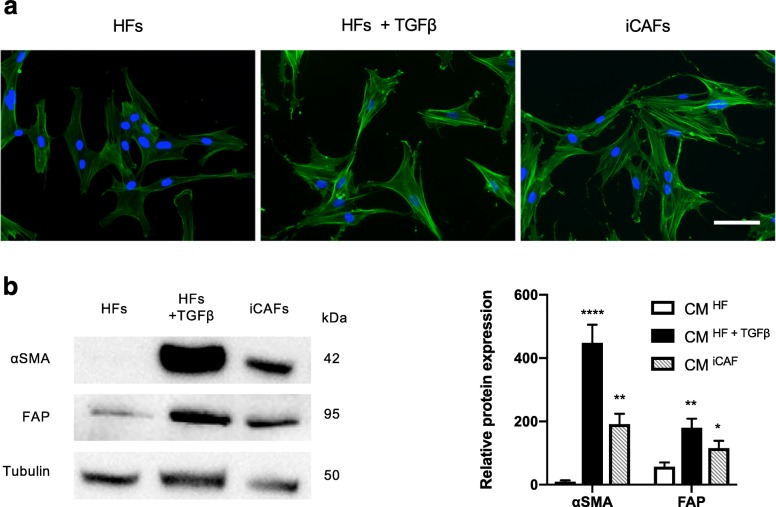
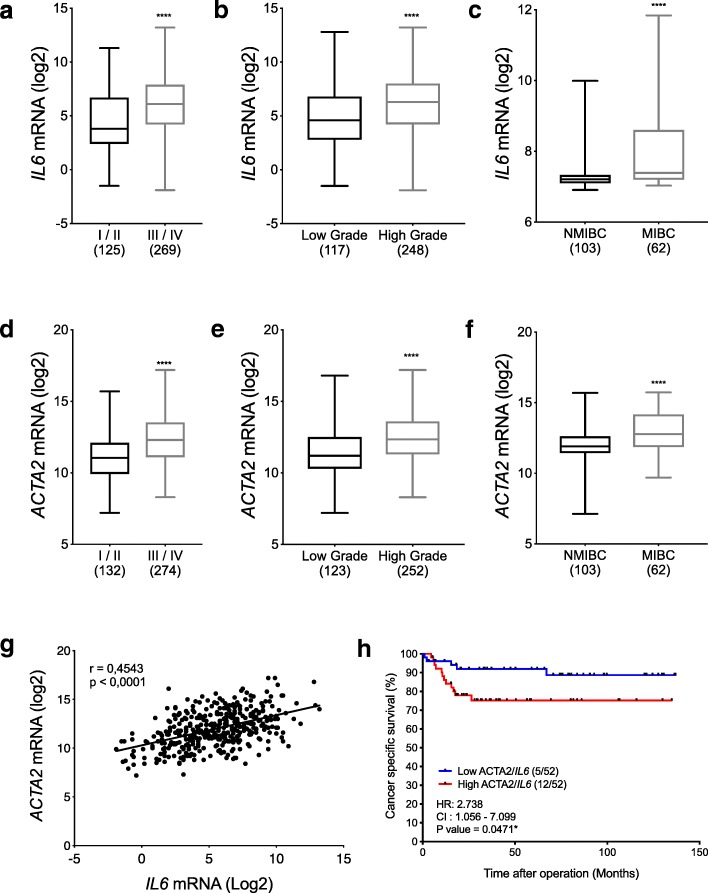
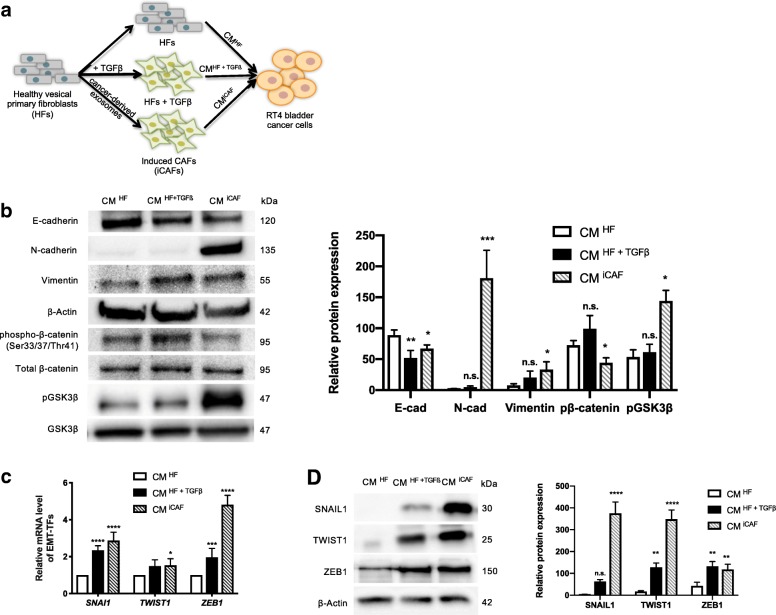
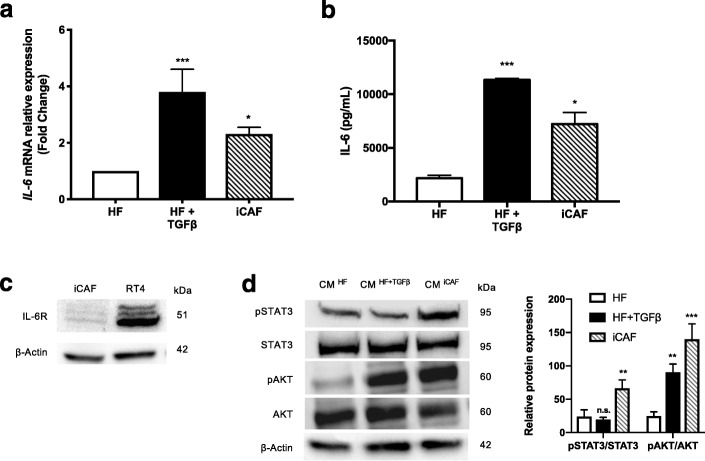
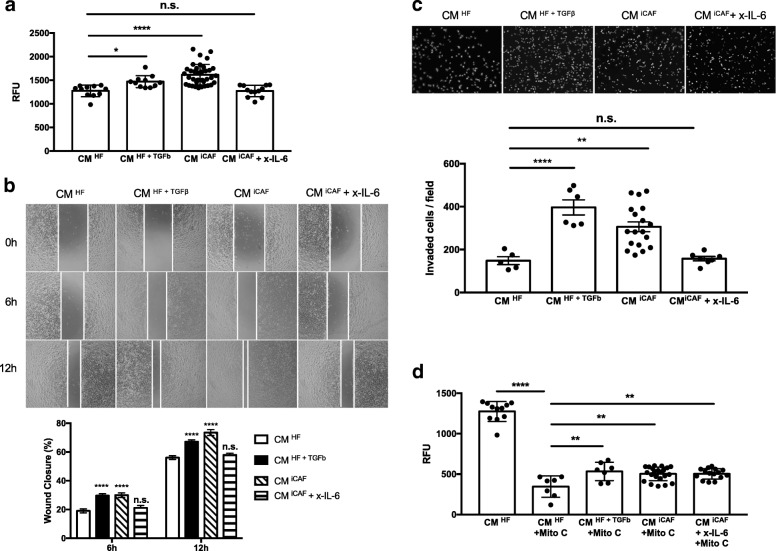
Cancer exosome-treated HFs showed CAFs characteristics with high expression levels of αSMA and FAP. We showed that the CM induces the upregulation of mesenchymal markers, such as N-cadherin and vimentin, while repressing epithelial markers E-cadherin and p-ß-catenin expression in non-invasive RT4 cells. Moreover, EMT transcription factors SNAIL1, TWIST1 and ZEB1 were upregulated in CM -cultured RT4 cells compared to control. We also showed that the IL-6 cytokine was highly expressed by CAFs, and its receptor IL-6R was found on RT4 bladder cancer cells. The culture of RT4 bladder cancer cells with CM resulted in markedly promoted cell growth, migration and invasion. Importantly, inhibition of CAFs-secreted IL-6 by neutralizing antibody significantly reversed the IL-6-induced EMT phenotype, suggesting that this cytokine is necessary for CAF-induced EMT in the progression of human bladder cancer. Finally, we observed that IL6 expression is up-regulated in aggressive bladder cancer and correlate with CAF marker ACTA2.
We conclude that CAFs promote aggressive phenotypes of non-invasive bladder cancer cells through an EMT induced by the secretion of IL-6.
肿瘤细胞激活的癌相关成纤维细胞(CAFs)是癌症组织中主要的基质细胞类型,在与肿瘤细胞相互作用以促进癌症进展方面发挥着重要作用。上皮-间充质转化(EMT)是转移性细胞的一个关键特征。然而,CAFs 诱导膀胱癌细胞 EMT 程序的机制尚不清楚。
为了研究 CAFs 在膀胱癌进展中的作用,我们通过膀胱癌衍生的外泌体将健康的原代膀胱成纤维细胞(HFs)诱导为 CAFs(iCAFs)。通过 qPCR 和 Western blot 测定条件培养基(CM)对非侵袭性 RT4 膀胱癌细胞系 EMT 标志物表达的影响。通过 ELISA 和 Western blot 评估 iCAFs 中的 IL6 表达。使用 cyQUANT 测定法、划痕试验和 Transwell 室分别评估 CM +/-抗 IL6 中和抗体对 RT4 细胞增殖、迁移和侵袭的影响。我们通过查询 TCGA 和 GEO 基因组数据平台的人类膀胱癌标本的基因表达数据集,研究了 IL6 表达与膀胱癌进展的相关性。
经癌症外泌体处理的 HFs 表现出 CAFs 的特征,αSMA 和 FAP 表达水平高。我们表明,CM 诱导非侵袭性 RT4 细胞中间充质标志物(如 N-钙粘蛋白和波形蛋白)的上调,同时抑制上皮标志物 E-钙粘蛋白和 p-β-catenin 的表达。此外,EMT 转录因子 SNAIL1、TWIST1 和 ZEB1 在 CM 培养的 RT4 细胞中上调。我们还表明,CAFs 高度表达 IL-6 细胞因子,其受体 IL-6R 存在于 RT4 膀胱癌细胞上。用 CM 培养 RT4 膀胱癌细胞导致细胞生长、迁移和侵袭明显增强。重要的是,用中和抗体抑制 CAFs 分泌的 IL-6 显著逆转了 IL-6 诱导的 EMT 表型,表明这种细胞因子在人膀胱癌中 CAF 诱导的 EMT 进展中是必需的。最后,我们观察到 IL6 表达在侵袭性膀胱癌中上调,并与 CAF 标志物 ACTA2 相关。
我们的结论是,CAFs 通过分泌 IL-6 诱导 EMT,促进非侵袭性膀胱癌细胞的侵袭表型。