Division of Gastroenterology, Department of Medicine, Massachusetts General Hospital, Boston, MA, USA.
Division of Oncology, Department of Medicine, Massachusetts General Hospital, Boston, MA, USA.
J Immunother Cancer. 2019 Feb 11;7(1):41. doi: 10.1186/s40425-019-0524-1.
Alongside its clinical success, checkpoint blockade has also given rise to a set of immune-related adverse events (irAEs). In addition to causing considerable morbidity and even mortality, irAEs may limit the success and scope of immunotherapy. Most irAEs arise at mucosal barriers, including the gastrointestinal mucosa, leading most commonly to colitis, though both gastritis and enteritis can result from checkpoint blockade. While guidelines generally recommend confirmatory testing for suspected severe irAEs, the role of endoscopy in diagnosing more moderate irAEs is less clear. Many patients with suspected gastrointestinal irAEs are treated empirically with glucocorticoids based on typical symptoms. Although efficient, this approach may miss less common underlying etiologies, and may expose patients unnecessarily to an increased risk of infection, and a potentially dampened antitumor response.
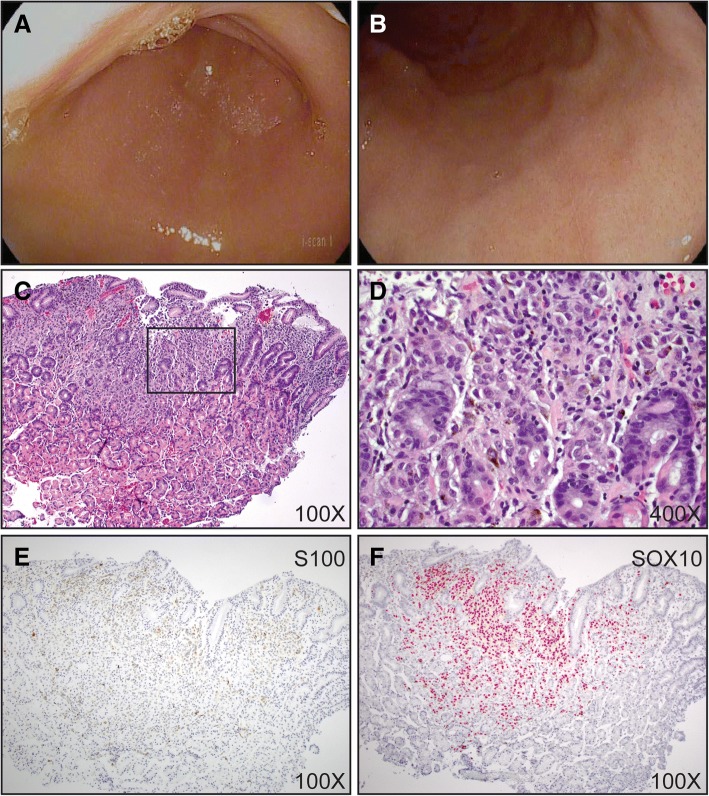
We report a case of ipilimumab-induced antitumor immunity targeting microscopic gastric melanoma metastases, mimicking checkpoint blockade induced gastritis. Immune suppression was avoided and the immunotherapy was continued.
Checkpoint blockade can induce rapid inflammatory responses to tumor tissue present throughout the body. These responses are desirable, but may also lead to local tissue injury, causing symptoms that may mimic adverse events. This is particularly important to consider in organs where metastatic disease may be unappreciated at the time of treatment, and where irAEs are otherwise common, such as the gastrointestinal tract. In this setting, empiric immune suppression may inhibit antitumor responses, improving symptoms but at a potential cost to therapeutic efficacy.
除了临床疗效显著外,免疫检查点抑制剂还会引起一系列免疫相关不良反应(irAEs)。irAEs 不仅会导致较高的发病率,甚至死亡,还可能限制免疫疗法的成功和应用范围。大多数 irAEs 发生在黏膜屏障,包括胃肠道黏膜,最常见的是结肠炎,但胃炎和肠炎也可能由免疫检查点抑制剂引起。虽然指南通常建议对疑似严重 irAEs 进行确认性检查,但内镜在诊断更中度 irAEs 中的作用尚不明确。许多疑似胃肠道 irAEs 的患者根据典型症状接受经验性糖皮质激素治疗。虽然这种方法有效,但可能会错过不太常见的潜在病因,并且可能使患者不必要地面临感染风险增加和抗肿瘤反应减弱的风险。
我们报告了一例 ipilimumab 诱导的针对微小胃黑色素瘤转移的抗肿瘤免疫,类似于免疫检查点抑制剂诱导的胃炎。避免了免疫抑制,并继续进行免疫治疗。
免疫检查点抑制剂可诱导全身肿瘤组织的快速炎症反应。这些反应是理想的,但也可能导致局部组织损伤,引起可能类似于不良反应的症状。在治疗时可能未发现转移性疾病的器官中,以及 irAEs 常见的情况下,如胃肠道,这一点尤其重要。在这种情况下,经验性免疫抑制可能会抑制抗肿瘤反应,改善症状,但可能会降低治疗效果。