Harvard Medical School, Boston, MA, USA.
Present address: Johns Hopkins Medical Institutions, Baltimore, MD, USA.
J Immunother Cancer. 2019 Nov 7;7(1):292. doi: 10.1186/s40425-019-0756-0.
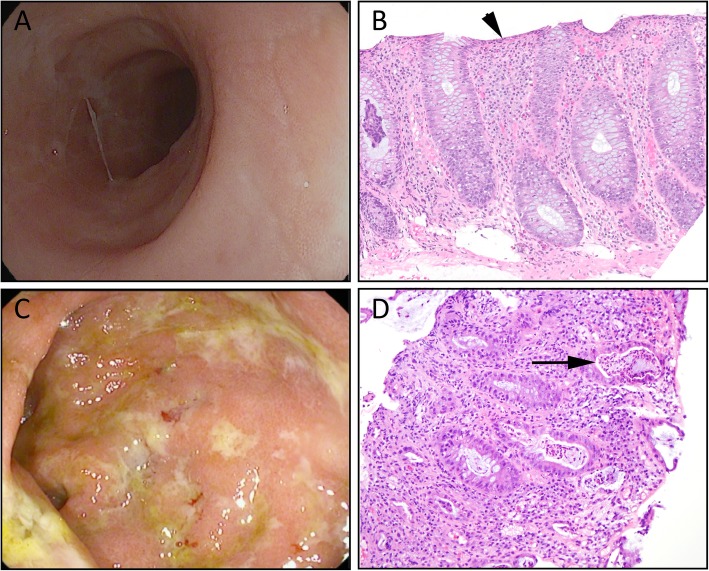
Immune checkpoint inhibitors (CPIs) are effective against a variety of malignancies but can be limited by inflammatory toxicities such as enterocolitis. Enterocolitis is typically treated with systemically active glucocorticoids. Endoscopy can stratify patients by the severity of mucosal inflammation, including identifying patients with colitis in the absence of visible mucosal changes: microscopic colitis. Whether patients with CPI microscopic colitis could be managed differently from colitis with more severe mucosal involvement is unclear. The objective of this study was to describe outcomes in CPI microscopic colitis focusing on the response to first line treatment with budesonide.
We evaluated data from a retrospective cohort from a single-center large academic hospital. The participants were all adult patients evaluated by endoscopy for suspected CPI enterocolitis between 3/2017 and 3/2019. The exposures were: Mayo Endoscopic Score (range 0-3). The subset was: oral budesonide, maximum dose 12 mg daily, administered minimum of 5 weeks. The main outcomes and measures were: Primary: time from first CPI exposure to first glucocorticoid use; use of systemic glucocorticoids; time from symptom onset to resolution; continuation of CPI therapy; number of additional CPI infusions received. Secondary: admissions for symptom control; novel irAE development; need for second-line immunosuppression; oncologic outcomes.
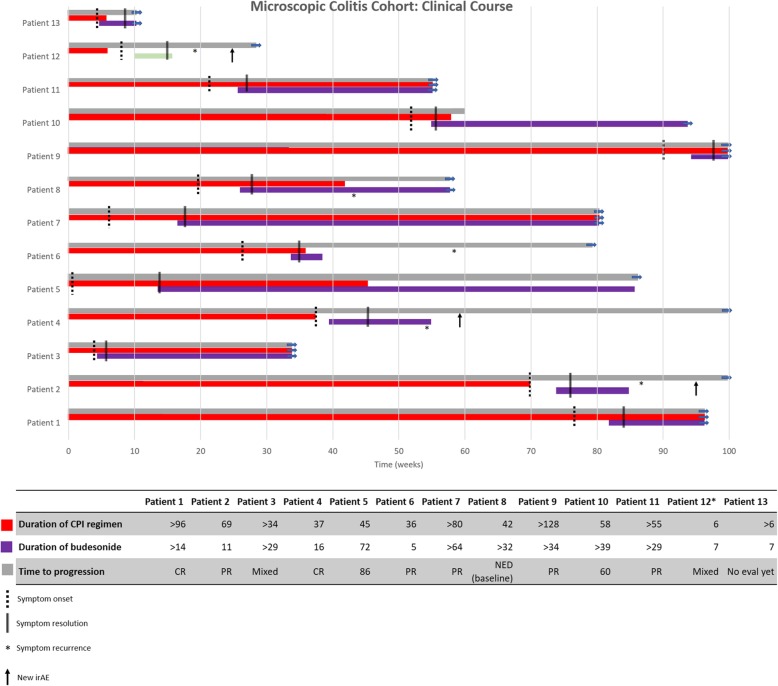
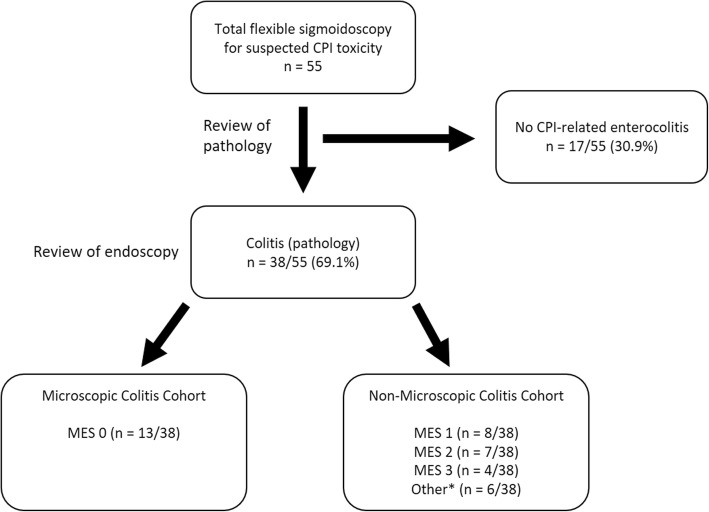
We identified 38 patients with biopsy confirmed CPI enterocolitis, 13 in the microscopic colitis cohort, and 25 in the non-microscopic colitis cohort. Budesonide use was higher in the microscopic colitis cohort (12/13 vs 3/25, p < 0.001), and systemic glucocorticoid use was higher in non-microscopic colitis (22/25 vs. 3/13, p < 0.001). Time from symptom onset to resolution did not differ. Microscopic colitis patients more frequently remained on CPI after developing (entero)colitis (76.9% vs 16.0%, p < 0.001). Microscopic colitis patients tolerating further CPI received, on average, 4.2 CPI infusions more than non-microscopic colitis patients tolerating CPI (5.8 vs 1.6, p = 0.03). Microscopic colitis was associated with increased time-to-treatment-failure (HR 0.30, 95% CI 0.14-0.66) and progression-free survival (HR 0.22, 95% CI 0.07-0.70).
Gastrointestinal mucosal inflammation without visible mucosal injury is a distinct, prevalent CPI enterocolitis subset that can be diagnosed by endoscopy. First-line budesonide appears effective in controlling "microscopic colitis" symptoms and prolonging immunotherapy duration. These findings present a compelling rationale for routine endoscopic evaluation of suspected CPI enterocolitis and suggest an alternative glucocorticoid-sparing treatment strategy for a subset of such patients.
免疫检查点抑制剂(CPI)对多种恶性肿瘤有效,但可受到炎症毒性的限制,如结肠炎。结肠炎通常采用全身性糖皮质激素治疗。内镜可根据黏膜炎症的严重程度对患者进行分层,包括识别无可见黏膜变化的结肠炎患者:显微镜下结肠炎。是否可以采用不同的方法治疗 CPI 显微镜下结肠炎与更严重的黏膜受累结肠炎患者尚不明确。本研究的目的是描述 CPI 显微镜下结肠炎的结果,重点是对布地奈德一线治疗的反应。
我们评估了来自单中心大型学术医院的回顾性队列研究的数据。所有参与者均为 2017 年 3 月至 2019 年 3 月期间因疑似 CPI 结肠炎而行内镜检查的成年患者。暴露因素为:Mayo 内镜评分(范围 0-3)。亚组为:口服布地奈德,最大剂量为每天 12mg,至少使用 5 周。主要结局和措施为:主要结局:首次接触 CPI 至首次使用糖皮质激素的时间;使用全身性糖皮质激素;症状出现至缓解的时间;继续使用 CPI 治疗;接受的额外 CPI 输注次数。次要结局:因症状控制而入院;新发免疫相关不良事件;需要二线免疫抑制;肿瘤学结局。
我们确定了 38 例活检证实的 CPI 结肠炎患者,其中 13 例为显微镜下结肠炎队列,25 例为非显微镜下结肠炎队列。显微镜下结肠炎队列中布地奈德的使用率更高(12/13 比 3/25,p<0.001),而非显微镜下结肠炎队列中全身糖皮质激素的使用率更高(22/25 比 3/13,p<0.001)。症状出现至缓解的时间无差异。出现(肠)结肠炎后,显微镜下结肠炎患者继续使用 CPI 的比例更高(76.9%比 16.0%,p<0.001)。耐受进一步 CPI 的显微镜下结肠炎患者平均接受的 CPI 输注次数比非显微镜下结肠炎患者多 4.2 次(5.8 比 1.6,p=0.03)。显微镜下结肠炎与治疗失败时间延长(HR 0.30,95%CI 0.14-0.66)和无进展生存率降低(HR 0.22,95%CI 0.07-0.70)相关。
无可见黏膜损伤的胃肠道黏膜炎症是一种独特的、常见的 CPI 结肠炎亚组,可通过内镜诊断。一线布地奈德似乎能有效控制“显微镜下结肠炎”症状并延长免疫治疗持续时间。这些发现为怀疑患有 CPI 结肠炎的患者进行常规内镜评估提供了有力的理由,并为该类患者的一种替代糖皮质激素保留治疗策略提供了依据。